Okutsu Masaaki, Horio Takeshi, Tanaka Hisataka, Akiyama Maki, Okimoto Niro, Tsubouchi Toshiyuki, Kawajiri Kenji, Ohashi Yasuhiro, Sumitsuji Satoru, Ikari Yuji
Department of Internal Medicine, Kawasaki Medical School General Medical Center, 2-6-1, Nakasange, Kita-ku, Okayama, 700-8505, Japan.
Department of Cardiology, Nozaki Tokushukai Hospital, Daito, Japan.
Heart Vessels. 2018 Oct;33(10):1121-1128. doi: 10.1007/s00380-018-1160-2. Epub 2018 Apr 11.
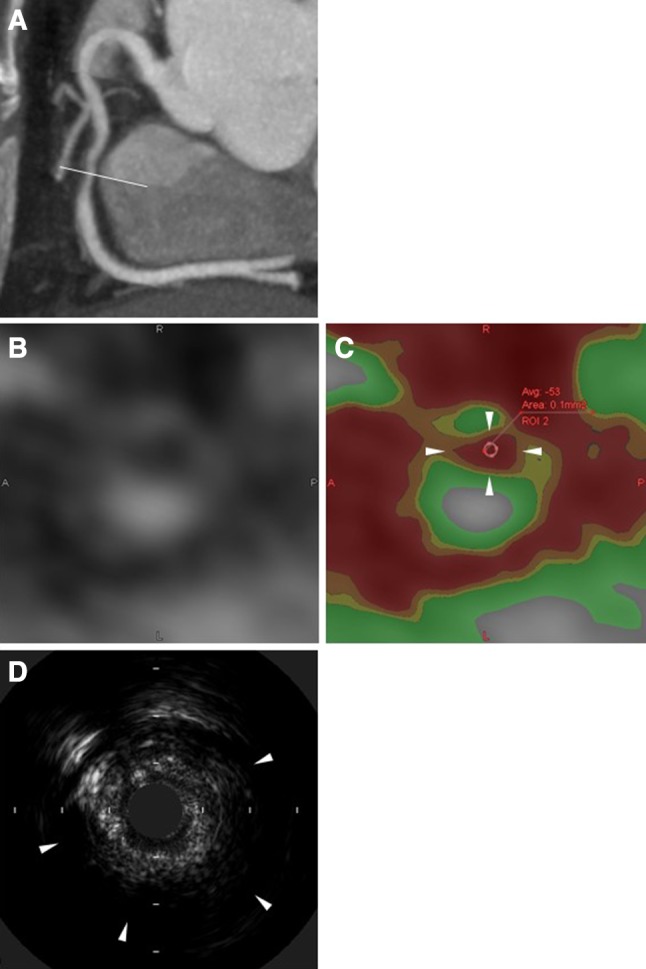
Attenuated plaque on intravascular ultrasound (IVUS) and low attenuation plaque on computed tomography angiography (CTA) are associated with no-reflow phenomenon during percutaneous coronary intervention (PCI). However, evaluation by a single modality has been unable to satisfactorily predict this phenomenon. We investigated whether the combination of IVUS and CTA findings can ameliorate the predictive potential for no-reflow phenomenon after stent implantation during PCI in stable coronary artery disease (CAD). A total of 988 lesions of 707 stable CAD patients who underwent coronary CTA before PCI were enrolled. PCI was performed with preprocedural IVUS and stent implantation. As for plaque characters, very low attenuation plaque (CTA v-LAP) whose minimum density was < 0 Hounsfield units on CTA and attenuated plaque (IVUS AP) on IVUS were evaluated. No-reflow phenomenon was observed in 22 lesions (2.2%) of 19 patients (2.7%). Both CTA v-LAP and IVUS AP were much more frequently observed in patients with no-reflow phenomenon. Positive (PPV) and negative predictive values (NPV) and accuracy for prediction of no-reflow were almost equivalent between CTA v-LAP (13.2, 99.6, and 87.0%) and IVUS AP (15.7, 99.8, and 89.0%). The combination of CTA v-LAP and IVUS AP markedly ameliorated PPV (31.7%) without deterioration of NPV (99.7%) and increased the diagnostic accuracy (95.5%). These findings showed that the combination of CTA v-LAP and IVUS AP improved the predictive power for no-reflow phenomenon after coronary stenting in stable CAD patients, suggesting the usefulness of combined estimation by using CTA and IVUS for predicting no-reflow phenomenon during PCI in clinical practice.
血管内超声(IVUS)显示的衰减斑块以及计算机断层血管造影(CTA)显示的低衰减斑块与经皮冠状动脉介入治疗(PCI)期间的无复流现象相关。然而,单一模式的评估未能令人满意地预测这一现象。我们研究了IVUS和CTA检查结果的组合是否能改善稳定冠状动脉疾病(CAD)患者PCI期间支架植入后无复流现象的预测潜力。共有707例稳定CAD患者在PCI前接受了冠状动脉CTA检查,共纳入988个病变。采用术前IVUS进行PCI并植入支架。对于斑块特征,评估CTA上最小密度<0亨氏单位的极低衰减斑块(CTA v-LAP)以及IVUS上的衰减斑块(IVUS AP)。19例患者(2.7%)的22个病变(2.2%)观察到无复流现象。无复流现象的患者中CTA v-LAP和IVUS AP的出现频率均更高。CTA v-LAP(13.2%、99.6%和87.0%)和IVUS AP(15.7%、99.8%和89.0%)预测无复流的阳性预测值(PPV)、阴性预测值(NPV)和准确性几乎相当。CTA v-LAP和IVUS AP的组合显著提高了PPV(31.7%),而NPV没有恶化(99.7%),并提高了诊断准确性(95.5%)。这些结果表明,CTA v-LAP和IVUS AP的组合提高了稳定CAD患者冠状动脉支架植入后无复流现象的预测能力,提示在临床实践中联合使用CTA和IVUS进行评估对预测PCI期间的无复流现象有用。