Research Group in Anaerobic Bacteria (GIBA), School of Microbiology, Universidad de Antioquia, Medellín, Colombia.
Basic and Applied Microbiology Research Group (MICROBA), School of Microbiology, Universidad de Antioquia, Medellín, Colombia.
PLoS One. 2018 Apr 12;13(4):e0195694. doi: 10.1371/journal.pone.0195694. eCollection 2018.
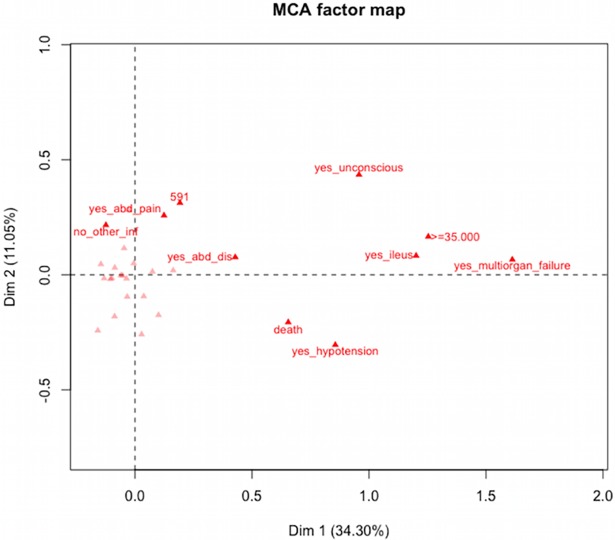
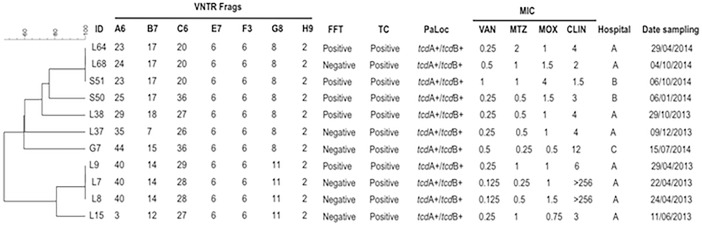
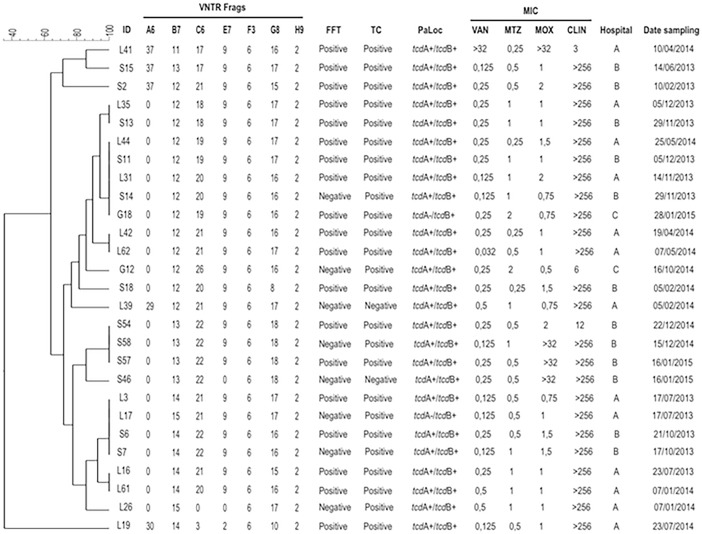
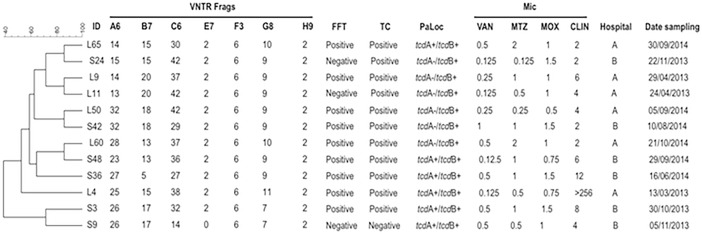
We aimed to achieve a higher typing resolution within the three dominant Clostridium difficile ribotypes (591,106 and 002) circulating in Colombia. A total of 50 C. difficile isolates we had previously typed by PCR-ribotyping, representing the major three ribotypes circulating in Colombia, were analyzed. Twenty-seven isolates of ribotype 591, 12 of ribotype 106 and 11 of ribotype 002 were subtyped by multiple locus variable-number tandem-repeat analysis (MLVA). The presence of the PaLoc genes (tcdA/tcdB), toxin production in culture and antimicrobial susceptibility were also determined. From the total C. difficile ribotypes analyzed, 20 isolates (74%) of ribotype 591, nine (75%) of ribotype 106 and five (45.5%) of ribotype 002 were recovered from patients with Clostridium difficile infection (CDI). MLVA allowed us to recognize four and two different clonal complexes for ribotypes 591 and 002, respectively, having a summed tandem-repeat difference (STRD) <2, whereas none of the ribotype 106 isolates were grouped in a cluster or clonal complex having a STRD >10. Six ribotype 591 and three ribotype 002 isolates belonging to a defined clonal complex were isolated on the same week in two different hospitals. All ribotypes harbored either tcdA+/tcdB+ or tcdA-/tcdB+ PaLoc genes. Moreover, 94% of the isolates were positive for toxin in culture. All isolates were susceptible to vancomycin and metronidazole, while 75% to 100% of the isolates were resistant to clindamycin, and less than 14.8% of ribotype 591 isolates were resistant to moxifloxacina. No significant differences were found among ribotypes with respect to demographic and clinical patients' data; however, our results demonstrated a high molecular heterogeneity of C. difficile strains circulating in Colombia.
我们旨在提高哥伦比亚流行的三种主要艰难梭菌核糖型(591、106 和 002)的分型分辨率。我们之前通过 PCR-核糖体分型对 50 株艰难梭菌进行了分型,这些菌株代表了哥伦比亚流行的三种主要核糖型。对 27 株 591 型、12 株 106 型和 11 株 002 型分离株进行了多位点可变数串联重复分析(MLVA)亚型分析。还确定了 PaLoc 基因(tcdA/tcdB)的存在、培养中的毒素产生和抗菌药物敏感性。在分析的总艰难梭菌核糖型中,20 株(74%)591 型、9 株(75%)106 型和 5 株(45.5%)002 型分离株来自艰难梭菌感染(CDI)患者。MLVA 使我们能够识别出分别具有 STRD<2 的 4 个和 2 个不同的克隆复合体,而 106 型分离株均未被分组为具有 STRD>10 的簇或克隆复合体。在两家不同的医院,同一周内分别从 6 株 591 型和 3 株 002 型分离株中分离出属于特定克隆复合体的菌株。所有核糖型均携带 tcdA+/tcdB+或 tcdA-/tcdB+PaLoc 基因。此外,94%的分离株在培养物中呈毒素阳性。所有分离株均对万古霉素和甲硝唑敏感,而 75%至 100%的分离株对克林霉素耐药,不到 14.8%的 591 型分离株对莫西沙星耐药。不同核糖型在患者的人口统计学和临床数据方面没有发现显著差异;然而,我们的结果表明,哥伦比亚流行的艰难梭菌菌株具有很高的分子异质性。