
随机审计研究实验室可能是提高研究质量的一种经济实惠的方法:一项模拟研究。
Randomly auditing research labs could be an affordable way to improve research quality: A simulation study.
机构信息
School of Public Health and Social Work, Queensland University of Technology, Brisbane, Australia.
Data & Policy, Faculty of Law & Digital Media Research Centre, Queensland University of Technology, Gardens Point, QLD, Australia.
出版信息
PLoS One. 2018 Apr 12;13(4):e0195613. doi: 10.1371/journal.pone.0195613. eCollection 2018.
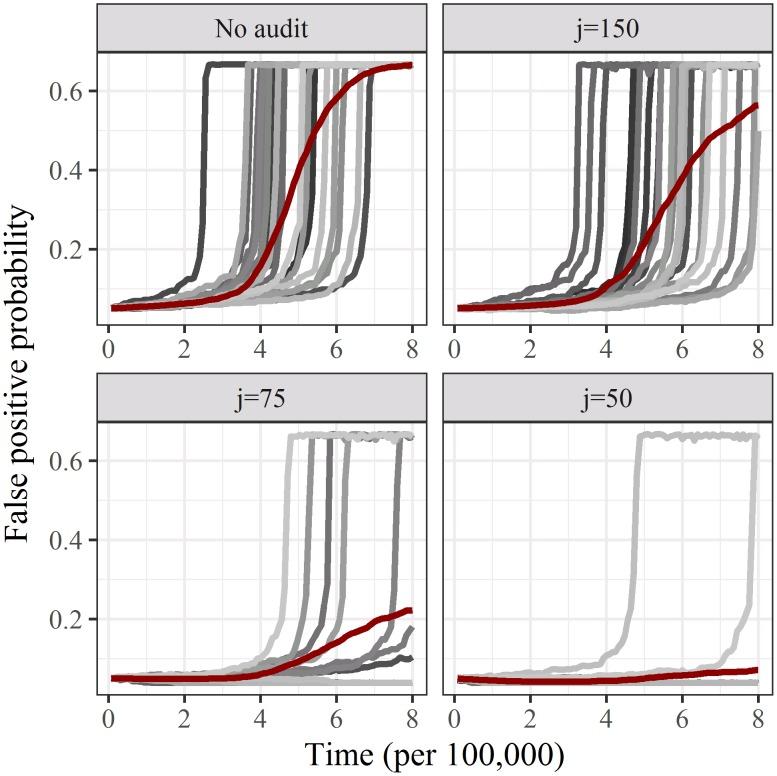
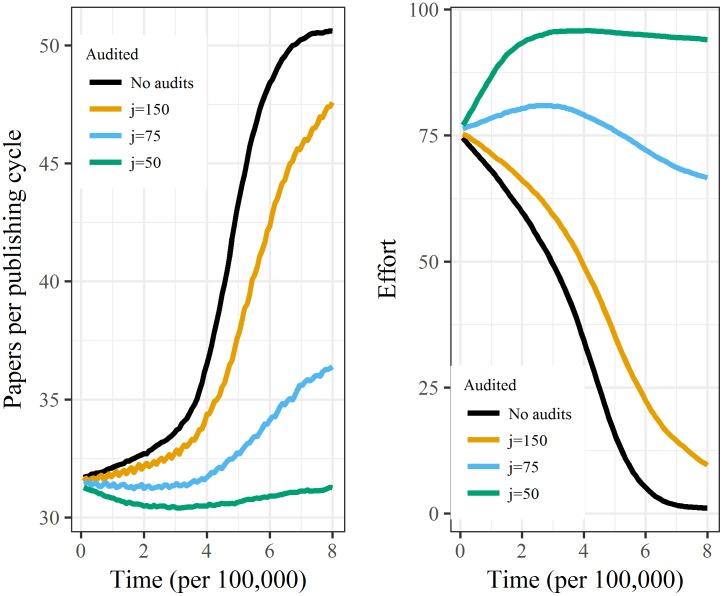
The "publish or perish" incentive drives many researchers to increase the quantity of their papers at the cost of quality. Lowering quality increases the number of false positive errors which is a key cause of the reproducibility crisis. We adapted a previously published simulation of the research world where labs that produce many papers are more likely to have "child" labs that inherit their characteristics. This selection creates a competitive spiral that favours quantity over quality. To try to halt the competitive spiral we added random audits that could detect and remove labs with a high proportion of false positives, and also improved the behaviour of "child" and "parent" labs who increased their effort and so lowered their probability of making a false positive error. Without auditing, only 0.2% of simulations did not experience the competitive spiral, defined by a convergence to the highest possible false positive probability. Auditing 1.35% of papers avoided the competitive spiral in 71% of simulations, and auditing 1.94% of papers in 95% of simulations. Audits worked best when they were only applied to established labs with 50 or more papers compared with labs with 25 or more papers. Adding a ±20% random error to the number of false positives to simulate peer reviewer error did not reduce the audits' efficacy. The main benefit of the audits was via the increase in effort in "child" and "parent" labs. Audits improved the literature by reducing the number of false positives from 30.2 per 100 papers to 12.3 per 100 papers. Auditing 1.94% of papers would cost an estimated $15.9 million per year if applied to papers produced by National Institutes of Health funding. Our simulation greatly simplifies the research world and there are many unanswered questions about if and how audits would work that can only be addressed by a trial of an audit.
“发表或毁灭”的激励促使许多研究人员为了数量而牺牲质量,增加论文的数量。降低质量会增加假阳性错误的数量,这是可重复性危机的一个关键原因。我们改编了之前发表的一项关于研究世界的模拟研究,其中发表大量论文的实验室更有可能拥有继承其特征的“子”实验室。这种选择创造了一种竞争螺旋,偏向于数量而不是质量。为了试图阻止这种竞争螺旋,我们增加了随机审计,可以检测和去除假阳性比例高的实验室,并且改进了“子”和“父”实验室的行为,增加了它们的努力,从而降低了出现假阳性错误的概率。没有审计,只有 0.2%的模拟实验没有经历竞争螺旋,竞争螺旋的定义是达到最高可能的假阳性概率的收敛。对 1.35%的论文进行审计,71%的模拟实验可以避免竞争螺旋,对 1.94%的论文进行审计,95%的模拟实验可以避免竞争螺旋。当审计仅应用于拥有 50 篇或更多论文的成熟实验室,而不是拥有 25 篇或更多论文的实验室时,审计效果最好。模拟同行评审错误,将假阳性数量增加±20%的随机误差并不会降低审计的效果。审计的主要好处是通过增加“子”和“父”实验室的努力。审计通过将每 100 篇论文中的假阳性数量从 30.2 减少到 12.3,从而改善了文献。如果将其应用于美国国立卫生研究院资助的论文,对 1.94%的论文进行审计每年估计需要花费 1590 万美元。我们的模拟大大简化了研究世界,关于审计是否以及如何发挥作用,还有许多悬而未决的问题,只能通过审计试验来解决。


 Zotero 插件