Skeletal Biology and Engineering Research Center, Department of Development and Regeneration, KU Leuven, Leuven, Belgium.
Prometheus - Division of Skeletal Tissue Engineering Leuven, KU Leuven, Leuven, Belgium.
Sci Rep. 2018 Apr 12;8(1):5881. doi: 10.1038/s41598-018-24229-x.
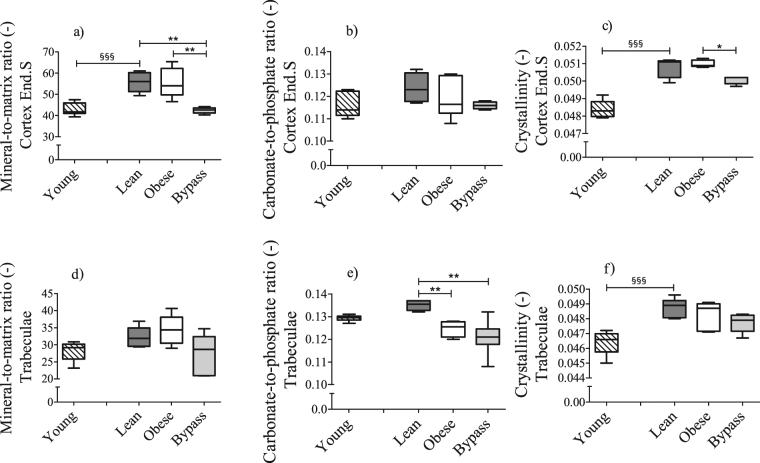
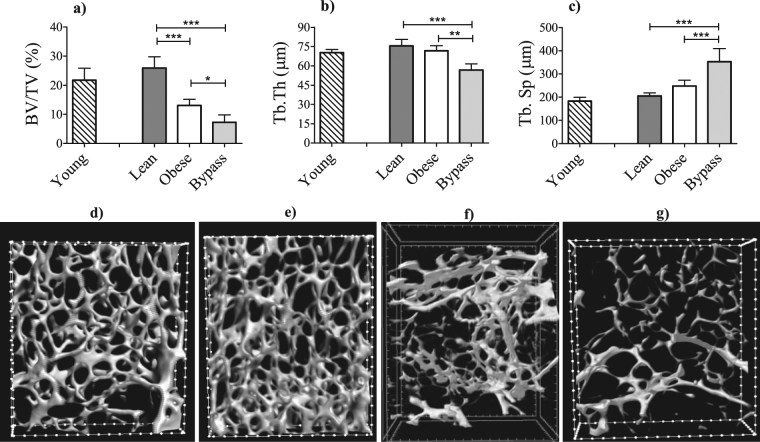
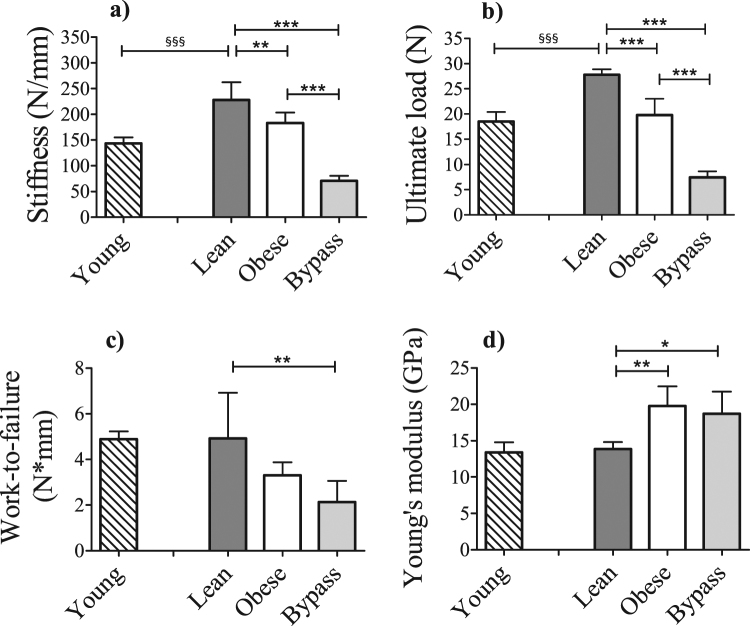
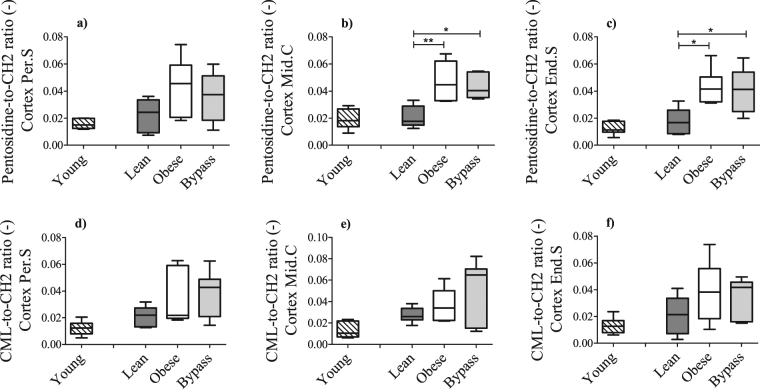
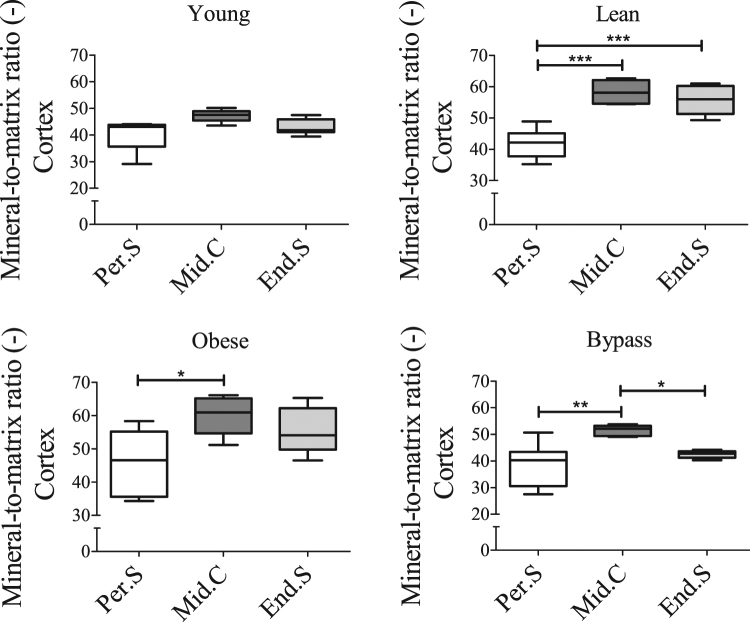
Type 2 diabetes mellitus (T2DM) is a metabolic disorder associated with obesity and hyperglycemia. Roux-en-Y gastric bypass (RYGB) surgery is a common treatment for severely obese patients and T2DM. Both RYGB and T2DM are linked to increased skeletal fragility, though the exact mechanisms are poorly understood. Our aim was to characterize the structural, mechanical and compositional properties of bones from diet-induced obese and RYGB-treated obese (bypass) mice to elucidate which the exact factors are contributing to the increased skeletal fragility. To achieve this, a combinatory approach including microfocus X-ray computed tomography, 3-point bending, finite element modeling and Raman spectroscopy, was used. Compared to aged-matched lean controls, the obese mice displayed decreased cortical thickness, trabecular bone loss, decreased stiffness and increased Young's modulus. For the bypass mice, these alterations were even more pronounced, and additionally they showed low mineral-to-matrix ratio in the cortical endosteal area. Accumulation of the advanced glycation end-product (AGE) pentosidine was found in the cortex of obese and bypass groups and this accumulation was correlated with an increased Young's modulus. In conclusion, we found that the increased fracture risk in T2DM- and post-RYGB bones is mainly driven by accumulation of AGEs and macro-structural alterations, generating biomechanical dysfunctionality.
2 型糖尿病(T2DM)是一种与肥胖和高血糖有关的代谢紊乱。Roux-en-Y 胃旁路(RYGB)手术是治疗严重肥胖患者和 T2DM 的常用方法。RYGB 和 T2DM 均与骨骼脆弱度增加有关,但确切的机制尚不清楚。我们的目的是描述饮食诱导肥胖和 RYGB 治疗肥胖(旁路)小鼠的骨骼结构、力学和组成特性,以阐明哪些确切因素导致骨骼脆弱度增加。为此,我们采用了包括微焦点 X 射线计算机断层扫描、三点弯曲、有限元建模和拉曼光谱在内的组合方法。与年龄匹配的瘦对照相比,肥胖小鼠表现出皮质厚度降低、骨小梁丢失、刚度降低和杨氏模量增加。对于旁路小鼠,这些变化更为明显,此外,它们还显示皮质内骨端的矿化基质比值降低。在肥胖组和旁路组的皮质中发现了晚期糖基化终产物(AGE)戊糖的积累,这种积累与杨氏模量的增加有关。总之,我们发现 T2DM 和 RYGB 术后骨的骨折风险增加主要是由 AGE 的积累和宏观结构改变引起的,导致生物力学功能障碍。