Hildebrandt Tom, Heywood Ashley, Wesley Daniel, Schulz Kurt
Eating and Weight Disorders Program, Department of Psychiatry, Icahn School of Medicine at Mount Sinai, New York, NY, United States.
Front Psychol. 2018 Mar 29;9:390. doi: 10.3389/fpsyg.2018.00390. eCollection 2018.
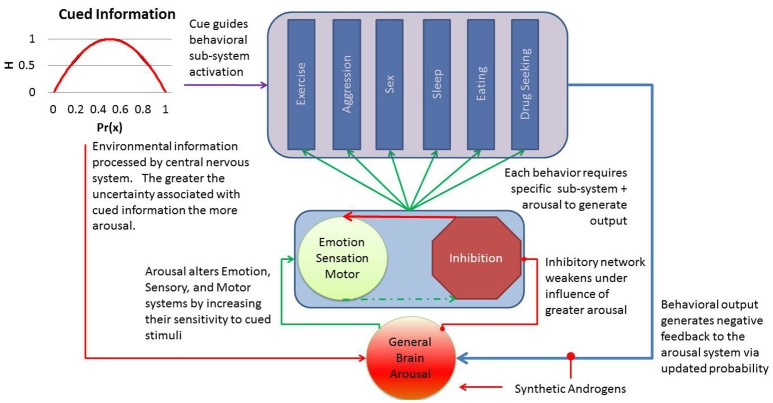
Synthetic androgens (i. e., anabolic-androgenic steroids) are the primary component to the majority of problematic appearance and performance enhancing drug (APED) use. Despite evidence that these substances are associated with increased risk for aggression, violence, body image disturbances, and polypharmacy and can develop a pattern of chronic use consistent with drug dependence, there are no formal definitions of androgen intoxication. Consequently, the purpose of this paper is to establish a testable theory of androgen intoxication. We present evidence and theorize that synthetic androgen intoxication can be defined by a pattern of poor self-regulation characterized by increased propensity for a range of behaviors (e.g., aggression, sex, drug seeking, exercise, etc.) via androgen mediated effects on general brain arousal. This theory posits that androgens reduce threshold for emotional reactivity, motor response, and alertness to sensory stimuli and disrupt inhibitory control over the behaviors associated with synthetic androgen use. These changes result from alteration to basic neurocircuitry that amplifies limbic activation and reduces top-down cortical control. The implications for this definition are to inform APED specific hypotheses about the behavioral and psychological effects of APED use and provide a basis for establishing clinical, legal, and public health guidelines to address the use and misuse of these substances.
合成雄激素(即合成代谢雄激素类固醇)是大多数问题性外观和性能增强药物(APED)使用的主要成分。尽管有证据表明这些物质与攻击、暴力、身体形象障碍和多药滥用风险增加有关,并且会形成与药物依赖一致的长期使用模式,但目前尚无雄激素中毒的正式定义。因此,本文的目的是建立一个可检验的雄激素中毒理论。我们提供证据并提出理论,即合成雄激素中毒可以通过一种自我调节不良的模式来定义,其特征是通过雄激素对大脑整体唤醒的介导作用,一系列行为(如攻击、性行为、药物寻求、运动等)的倾向增加。该理论认为,雄激素降低了情绪反应、运动反应和对感觉刺激的警觉性阈值,并破坏了对与合成雄激素使用相关行为的抑制控制。这些变化是由基本神经回路的改变引起的,这种改变会放大边缘系统的激活并减少自上而下的皮层控制。这一定义的意义在于为关于APED使用的行为和心理影响的特定假设提供信息,并为制定临床、法律和公共卫生指南以解决这些物质的使用和滥用问题提供基础。