Agricultural and Livestock Microbiology Post - Graduation Program, School of Agricultural and Veterinarian Sciences, São Paulo State University (UNESP), Jaboticabal, Brazil.
A&L Biologicals, Agroecological Research Services Centre, London, ON, Canada.
Microbiologyopen. 2018 Dec;7(6):e00617. doi: 10.1002/mbo3.617. Epub 2018 Apr 13.
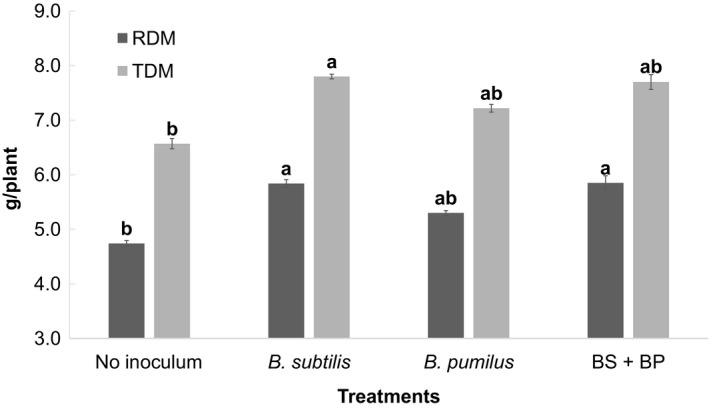
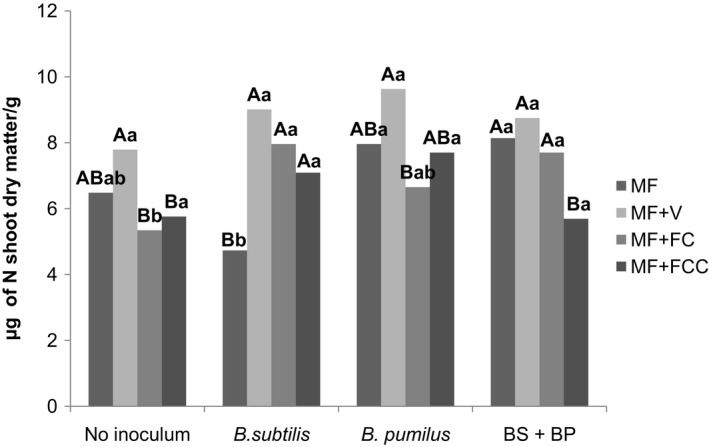
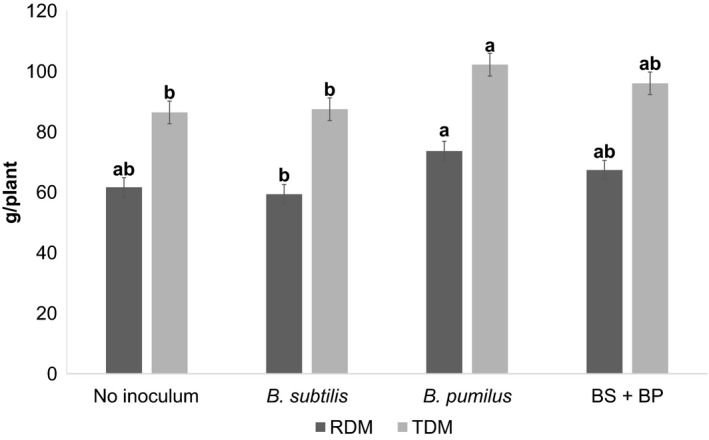
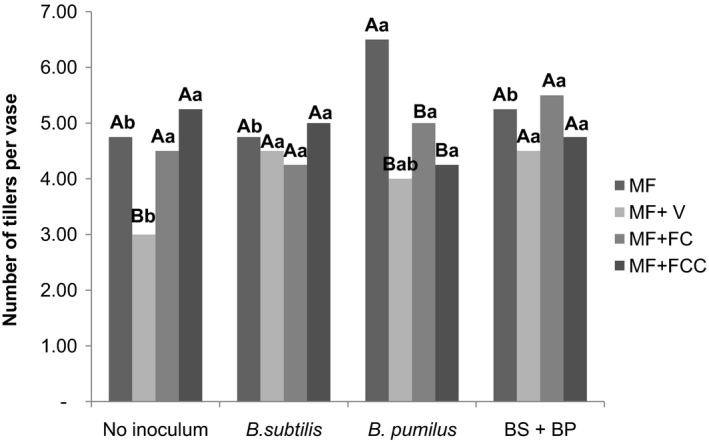
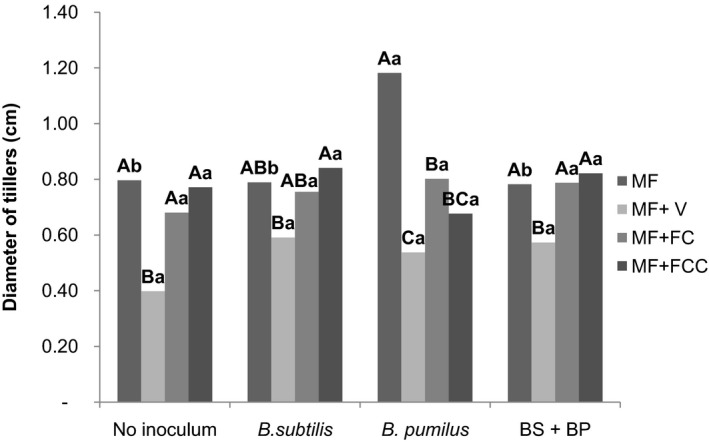
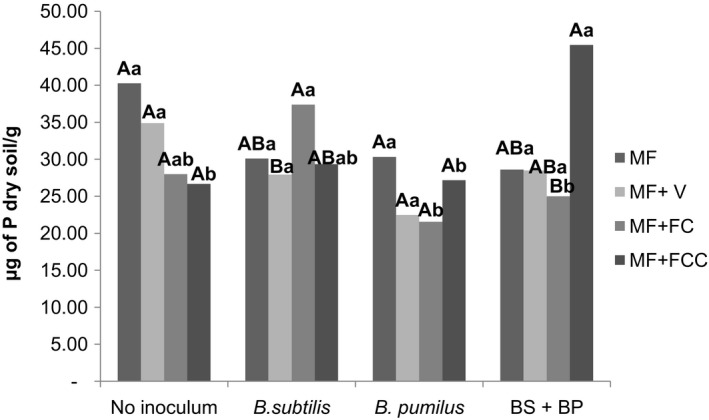
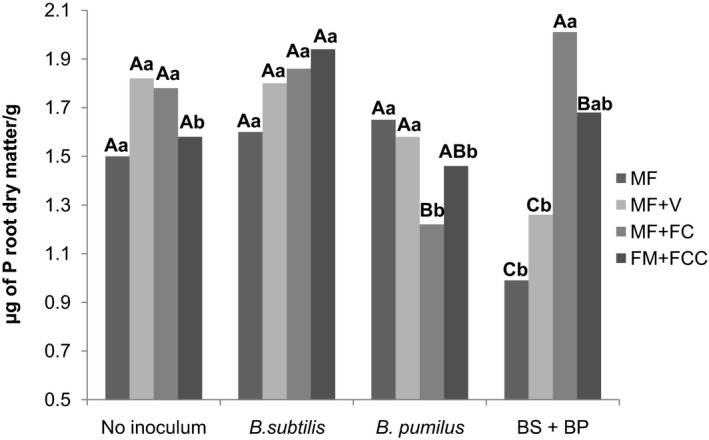
Mineral and organic fertilization can be optimized by using rhizobacteria which increases dry matter, yield, and nutrients in the soil and plant, among the other biological inputs. However, the discovery of single microbes or a consortium that can benefit plants has been a challenge. In this context, this study aimed to evaluate the effects of Bacillus subtilis and Bacillus pumilus combined with mineral fertilization and sugar and alcohol industry by-products in presprouted and the initial growth phase of sugar cane seedlings. The study was carried out in two phases. Phase 1 included presprouted seedlings with T1 = untreated control, T2 = B. subtilis, T3 = B. pumilus, and T4 = B. subtilis + B. pumilus treatments. Phase 2 included the same treatments with four types of fertilization: F1 = mineral fertilization, F2 = mineral fertilization + vinasse, F3 = mineral fertilization + filter cake, and F4 = mineral fertilization + filter cake compost. Of the phase 1 treatments, T2 (B. subtilis) was the best promoter of root growth and the total dry matter compared to the control with an increase of 23.0% compared to the control. In phase 2, B. pumilus application, increased the total dry matter by 13%, the number of tillers by 37%, and the diameter of the tillers by 48% when combined with mineral fertilization. The combined application of B. subtilis and B. pumilus increased the phosphorus content by 13% in soil treated with mineral fertilization and filter cake compost. The results of the this study strongly suggest that the use of B. subtilis and B. pumilus together with these by-products can improve soil fertility parameters and decrease adverse effects associated with vinasse fertilization, in addition to providing shoot and root growth and providing collective synergy for a high yield of sugarcane production with environmental benefits.
通过使用根际细菌,可以优化矿物质和有机肥料的施肥,从而增加土壤和植物中的干物质、产量和养分,这是其他生物投入的一部分。然而,发现能够使植物受益的单一微生物或共生体一直是一个挑战。在这种情况下,本研究旨在评估枯草芽孢杆菌和地衣芽孢杆菌与矿物质肥料以及糖和酒精工业副产品结合在甘蔗幼苗预萌发和初始生长阶段的效果。该研究分两个阶段进行。第一阶段包括预萌发的幼苗,处理 T1 为未处理对照,T2 为枯草芽孢杆菌,T3 为地衣芽孢杆菌,T4 为枯草芽孢杆菌+地衣芽孢杆菌。第二阶段包括相同的处理,有四种施肥类型:F1 为矿物质施肥,F2 为矿物质施肥+酒糟,F3 为矿物质施肥+滤饼,F4 为矿物质施肥+滤饼堆肥。在第一阶段的处理中,与对照相比,T2(枯草芽孢杆菌)是促进根系生长和总干物质的最佳处理,与对照相比增加了 23.0%。在第二阶段,当与矿物质肥料一起应用时,地衣芽孢杆菌的应用使总干物质增加了 13%,分蘖数增加了 37%,分蘖直径增加了 48%。枯草芽孢杆菌和地衣芽孢杆菌的联合应用增加了矿物质肥料和滤饼堆肥处理土壤中的磷含量 13%。本研究的结果强烈表明,枯草芽孢杆菌和地衣芽孢杆菌的联合使用以及这些副产品的使用可以改善土壤肥力参数,并减少酒糟施肥的不利影响,此外还可以促进甘蔗的生长和提供集体协同作用,从而实现高产和环境效益。