European Medicines Agency, London, UK.
D3 PharmaChemistry, Istituto Italiano di Tecnologia, Genova, Italy.
Eur Respir Rev. 2018 Apr 13;27(148). doi: 10.1183/16000617.0124-2017. Print 2018 Jun 30.
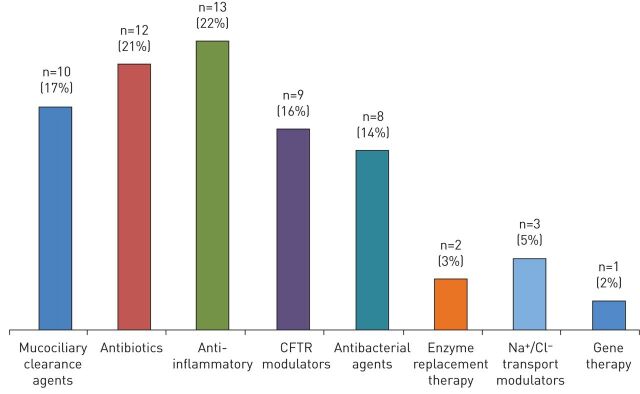
In this article we analyse the current authorised treatments and trends in early drug development for cystic fibrosis (CF) in the European Union for the time period 2000-2016. The analysis indicates a significant improvement in the innovation and development of new potential medicines for CF, shifting from products that act on the symptoms of the disease towards new therapies targeting the cause of CF. However, within these new innovative medicines, results for CF transmembrane conductance regulator (CFTR) modulators indicate that one major challenge for turning a CF concept product into an actual medicine for the benefit of patients resides in the fact that, although pre-clinical models have shown good predictability for certain mutations, a good correlation to clinical end-points or biomarkers ( forced expiratory volume in 1 s and sweat chloride) for all mutations has not yet been achieved. In this respect, the use of alternative end-points and innovative nonclinical models could be helpful for the understanding of those translational discrepancies. Collaborative endeavours to promote further research and development in these areas as well as early dialogue with the regulatory bodies available at the European competent authorities are recommended.
本文分析了 2000 年至 2016 年期间欧盟内囊性纤维化(CF)早期药物开发的现行许可治疗方法和趋势。分析表明,CF 新潜在药物的创新和开发有了显著改善,从针对疾病症状的产品转向针对 CF 病因的新疗法。然而,在这些新的创新药物中,囊性纤维化跨膜电导调节因子(CFTR)调节剂的结果表明,将 CF 概念产品转化为实际造福患者的药物的主要挑战之一在于,尽管临床前模型对某些突变显示出良好的预测性,但尚未实现所有突变与临床终点或生物标志物(1 秒用力呼气量和汗氯)的良好相关性。在这方面,使用替代终点和创新的临床前模型可能有助于理解这些转化差异。建议开展合作努力,推动这些领域的进一步研究和开发,并与欧洲主管当局现有的监管机构进行早期对话。