Alivernini Stefano, Pugliese Daniela, Tolusso Barbara, Bui Laura, Petricca Luca, Guidi Luisa, Mirone Luisa, Rapaccini Gian Ludovico, Federico Francesco, Ferraccioli Gianfranco, Armuzzi Alessandro, Gremese Elisa
Division of Rheumatology, Fondazione Policlinico Universitario A. Gemelli, Catholic University of the Sacred Heart, Rome, Italy.
IBD Unit, Fondazione Policlinico Universitario A. Gemelli, Catholic University of the Sacred Heart, Rome, Italy.
RMD Open. 2018 Apr 9;4(1):e000667. doi: 10.1136/rmdopen-2018-000667. eCollection 2018.
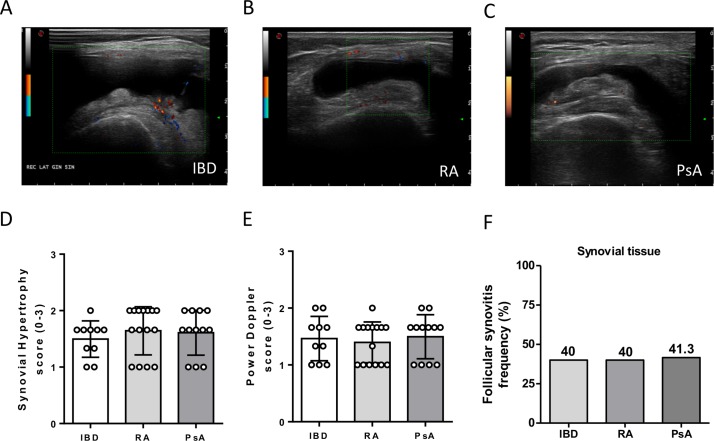
Paradoxical arthritis under tumour necrosis factor inhibitor (TNF-i) for inflammatory bowel disease (IBD) has been described. This study aims to evaluate the histological features of paired synovial tissue (ST) and colonic mucosa (CM) tissue in patients with IBD developing paradoxical arthritis under TNF-i.
Patients with IBD without history of coexisting joint involvement who developed arthritis under TNF-i were enrolled. Each patient underwent ST biopsy and ileocolonoscopy with CM biopsies. ST and CM paired samples were stained through immunohistochemistry (IHC) for CD68, CD21, CD20, CD3 and CD117. Clinical and immunological parameters (anticitrullinated peptides antibodies (ACPA)-immunoglobulin (Ig)M/IgA rheumatoid factor (RF)) were collected. Psoriatic arthritis (PsA) and ACPA/IgM-RF/IgA-RF negative rheumatoid arthritis (RA) were enrolled as comparison.
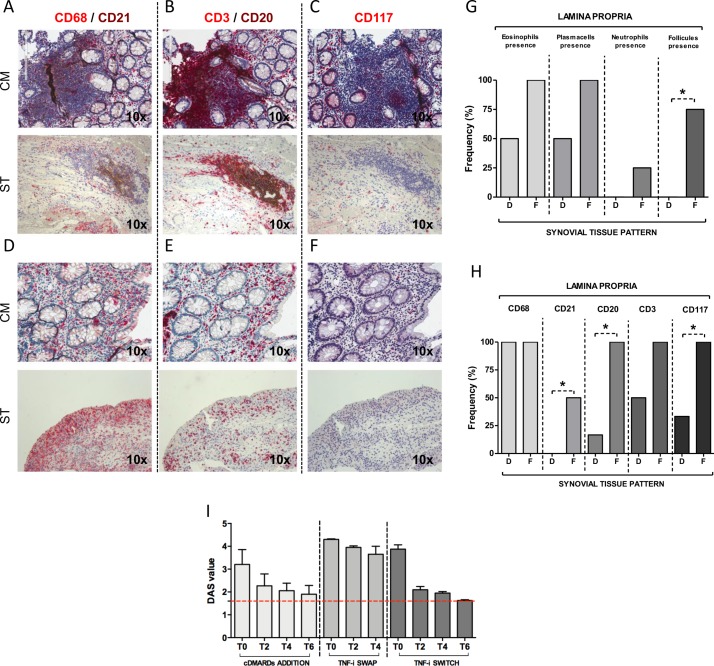
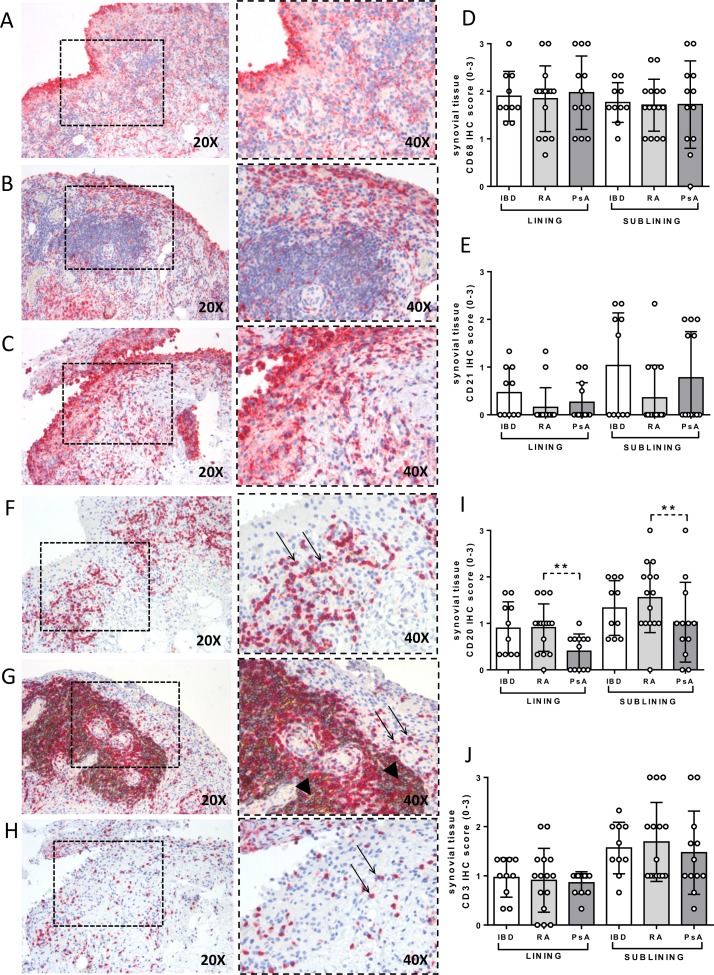
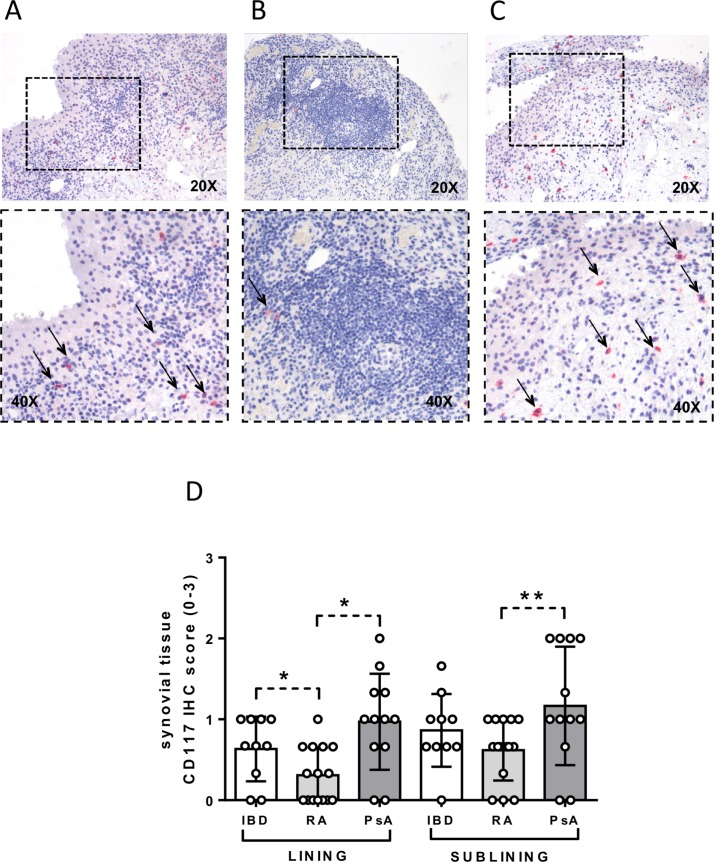
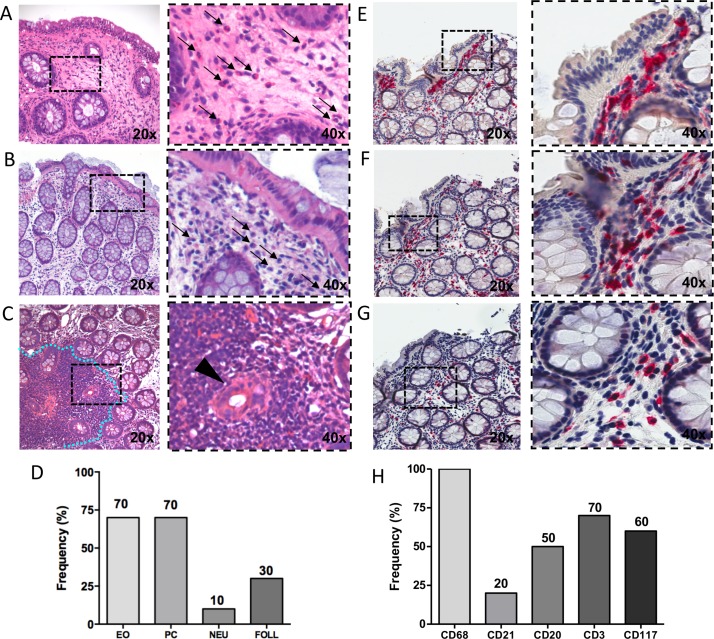
10 patients with IBD (age 46.0±9.7 years, 13.2±9.9 years of disease duration, 2.5±1.6 years of TNF-i exposure, six with Crohn's disease and four with ulcerative colitis, respectively) were studied. At ST level, IHC revealed that patients with IBD with paradoxical arthritis showed more similar histological findings in terms of synovial CD68, CD21, CD20, CD3 and CD117 cells compared with PsA than ACPA/IgM-RF/IgA-RF negative RA. Analysing the CM specimens, patients with IBD showed the presence of CD68, CD3, CD117 and CD20 cells in 100%, 70%, 60% and 50% of cases, respectively, despite endoscopic remission. Finally, addition of conventional disease-modifying antirheumatic drugs and switch to ustekinumab were more effective than swapping into different TNF-i in patients with IBD with paradoxical arthritis.
Patients with IBD may develop histologically proven synovitis during TNF-i, comparable to PsA. The inhibition of inflammatory pathways alternative to TNF (IL12/1L23) may be an effective therapeutic option for severe paradoxical articular manifestations.
已报道肿瘤坏死因子抑制剂(TNF-i)用于治疗炎症性肠病(IBD)时出现反常性关节炎。本研究旨在评估在TNF-i治疗下发生反常性关节炎的IBD患者的配对滑膜组织(ST)和结肠黏膜(CM)组织的组织学特征。
纳入无关节受累病史且在TNF-i治疗下发生关节炎的IBD患者。每位患者均接受ST活检以及CM活检的回结肠内镜检查。对ST和CM配对样本进行免疫组织化学(IHC)染色,检测CD68、CD21、CD20、CD3和CD117。收集临床和免疫学参数(抗瓜氨酸化肽抗体(ACPA)-免疫球蛋白(Ig)M/IgA类风湿因子(RF))。纳入银屑病关节炎(PsA)和ACPA/IgM-RF/IgA-RF阴性类风湿关节炎(RA)作为对照。
研究了10例IBD患者(年龄46.0±9.7岁,病程13.2±9.9年,TNF-i暴露时间2.5±1.6年,分别有6例克罗恩病患者和4例溃疡性结肠炎患者)。在ST水平,IHC显示,与ACPA/IgM-RF/IgA-RF阴性RA相比,IBD伴反常性关节炎患者在滑膜CD68、CD21、CD20、CD3和CD117细胞方面的组织学表现与PsA更为相似。分析CM标本发现,IBD患者中分别有100%、70%、60%和50%的病例存在CD68、CD3、CD117和CD20细胞,尽管内镜检查显示病情缓解。最后,对于IBD伴反常性关节炎患者,加用传统抗风湿药物并换用优特克单抗比换用不同的TNF-i更有效。
IBD患者在TNF-i治疗期间可能出现组织学证实的滑膜炎,与PsA相似。抑制TNF以外的炎症途径(IL12/1L23)可能是治疗严重反常性关节表现的有效治疗选择。