ICDDR, B, Dhaka, Bangladesh.
Bangladesh Breastfeeding Foundation (BBF), Dhaka, Bangladesh.
Matern Child Nutr. 2018 Jul;14(3):e12605. doi: 10.1111/mcn.12605. Epub 2018 Apr 16.
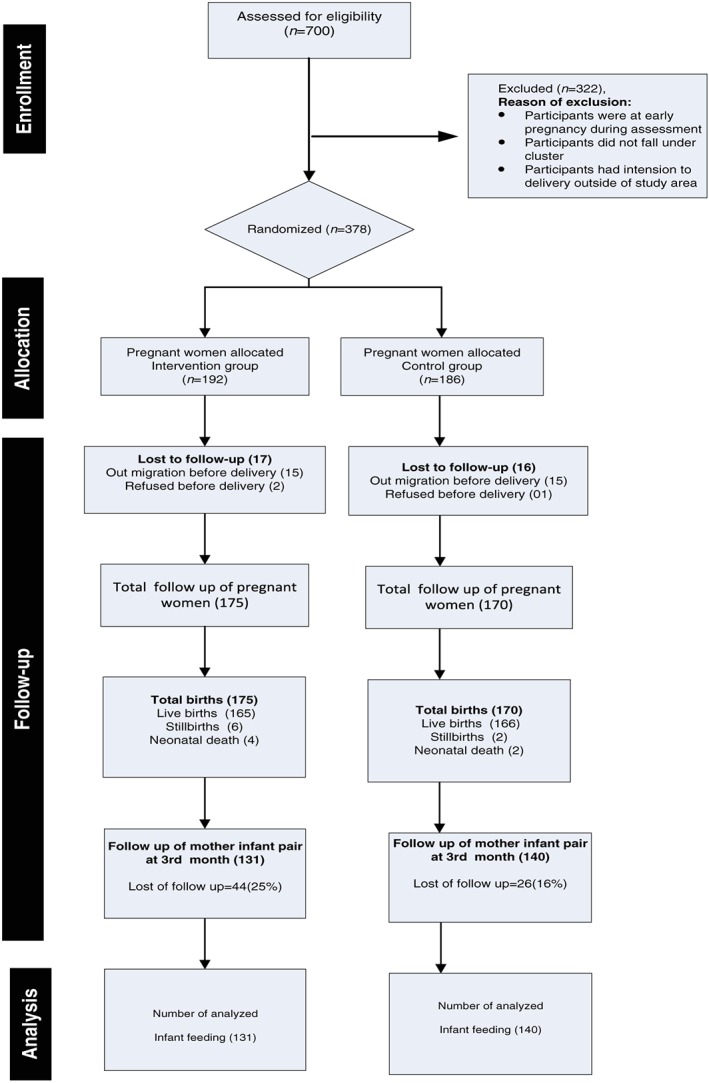
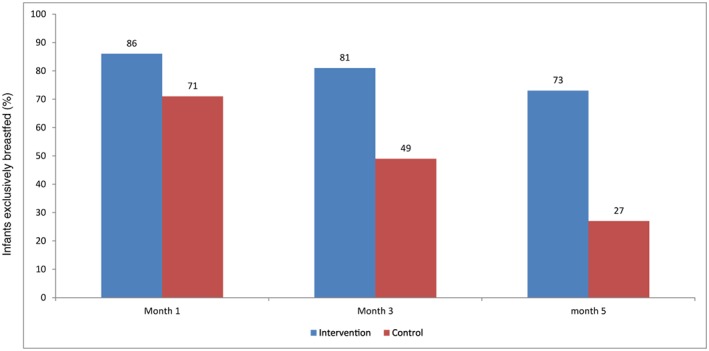
This study aimed to evaluate the impact of peer counselling on early initiation of breastfeeding (EIBF) and exclusive breastfeeding (EBF) rates for mother-infant pairs living in urban slums, Dhaka, Bangladesh. This randomized controlled trial enrolled 350 mother-infant pairs from selected slums between September 2014 and July 2016. The women assigned to intervention group received peer counselling from locally recruited, trained community female volunteers starting in third trimester of pregnancy until 6 months after delivery; control group received no intervention. EIBF, any liquids given after birth, and EBF were compared between groups. Follow-up was scheduled at enrolment, following childbirth, and every 2 months up to 6 months after delivery. Multiple logistic regressions were used to assess the effect peer counselling and other associated factors on EIBF and EBF practices. EIBF rate was higher in the intervention group than in the control group (89.1% vs. 77.4%, p = .005). More mothers in intervention group were exclusively breastfeeding at 5 months than mothers in the control group (73% vs. 27%, p < .005). Control mothers were twice as likely to not practice EIBF compared with intervention mothers (adjusted odds risk [aOR]: 2.53, CI [1.29, 4.97], p = .007). Overall, caesarean section was associated with an 8.9-fold higher risk of not achieving EIBF (aOR: 8.90, CI [4.05, 19.55], p < .001). Intervention mothers were 5.10-fold more likely to practice EBF compared with control mothers (aOR: 5.10, CI [2.89, 9.01], p < .001) at 5 months. This study demonstrates peer counselling can positively influence both EIBF and EBF among mothers living in urban area.
本研究旨在评估同伴咨询对孟加拉国达卡市贫民窟母婴群体早期母乳喂养(EIBF)和纯母乳喂养(EBF)率的影响。这项随机对照试验于 2014 年 9 月至 2016 年 7 月期间在选定的贫民窟中招募了 350 对母婴。分配到干预组的妇女从妊娠第三个月开始,直到分娩后 6 个月,接受当地招募的、经过培训的社区女性志愿者的同伴咨询;对照组未接受干预。比较了两组之间的 EIBF、出生后给予的任何液体和 EBF。随访计划在入组时、分娩后以及分娩后 2 个月至 6 个月进行。采用多因素逻辑回归分析评估同伴咨询和其他相关因素对 EIBF 和 EBF 实践的影响。干预组的 EIBF 率高于对照组(89.1% vs. 77.4%,p=0.005)。干预组在 5 个月时纯母乳喂养的母亲多于对照组(73% vs. 27%,p<0.005)。与干预组母亲相比,对照组母亲不进行 EIBF 的可能性是其两倍(调整后的优势比[aOR]:2.53,CI [1.29, 4.97],p=0.007)。总体而言,剖宫产与未达到 EIBF 的风险增加 8.9 倍相关(aOR:8.90,CI [4.05, 19.55],p<0.001)。与对照组母亲相比,干预组母亲在 5 个月时更有可能进行 EBF(aOR:5.10,CI [2.89, 9.01],p<0.001)。本研究表明,同伴咨询可以积极影响城市地区母婴群体的 EIBF 和 EBF。