Department of Epidemiology and Biostatistics, The University of Western Ontario, London, ON, Canada.
Schulich Interfaculty Program in Public Health, The University of Western Ontario, London, ON, Canada.
J Alzheimers Dis. 2018;63(2):423-444. doi: 10.3233/JAD-170991.
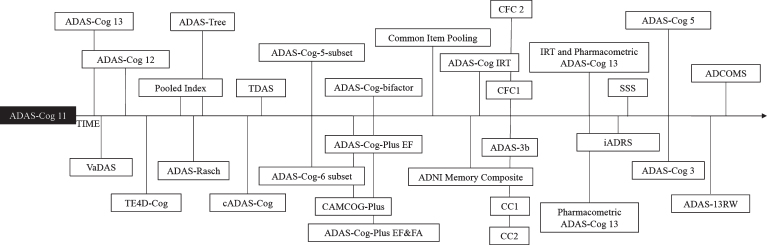
The Alzheimer's Disease Assessment Scale-Cognitive Subscale (ADAS-Cog) was developed in the 1980s to assess the level of cognitive dysfunction in Alzheimer's disease. Advancements in the research field have shifted focus toward pre-dementia populations, and use of the ADAS-Cog has extended into these pre-dementia studies despite concerns about its ability to detect important changes at these milder stages of disease progression. If the ADAS-Cog cannot detect important changes, our understanding of pre-dementia disease progression may be compromised and trials may incorrectly conclude that a novel treatment approach is not beneficial. The purpose of this review was to assess the performance of the ADAS-Cog in pre-dementia populations, and to review all modifications that have been made to the ADAS-Cog to improve its measurement performance in dementia or pre-dementia populations. The contents of this review are based on bibliographic searches of electronic databases to locate all studies using the ADAS-Cog in pre-dementia samples or subsamples, and to locate all modified versions. Citations from relevant articles were also consulted. Overall, our results suggest the original ADAS-Cog is not an optimal outcome measure for pre-dementia studies; however, given the prominence of the ADAS-Cog, care must be taken when considering the use of alternative outcome measures. Thirty-one modified versions of the ADAS-Cog were found. Modification approaches that appear most beneficial include altering scoring methodology or adding tests of memory, executive function, and/or daily functioning. Although modifications improve the performance of the ADAS-Cog, this is at the cost of introducing heterogeneity that may limit between-study comparison.
阿尔茨海默病评估量表-认知子量表(ADAS-Cog)于 20 世纪 80 年代开发,用于评估阿尔茨海默病患者的认知功能障碍程度。随着研究领域的发展,研究重点已经转移到痴呆前期人群,尽管人们对其在疾病进展较轻阶段检测重要变化的能力存在担忧,但 ADAS-Cog 的使用已扩展到这些痴呆前期研究中。如果 ADAS-Cog 无法检测到重要变化,我们对痴呆前期疾病进展的理解可能会受到影响,并且试验可能会错误地得出结论,认为新的治疗方法没有益处。本综述的目的是评估 ADAS-Cog 在痴呆前期人群中的表现,并综述所有为提高 ADAS-Cog 在痴呆或痴呆前期人群中的测量性能而对其进行的修改。本综述的内容基于电子数据库的文献检索,以定位所有在痴呆前期样本或亚样本中使用 ADAS-Cog 的研究,并定位所有修改版本。还查阅了相关文章的参考文献。总的来说,我们的研究结果表明,原始的 ADAS-Cog 不是痴呆前期研究的最佳结果测量指标;然而,鉴于 ADAS-Cog 的重要性,在考虑使用替代结果测量指标时必须谨慎。我们发现了 31 种 ADAS-Cog 的修改版本。似乎最有益的修改方法包括改变评分方法或添加记忆、执行功能和/或日常功能测试。虽然修改可以提高 ADAS-Cog 的性能,但这是以引入可能限制研究间比较的异质性为代价的。