Ruiz-Rizzo Adriana L, Neitzel Julia, Müller Hermann J, Sorg Christian, Finke Kathrin
Department of General and Experimental Psychology, Ludwig-Maximilians-Universität München, Munich, Germany.
Graduate School of Systemic Neurosciences, Ludwig-Maximilians-Universität München, Munich, Germany.
Front Hum Neurosci. 2018 Mar 12;12:89. doi: 10.3389/fnhum.2018.00089. eCollection 2018.
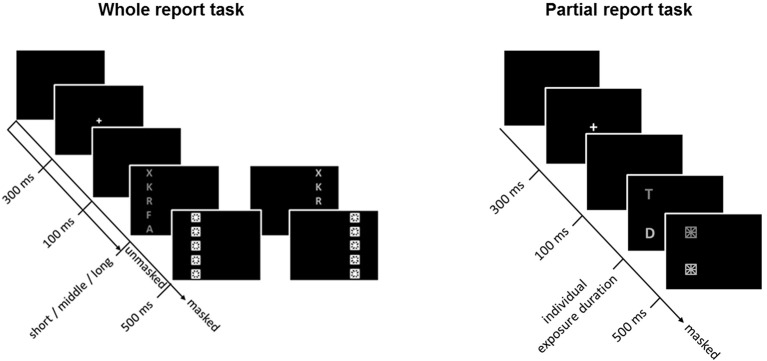
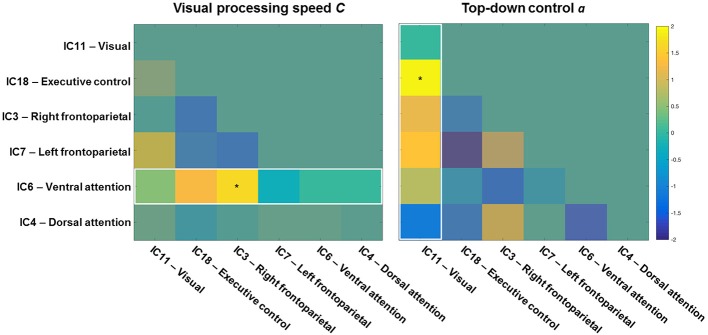
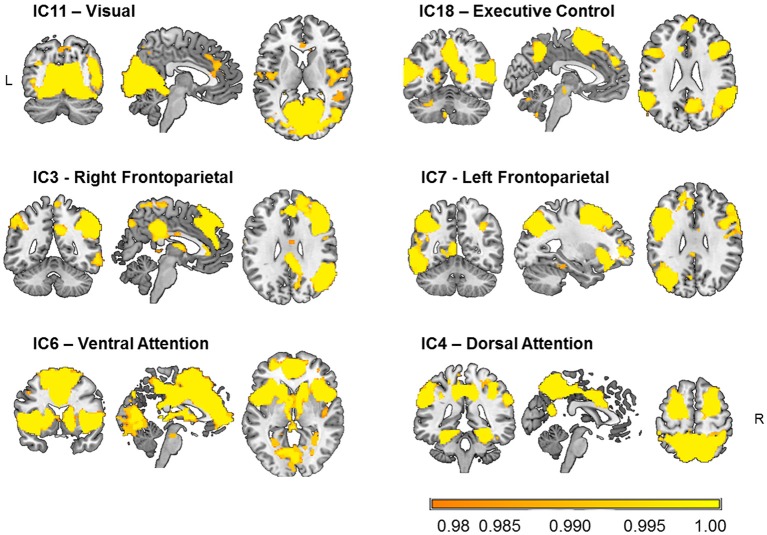
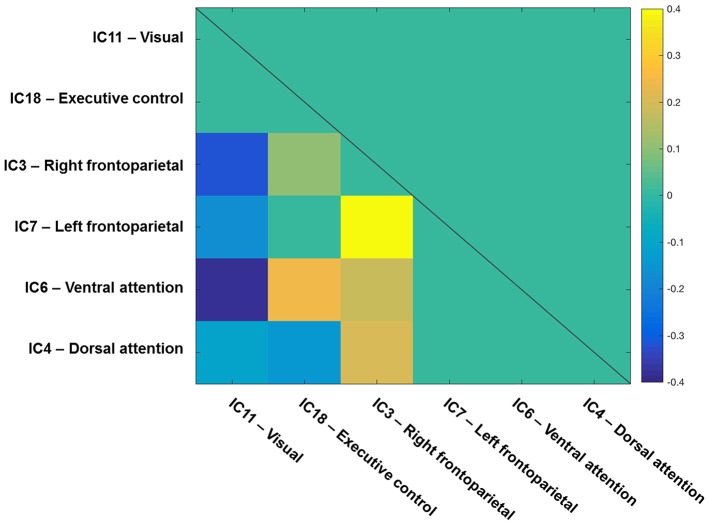
Separable visual attention functions are assumed to rely on distinct but interacting neural mechanisms. Bundesen's "theory of visual attention" (TVA) allows the mathematical estimation of independent parameters that characterize individuals' visual attentional capacity (i.e., visual processing speed and visual short-term memory storage capacity) and selectivity functions (i.e., top-down control and spatial laterality). However, it is unclear whether these parameters distinctively map onto different brain networks obtained from intrinsic functional connectivity, which organizes slowly fluctuating ongoing brain activity. In our study, 31 demographically homogeneous healthy young participants performed whole- and partial-report tasks and underwent resting-state functional magnetic resonance imaging (rs-fMRI). Report accuracy was modeled using TVA to estimate, individually, the four TVA parameters. Networks encompassing cortical areas relevant for visual attention were derived from independent component analysis of rs-fMRI data: visual, executive control, right and left frontoparietal, and ventral and dorsal attention networks. Two TVA parameters were mapped on particular functional networks. First, participants with higher (vs. lower) visual processing speed showed lower functional connectivity within the ventral attention network. Second, participants with more (vs. less) efficient top-down control showed higher functional connectivity within the dorsal attention network and lower functional connectivity within the visual network. Additionally, higher performance was associated with higher functional connectivity between networks: specifically, between the ventral attention and right frontoparietal networks for visual processing speed, and between the visual and executive control networks for top-down control. The higher inter-network functional connectivity was related to lower intra-network connectivity. These results demonstrate that separable visual attention parameters that are assumed to constitute relatively stable traits correspond distinctly to the functional connectivity both within and between particular functional networks. This implies that individual differences in basic attention functions are represented by differences in the coherence of slowly fluctuating brain activity.
可分离的视觉注意功能被认为依赖于不同但相互作用的神经机制。邦德森的“视觉注意理论”(TVA)允许对独立参数进行数学估计,这些参数表征个体的视觉注意能力(即视觉处理速度和视觉短期记忆存储容量)和选择性功能(即自上而下的控制和空间偏向性)。然而,尚不清楚这些参数是否独特地映射到从内在功能连接性获得的不同脑网络上,内在功能连接性组织着缓慢波动的持续脑活动。在我们的研究中,31名人口统计学特征相似的健康年轻参与者进行了整体和部分报告任务,并接受了静息态功能磁共振成像(rs-fMRI)。使用TVA对报告准确性进行建模,以分别估计四个TVA参数。通过对rs-fMRI数据进行独立成分分析,得出了包含与视觉注意相关的皮质区域的网络:视觉、执行控制、左右额顶叶以及腹侧和背侧注意网络。两个TVA参数被映射到特定的功能网络上。首先,视觉处理速度较高(相对于较低)的参与者在腹侧注意网络内显示出较低的功能连接性。其次,自上而下控制效率较高(相对于较低)的参与者在背侧注意网络内显示出较高的功能连接性,而在视觉网络内显示出较低的功能连接性。此外,较高的表现与网络之间较高的功能连接性相关:具体而言,对于视觉处理速度,腹侧注意网络和右额顶叶网络之间;对于自上而下控制,视觉网络和执行控制网络之间。较高的网络间功能连接性与较低的网络内连接性相关。这些结果表明,被认为构成相对稳定特征的可分离视觉注意参数与特定功能网络内部和之间的功能连接性明显对应。这意味着基本注意功能的个体差异由缓慢波动的脑活动的连贯性差异所表征。