Laboratory of Dermatology, Faculty of Medicine, EA7319, University of Reims Champagne-Ardenne, Reims, France.
Department of Dermatology, Reims University Hospital, University of Reims Champagne-Ardenne, Reims, France.
Front Immunol. 2018 Mar 13;9:479. doi: 10.3389/fimmu.2018.00479. eCollection 2018.
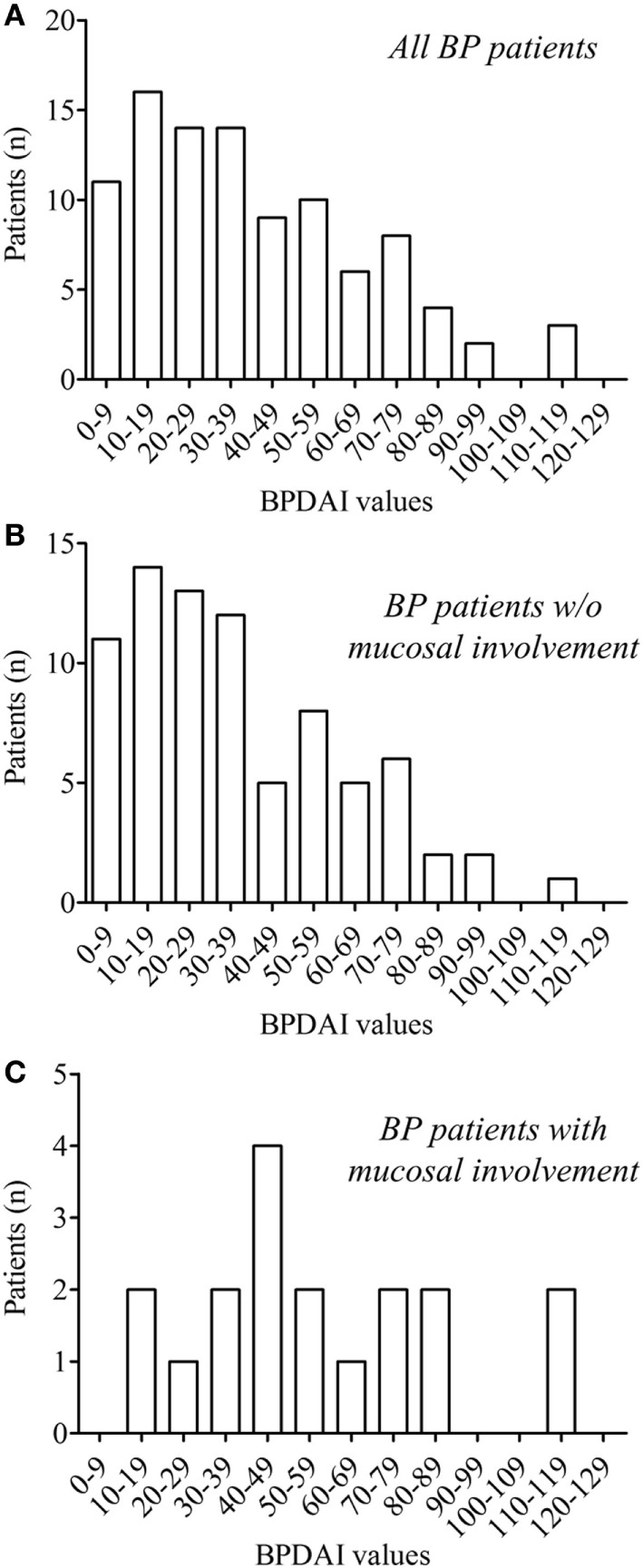
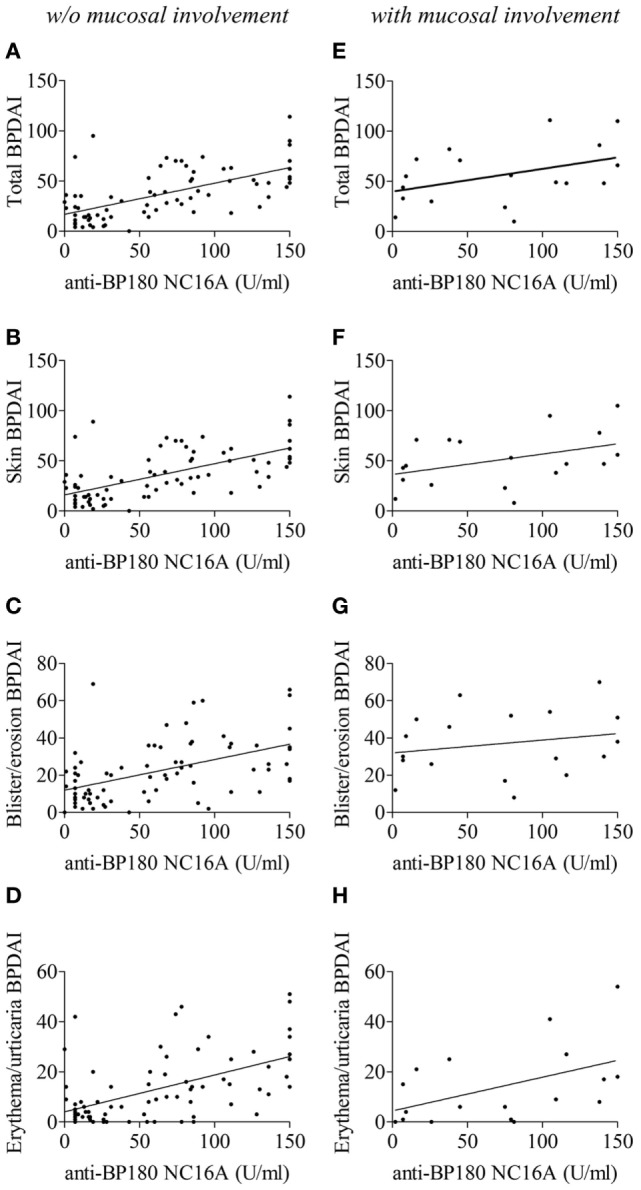
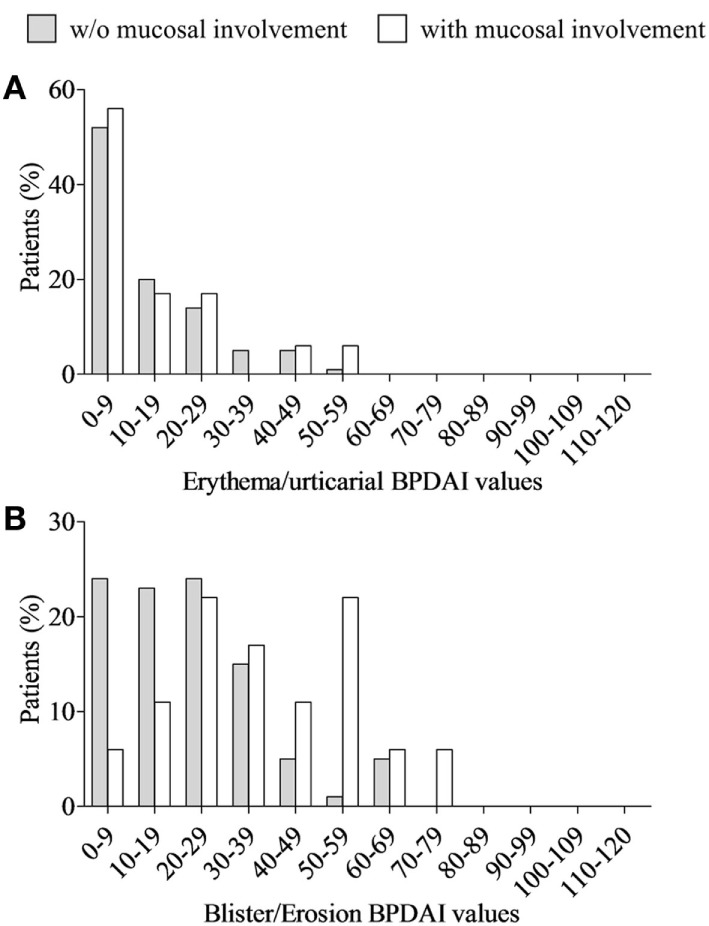
Bullous pemphigoid (BP) is the most common autoimmune bullous disease and typically affects the elderly. Binding of specific autoantibodies to BP180/230 hemidesmosomal components induces an inflammatory response leading to skin blister formation. Unusual manifestations of BP include additional mucous membrane involvement, without pathophysiological knowledge associated to the formation of these lesions. We here performed a prospective study on series of consecutive BP patients with ( = 77) and without ( = 18) mucosal involvements at baseline to further investigate why some BP patients display mucosal lesion and other not. Analysis of disease activity showed that BP patients with mucosal involvement displayed a higher total BP Disease Area Index (BPDAI) score ( = 0.008), but also higher skin and blister/erosion BPDAI scores ( = 0.02 and = 0.001, respectively). By contrast, the erythema/urticaria BPDAI score was identical between the two groups of patients. The erythema/urticaria BPDAI score, but not the blister/erosion BPDAI score, was correlated with the serum concentration of anti-BP180 NC16A autoantibodies in patients with mucosal involvement. In multivariate analysis, the absence of anti-BP230 autoantibody was the only factor independently associated with mucosal involvement (OR 7.8; 95% CI, 3.1-19.6) ( < 0.0001). Analysis of the distribution of BP patients according to BPDAI scores revealed a shift toward higher blister/erosion BPDAI scores for BP patients with mucosal involvement. This study indicates that mucosal lesions are clinically mainly related to disease severity and immunologically to the absence of anti-BP230 antibodies.
大疱性类天疱疮(BP)是最常见的自身免疫性大疱性疾病,通常影响老年人。特定自身抗体与 BP180/230 半桥粒成分结合会引发炎症反应,导致皮肤水疱形成。BP 的不常见表现包括额外的黏膜受累,而没有与这些病变形成相关的病理生理学知识。我们在此对一系列连续的 BP 患者进行了前瞻性研究,基线时有( = 77)和没有( = 18)黏膜受累,以进一步研究为什么有些 BP 患者出现黏膜病变而另一些则没有。疾病活动度分析显示,有黏膜受累的 BP 患者的总 BP 疾病面积指数(BPDAI)评分更高( = 0.008),但皮肤和水疱/糜烂 BPDAI 评分也更高( = 0.02 和 = 0.001,分别)。相比之下,两组患者的红斑/荨麻疹 BPDAI 评分相同。在有黏膜受累的患者中,只有红斑/荨麻疹 BPDAI 评分与血清中抗 BP180 NC16A 自身抗体浓度相关,而不是水疱/糜烂 BPDAI 评分。在多变量分析中,缺乏抗 BP230 自身抗体是与黏膜受累相关的唯一独立因素(OR 7.8;95%CI,3.1-19.6)( < 0.0001)。根据 BPDAI 评分对 BP 患者进行分析发现,有黏膜受累的 BP 患者的水疱/糜烂 BPDAI 评分较高。这项研究表明,黏膜病变在临床上主要与疾病严重程度相关,在免疫学上与缺乏抗 BP230 抗体相关。