Washington University Pain Center and Department of Anesthesiology, Washington University School of Medicine, St. Louis, Missouri 63110.
Washington University Program in Neuroscience, Washington University School of Medicine, St. Louis, Missouri 63110.
eNeuro. 2018 Apr 13;5(2). doi: 10.1523/ENEURO.0412-17.2018. eCollection 2018 Mar-Apr.
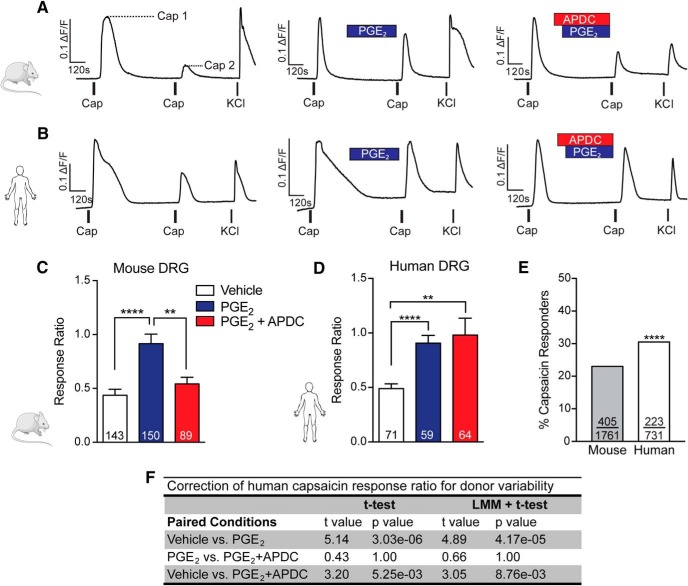
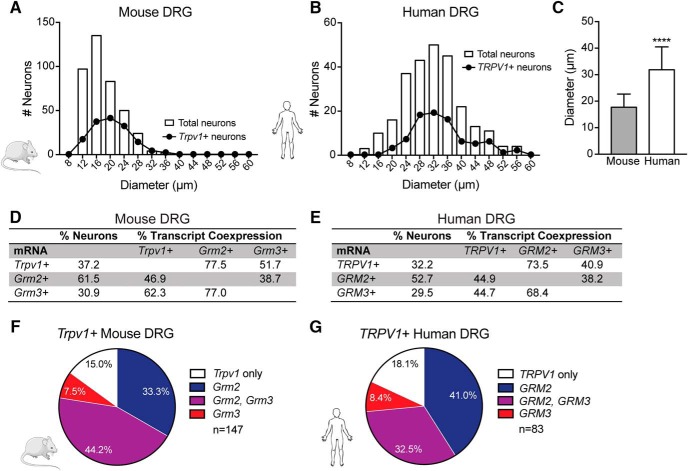
The use of human tissue to validate putative analgesic targets identified in rodents is a promising strategy for improving the historically poor translational record of preclinical pain research. We recently demonstrated that in mouse and human sensory neurons, agonists for metabotropic glutamate receptors 2 and 3 (mGluR2/3) reduce membrane hyperexcitability produced by the inflammatory mediator prostaglandin E (PGE). Previous rodent studies indicate that mGluR2/3 can also reduce peripheral sensitization by suppressing inflammation-induced sensitization of TRPV1. Whether this observation similarly translates to human sensory neurons has not yet been tested. We found that activation of mGluR2/3 with the agonist APDC suppressed PGE-induced sensitization of TRPV1 in mouse, but not human, sensory neurons. We also evaluated sensory neuron expression of the gene transcripts for mGluR2 (), mGluR3 (), and TRPV1 (). The majority of mouse and human sensory neurons expressed and/or , and in both mice and humans, was expressed in a greater percentage of sensory neurons than . Although we demonstrated a functional difference in the modulation of TRPV1 sensitization by mGluR2/3 activation between mouse and human, there were no species differences in the gene transcript colocalization of mGluR2 or mGluR3 with TRPV1 that might explain this functional difference. Taken together with our previous work, these results suggest that mGluR2/3 activation suppresses only some aspects of human sensory neuron sensitization caused by PGE. These differences have implications for potential healthy human voluntary studies or clinical trials evaluating the analgesic efficacy of mGluR2/3 agonists or positive allosteric modulators.
利用人类组织来验证在啮齿动物中发现的潜在镇痛靶点,是提高临床前疼痛研究历史上较差转化记录的一种有前途的策略。我们最近证明,在小鼠和人感觉神经元中,代谢型谷氨酸受体 2 和 3(mGluR2/3)的激动剂可减少炎症介质前列腺素 E(PGE)产生的膜超兴奋性。先前的啮齿动物研究表明,mGluR2/3 还可以通过抑制 TRPV1 的炎症诱导敏化来减少外周致敏。这种观察结果是否同样适用于人感觉神经元尚未得到检验。我们发现,用激动剂 APDC 激活 mGluR2/3 可抑制 PGE 诱导的小鼠感觉神经元,但不能抑制人类感觉神经元的 TRPV1 敏化。我们还评估了感觉神经元中 mGluR2()、mGluR3()和 TRPV1()的基因转录物的表达。大多数小鼠和人感觉神经元表达 和/或 ,并且在小鼠和人中, 在感觉神经元中的表达百分比均高于 。尽管我们在 mGluR2/3 激活对 TRPV1 敏化的调节方面证明了小鼠和人之间存在功能差异,但 mGluR2 或 mGluR3 与 TRPV1 的基因转录物共定位在物种之间没有差异,这可能解释了这种功能差异。结合我们以前的工作,这些结果表明 mGluR2/3 激活仅抑制了 PGE 引起的人类感觉神经元敏化的某些方面。这些差异对于评估 mGluR2/3 激动剂或正变构调节剂的镇痛疗效的潜在人类自愿研究或临床试验具有重要意义。