Department of Epidemiology, Faculty of Medical Sciences, University of Kragujevac, Kragujevac, Serbia.
Department of Pharmacology and Toxicology, Faculty of Medical Sciences, University of Kragujevac, Kragujevac, Serbia.
Indian J Med Res. 2017 Dec;146(6):746-753. doi: 10.4103/ijmr.IJMR_1935_15.
BACKGROUND & OBJECTIVES: Ischaemic heart disease (IHD) has been one of the leading causes of mortality in the world. In many European countries the mortality rates due to IHD have been rising rapidly. This study was aimed to assess the IHD mortality trend in Serbia.
A population-based cross-sectional study analyzing IHD mortality in Serbia in the period 1991-2013 was carried out based on official data. The age-standardized rates (ASRs, per 100,000) were calculated using the direct method, according to the European standard population. Joinpoint analysis was used to estimate the average annual percentage change (AAPC) with the corresponding 95 per cent confidence interval (CI).
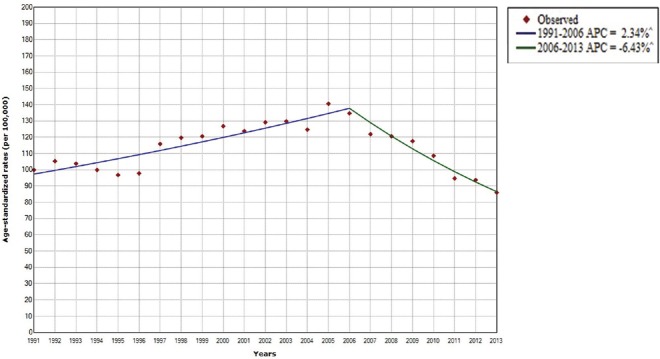
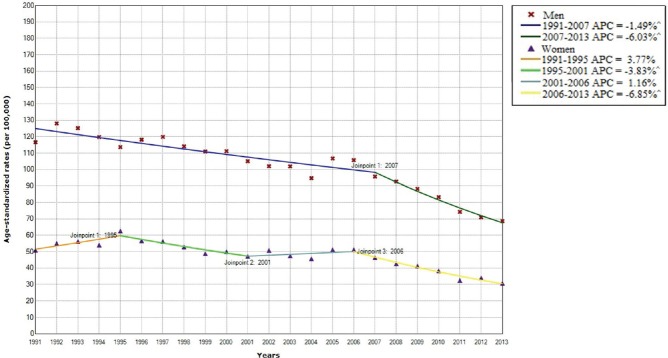
More than 253,000 people (143,420 men and 110,276 women) died due to IHD in Serbia during the observed period, and most of them (over 160,000 people) were patients with myocardial infarction (MI). Average annual ASR for IHD was 113.6/100,000. There was no overall significant trend for mortality due to IHD (AAPC=+0.1%, 95% CI -0.8-1.0), but there was one joinpoint: the trend significantly increased by +2.3 per cent per year from 1991 to 2006 and then significantly decreased by -6.4 per cent from 2006 to onwards. Significantly decreased mortality trends for MI in both genders were observed: according to the comparability test, mortality trends in men and women were parallel (final selected model failed to reject parallelism, P=0.0567).
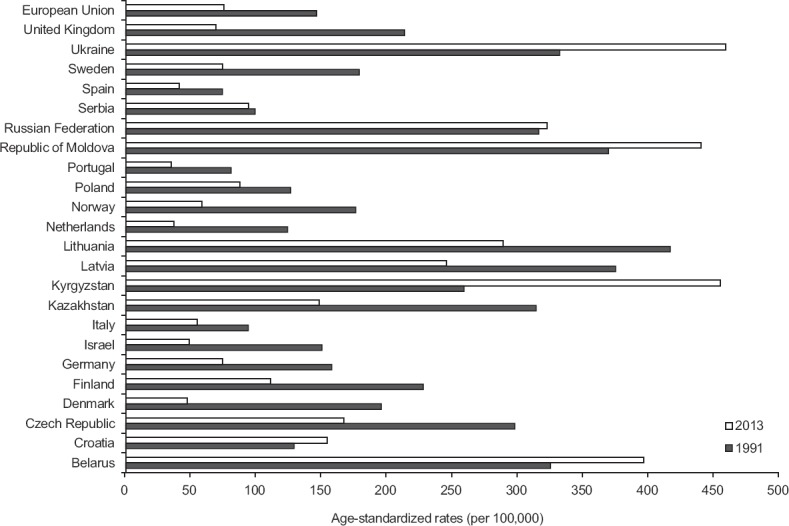
INTERPRETATION & CONCLUSIONS: No significant trend for mortality due to IHD was observed in Serbia during the study period. The substantial decline of mortality from IHD seen in most developed countries during the past decades was not observed in Serbia. Further efforts are required to reduce mortality from IHD in Serbian population.
缺血性心脏病(IHD)一直是全球主要的死亡原因之一。在许多欧洲国家,IHD 死亡率迅速上升。本研究旨在评估塞尔维亚的 IHD 死亡率趋势。
本研究基于官方数据进行了一项基于人群的横断面研究,分析了 1991 年至 2013 年期间塞尔维亚的 IHD 死亡率。使用直接法根据欧洲标准人口计算年龄标准化率(ASR,每 10 万人)。使用 Joinpoint 分析估计平均年变化百分比(AAPC)及其相应的 95%置信区间(CI)。
在观察期间,塞尔维亚有超过 253000 人(143420 名男性和 110276 名女性)死于 IHD,其中大多数(超过 160000 人)为心肌梗死(MI)患者。IHD 的平均年 ASR 为 113.6/10 万人。IHD 死亡率总体无显著趋势(AAPC=+0.1%,95%CI-0.8-1.0),但有一个联合点:1991 年至 2006 年,趋势每年显著增加+2.3%,然后从 2006 年开始显著下降-6.4%。两性的 MI 死亡率均呈显著下降趋势:根据可比性检验,男性和女性的死亡率趋势平行(最终选择的模型未能拒绝平行性,P=0.0567)。
在研究期间,塞尔维亚的 IHD 死亡率没有显著趋势。在过去几十年中,大多数发达国家的 IHD 死亡率显著下降,但在塞尔维亚没有观察到这种情况。需要进一步努力降低塞尔维亚人口的 IHD 死亡率。