Institute of Environmental Medicine, Karolinska Institutet, Stockholm, Sweden.
Institute for Risk Assessment Sciences (IRAS), Utrecht University, Utrecht, The Netherlands.
Environ Health Perspect. 2018 Apr 12;126(4):047005. doi: 10.1289/EHP2738.
The role of tobacco smoke exposure in the development and persistence of asthma and rhinoconjunctivitis through childhood into adolescence is unclear.
We assessed the associations of parental smoking from fetal life through adolescence with asthma and rhinoconjunctivitis during childhood and adolescence.
We analyzed data for 10,860 participants of five European birth cohort studies from the Mechanisms of the Development of Allergy (MeDALL) consortium. Parental smoking habits and health outcomes (early transient, persistent, and adolescent-onset asthma and rhinoconjunctivitis) were based on questionnaires covering the period from pregnancy to 14-16 y of age. Data were combined and analyzed using a one-stage and two-stage individual participant data meta-analysis.
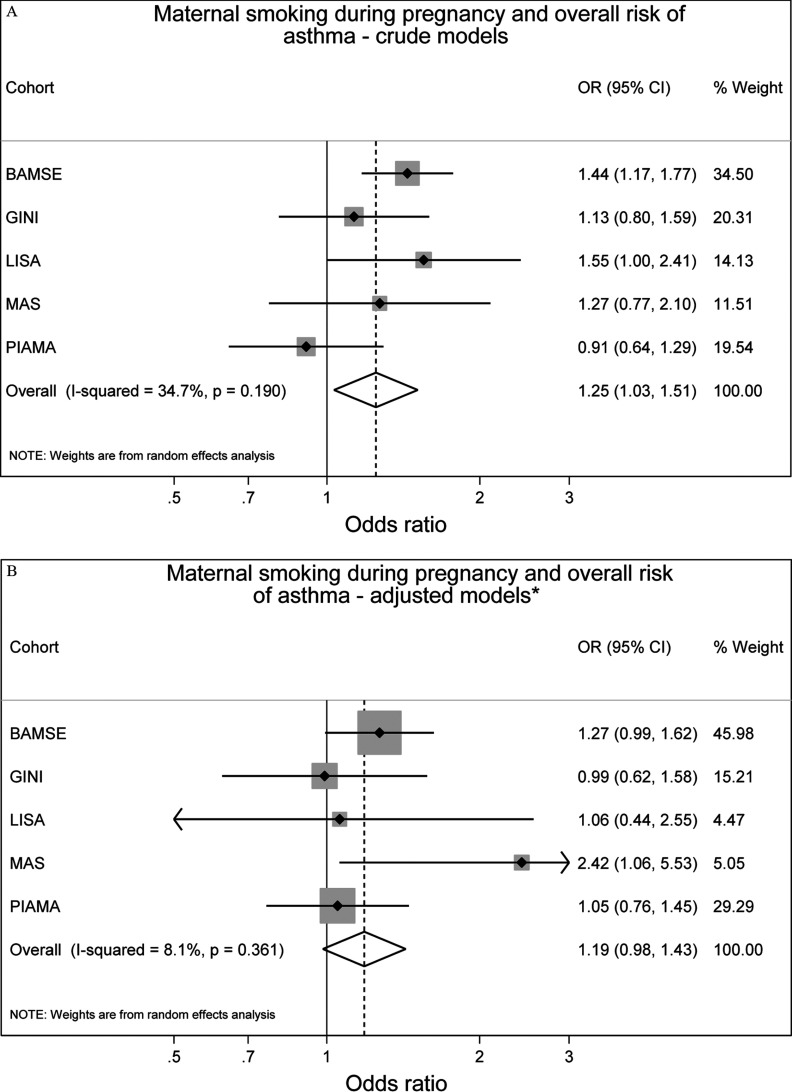
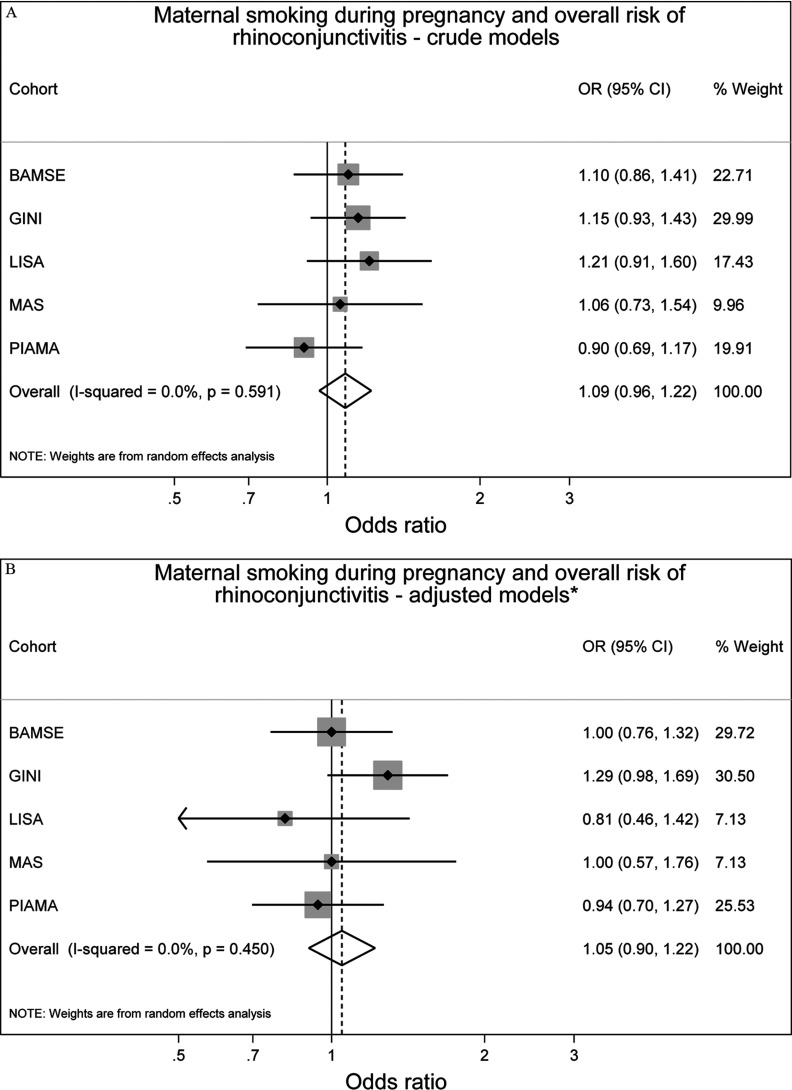
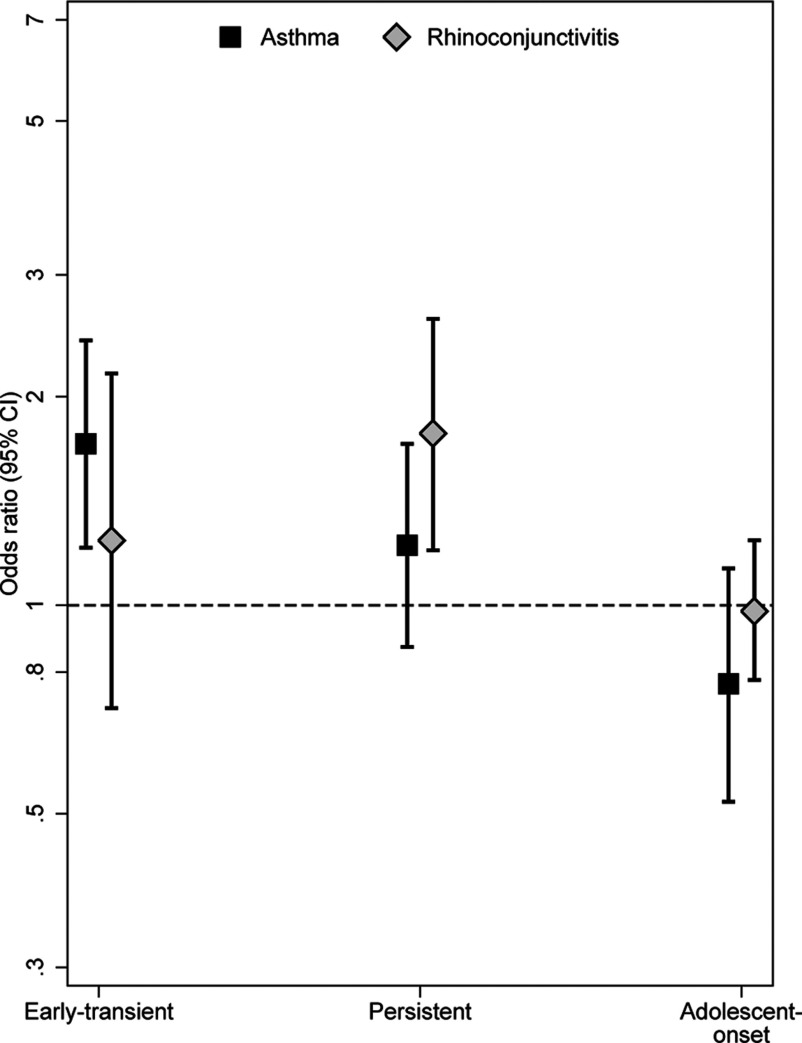
Overall, any maternal smoking during pregnancy tended to be associated with an increased odds of prevalent asthma [adjusted odds ratio (aOR)=1.19 (95% CI: 0.98, 1.43)], but not prevalent rhinoconjunctivitis [aOR=1.05 (95% CI: 0.90, 1.22)], during childhood and adolescence. In analyses with phenotypes related to age of onset and persistence of disease, any maternal smoking during pregnancy was associated with early transient asthma [aOR=1.79 (95% CI: 1.14, 2.83)]. Maternal smoking of ≥10 cigarettes/day during pregnancy was associated with persistent asthma [aOR=1.66 (95% CI: 1.29, 2.15)] and persistent rhinoconjunctivitis [aOR=1.55 (95% CI, 1.09, 2.20)]. Tobacco smoke exposure during fetal life, infancy, childhood, and adolescence was not associated with adolescent-onset asthma or rhinoconjunctivitis.
Findings from this combined analysis of five European birth cohorts strengthen evidence linking early exposure to tobacco smoke with asthma during childhood and adolescence. Children with high early-life exposure were more likely than unexposed children to have early transient and persistent asthma and persistent rhinoconjunctivitis. https://doi.org/10.1289/EHP2738.
目前,尚不清楚胎儿期至青春期期间接触烟草烟雾对儿童期和青春期哮喘和鼻结膜炎的发展和持续存在的作用。
我们评估了从胎儿期到青春期父母吸烟与儿童期和青春期哮喘和鼻结膜炎的相关性。
我们分析了过敏机制(MeDALL)研究联盟五个欧洲出生队列研究的 10860 名参与者的数据。父母吸烟习惯和健康结局(早期一过性、持续性和青少年起病的哮喘和鼻结膜炎)基于涵盖从怀孕到 14-16 岁的调查问卷。通过使用一阶和两阶段个体参与者数据荟萃分析来合并和分析数据。
总体而言,母亲怀孕期间任何吸烟均与儿童期和青春期常见哮喘的患病风险增加相关(校正优势比[aOR]为 1.19[95%CI:0.98,1.43]),但与常见鼻结膜炎无关[aOR=1.05(95%CI:0.90,1.22)])。在与疾病发病年龄和持续时间相关的表型分析中,母亲怀孕期间任何吸烟均与早期一过性哮喘相关[aOR=1.79(95%CI:1.14,2.83)]。母亲怀孕期间每天吸烟≥10 支与持续性哮喘相关[aOR=1.66(95%CI:1.29,2.15)]和持续性鼻结膜炎相关[aOR=1.55(95%CI,1.09,2.20)]。胎儿期、婴儿期、儿童期和青春期的烟草烟雾暴露与青少年起病的哮喘或鼻结膜炎无关。
这项对五个欧洲出生队列的联合分析结果加强了早期接触烟草烟雾与儿童期和青春期哮喘之间的关联证据。与未暴露的儿童相比,高早期暴露的儿童更有可能患有早期一过性和持续性哮喘以及持续性鼻结膜炎。https://doi.org/10.1289/EHP2738.