Department of Orthopaedic Surgery, Graduate School of Medical Sciences, Kyushu University, Fukuoka, Japan.
Department of Orthopaedic Surgery, Saga-Ken Medical Center, Saga, Japan.
PLoS One. 2018 Apr 17;13(4):e0195946. doi: 10.1371/journal.pone.0195946. eCollection 2018.
The aim of this study was to investigate the clinicopathologic features of lumbar disc herniation (LDH) with endplate degeneration and the association between cartilaginous fragments and inflammatory response to the herniated disc.
LDH often involves hyaline cartilage fragments pulled from the vertebral endplates. Modic changes are closely associated with LDH that contains hyaline cartilage, and cartilaginous endplates seem to affect resorption of the herniated disc.
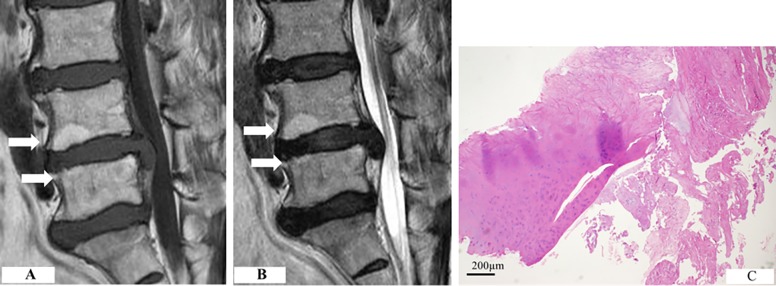
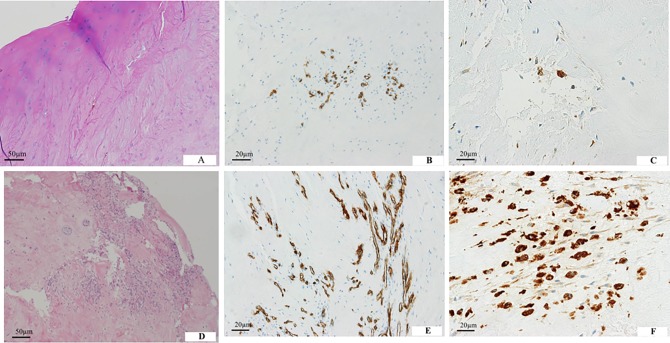
A total of 78 patients who underwent microscopic discectomy between 9 and 16 weeks after an occurrence of LDH were reviewed. Modic changes, disc degeneration, high-intensity zone, and vertebral corner defect were evaluated using magnetic resonance imaging (MRI). Histopathological observations of cartilaginous endplates and inflamed granulation tissue in the herniated disc were made. In cases with inflamed granulation tissue, neovascularization and macrophage infiltration were also evaluated using immunohistochemical analysis.
Modic changes were observed in approximately one-third of the patients (26 cases: type 1, 7; type 2, 17; and type 3, 2). Cartilaginous endplates were observed in 32 cases (41%) and in the majority of cases with Modic changes compared with cases without Modic changes (65%, p = 0.001). Although inflamed granulation tissue was observed in 60 cases (77%), no significant differences were detected in patient age and the composition of the herniated material. Immunohistochemical analysis showed that fewer CD34-positive capillaries and CD68-positive cells were found in cases with cartilaginous fragments compared with those without cartilaginous fragments (p < 0.001). In addition, a higher immunoreactivity to CD34 and CD68 was found in herniated discs <25% of whose area was occupied by cartilaginous endplates compared with discs whose area was occupied at 25% or more (p < 0.001).
There is an association between LDH with endplate degeneration and cartilaginous herniation, with Modic type 2 predominating. Furthermore, neovascularization and macrophage infiltration, especially if the amount of cartilage is high, are likely to be less frequent in cartilaginous herniation, leading to failure in the spontaneous remission of clinical symptoms.
本研究旨在探讨伴有终板退变的腰椎间盘突出症(LDH)的临床病理特征,以及软骨碎片与椎间盘突出物炎症反应之间的关系。
LDH 常伴有从椎体终板拉出的透明软骨碎片。终板的 Modic 改变与含有透明软骨的 LDH 密切相关,软骨终板似乎影响椎间盘的吸收。
回顾了 78 例在 LDH 发生后 9 至 16 周接受显微镜下椎间盘切除术的患者。使用磁共振成像(MRI)评估 Modic 改变、椎间盘退变、高信号区和椎体角缺损。对椎间盘突出物中的软骨终板和炎症肉芽组织进行组织病理学观察。在有炎症肉芽组织的病例中,还通过免疫组织化学分析评估新血管形成和巨噬细胞浸润。
约三分之一的患者(26 例:1 型 7 例,2 型 17 例,3 型 2 例)存在 Modic 改变。观察到软骨终板 32 例(41%),与无 Modic 改变的病例相比,多数病例存在 Modic 改变(65%,p = 0.001)。虽然有 60 例(77%)观察到炎症肉芽组织,但患者年龄和椎间盘突出物的组成无显著差异。免疫组织化学分析显示,与无软骨碎片的病例相比,有软骨碎片的病例中 CD34 阳性毛细血管和 CD68 阳性细胞较少(p < 0.001)。此外,在软骨终板所占面积<25%的椎间盘与所占面积 25%或以上的椎间盘相比,CD34 和 CD68 的免疫反应更高(p < 0.001)。
伴有终板退变和软骨突出的 LDH 与软骨突出之间存在关联,其中以 Modic 2 型为主。此外,新血管形成和巨噬细胞浸润,尤其是软骨量较高时,在软骨突出中可能不太频繁,导致临床症状的自发缓解失败。