Valdespino-Castillo Patricia M, Hu Ping, Merino-Ibarra Martín, López-Gómez Luz M, Cerqueda-García Daniel, González-De Zayas Roberto, Pi-Puig Teresa, Lestayo Julio A, Holman Hoi-Ying, Falcón Luisa I
Climate and Ecosystem Sciences Division, Lawrence Berkeley National Laboratory, University of California, Berkeley, Berkeley, CA, United States.
Unidad Académica de Ecología y Biodiversidad Acuática, Instituto de Ciencias del Mar y Limnología, Universidad Nacional Autónoma de México, Mexico City, Mexico.
Front Microbiol. 2018 Apr 3;9:510. doi: 10.3389/fmicb.2018.00510. eCollection 2018.
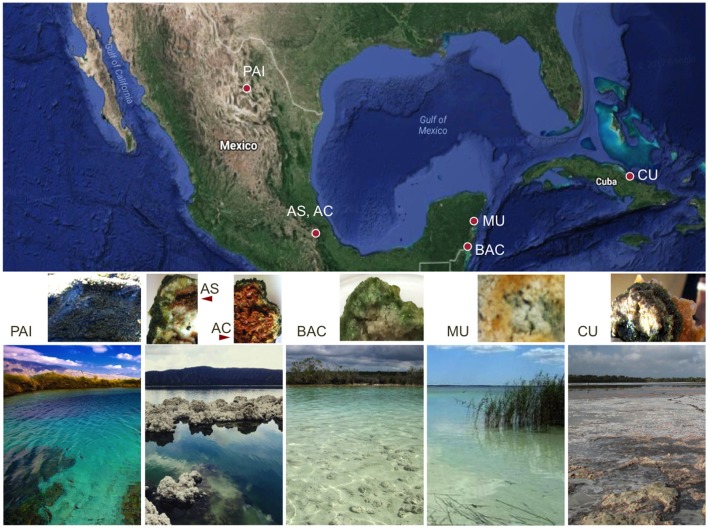
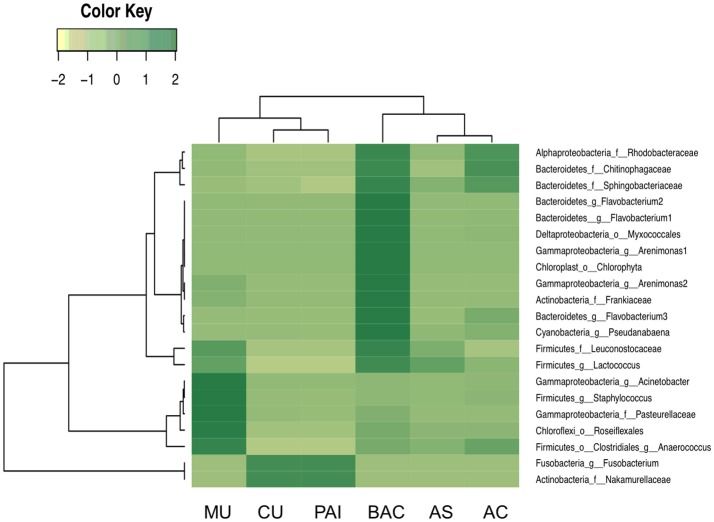
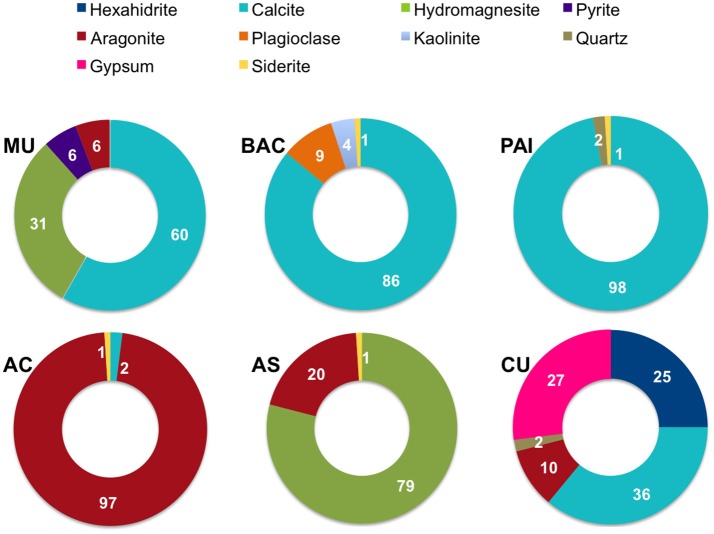
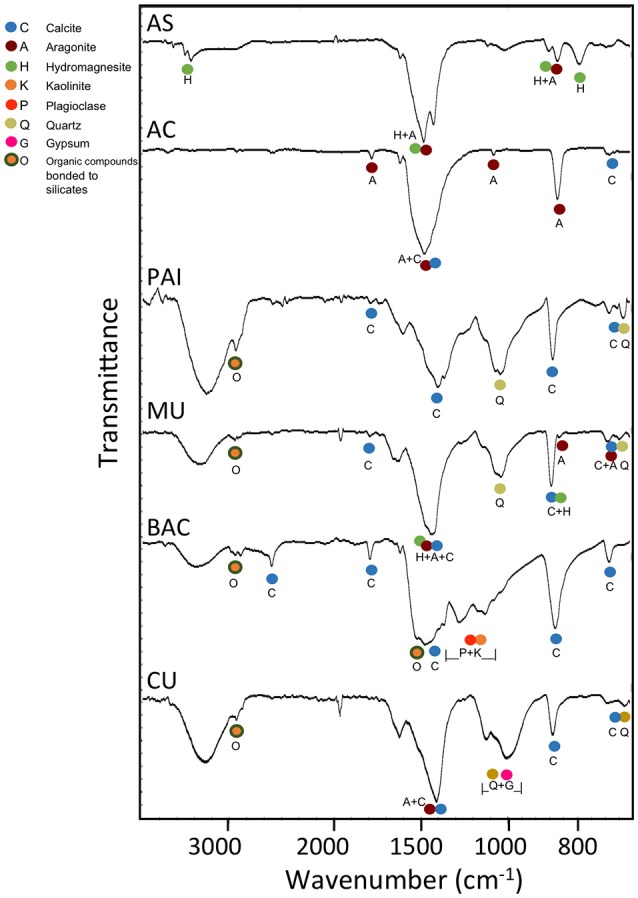
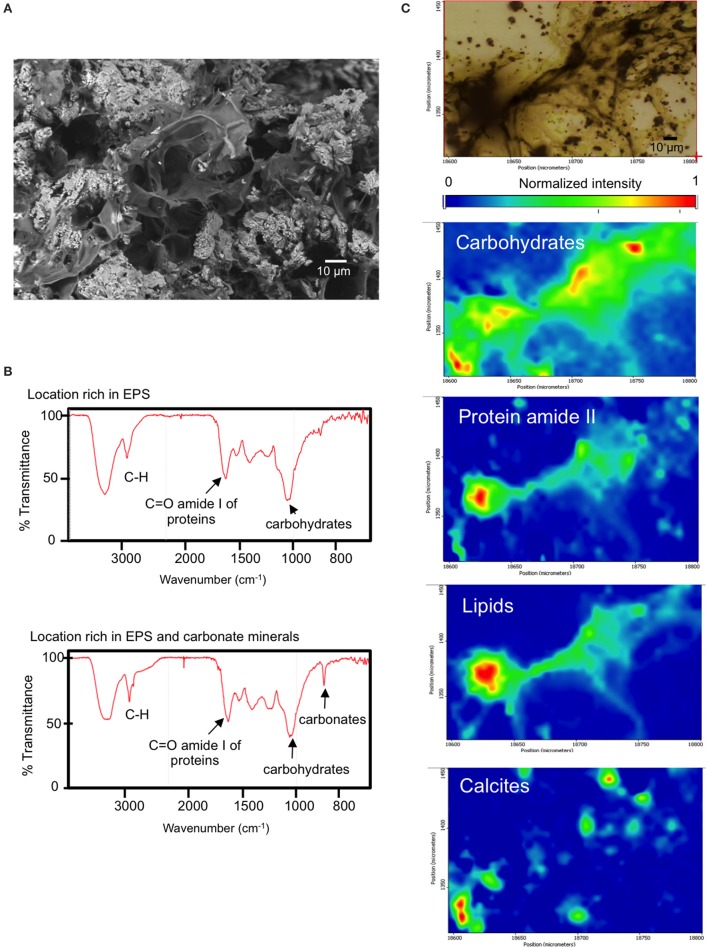
Microbialites are modern analogs of ancient microbial consortia that date as far back as the Archaean Eon. Microbialites have contributed to the geochemical history of our planet through their diverse metabolic capacities that mediate mineral precipitation. These mineral-forming microbial assemblages accumulate major ions, trace elements and biomass from their ambient aquatic environments; their role in the resulting chemical structure of these lithifications needs clarification. We studied the biogeochemistry and microbial structure of microbialites collected from diverse locations in Mexico and in a previously undescribed microbialite in Cuba. We examined their structure, chemistry and mineralogy at different scales using an array of nested methods including 16S rRNA gene high-throughput sequencing, elemental analysis, X-Ray fluorescence (XRF), X-Ray diffraction (XRD), Scanning Electron Microscopy-Energy Dispersive Spectroscopy (SEM-EDS), Fourier Transformed Infrared (FTIR) spectroscopy and Synchrotron Radiation-based Fourier Transformed Infrared (SR-FTIR) spectromicroscopy. The resulting data revealed high biological and chemical diversity among microbialites and specific microbe to chemical correlations. Regardless of the sampling site, Proteobacteria had the most significant correlations with biogeochemical parameters such as organic carbon (C), nitrogen and C:Ca ratio. Biogeochemically relevant bacterial groups (dominant phototrophs and heterotrophs) showed significant correlations with major ion composition, mineral type and transition element content, such as cadmium, cobalt, chromium, copper and nickel. Microbial-chemical relationships were discussed in reference to microbialite formation, microbial metabolic capacities and the role of transition elements as enzyme cofactors. This paper provides an analytical baseline to drive our understanding of the links between microbial diversity with the chemistry of their lithified precipitations.
微生物岩是可追溯到太古宙的古代微生物群落的现代类似物。微生物岩凭借其介导矿物沉淀的多样代谢能力,对我们星球的地球化学历史产生了影响。这些形成矿物的微生物组合从周围水生环境中积累主要离子、微量元素和生物质;它们在这些石化产物的化学结构中所起的作用尚需阐明。我们研究了从墨西哥不同地点以及古巴一处此前未描述过的微生物岩采集的微生物岩的生物地球化学和微生物结构。我们使用一系列嵌套方法,包括16S rRNA基因高通量测序、元素分析、X射线荧光光谱(XRF)、X射线衍射(XRD)、扫描电子显微镜-能谱仪(SEM-EDS)、傅里叶变换红外光谱(FTIR)以及基于同步辐射的傅里叶变换红外光谱显微镜(SR-FTIR),在不同尺度上研究了它们的结构、化学性质和矿物学。所得数据揭示了微生物岩之间高度的生物和化学多样性以及特定微生物与化学性质之间的相关性。无论采样地点如何,变形菌门与生物地球化学参数如有机碳(C)、氮以及C:Ca比值的相关性最为显著。与生物地球化学相关的细菌类群(主要的光合生物和异养生物)与主要离子组成、矿物类型以及过渡元素含量(如镉、钴、铬、铜和镍)显示出显著相关性。我们结合微生物岩的形成、微生物代谢能力以及过渡元素作为酶辅因子的作用,讨论了微生物与化学之间的关系。本文提供了一个分析基线,以推动我们对微生物多样性与其石化沉淀化学性质之间联系的理解。