Vanoni Federica, Federici Silvia, Antón Jordi, Barron Karyl S, Brogan Paul, De Benedetti Fabrizio, Dedeoglu Fatma, Demirkaya Erkan, Hentgen Veronique, Kallinich Tilmann, Laxer Ronald, Russo Ricardo, Toplak Natasa, Uziel Yosef, Martini Alberto, Ruperto Nicolino, Gattorno Marco, Hofer Michael
Department of Pediatrics, Ospedale San Giovanni, 6500, Bellinzona, Switzerland.
Unité Romande d'Immuno-rhumatologie Pédiatrique, CHUV, University of Lausanne, Lausanne, and HUG, Geneva, Switzerland.
Pediatr Rheumatol Online J. 2018 Apr 18;16(1):27. doi: 10.1186/s12969-018-0246-9.
Diagnosis of Periodic fever, aphthous stomatitis, pharyngitis and cervical adenitis (PFAPA) is currently based on a set of criteria proposed in 1999 modified from Marshall's criteria. Nevertheless no validated evidence based set of classification criteria for PFAPA has been established so far. The aim of this study was to identify candidate classification criteria PFAPA syndrome using international consensus formation through a Delphi questionnaire survey.
A first open-ended questionnaire was sent to adult and pediatric clinicians/researchers, asking to identify the variables thought most likely to be helpful and relevant for the diagnosis of PFAPA. In a second survey, respondents were asked to select, from the list of variables coming from the first survey, the 10 features that they felt were most important, and to rank them in descending order from most important to least important.
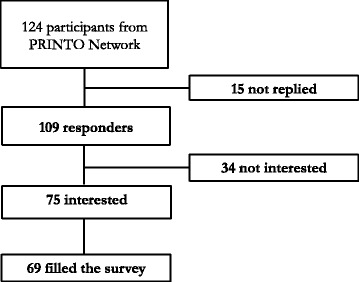
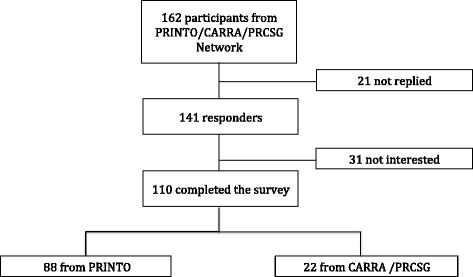
The response rate to the first and second Delphi was respectively 109/124 (88%) and 141/162 (87%). The number of participants that completed the first and second Delphi was 69/124 (56%) and 110/162 (68%). From the first Delphi we obtained a list of 92 variables, of which 62 were selected in the second Delphi. Variables reaching the top five position of the rank were regular periodicity, aphthous stomatitis, response to corticosteroids, cervical adenitis, and well-being between flares.
Our process led to identification of features that were felt to be the most important as candidate classification criteria for PFAPA by a large sample of international rheumatologists. The performance of these items will be tested further in the next phase of the study, through analysis of real patient data.
周期性发热、口疮性口炎、咽炎和颈淋巴结炎(PFAPA)的诊断目前基于1999年提出的一组标准,该标准是对马歇尔标准的修改。然而,迄今为止尚未建立经过验证的基于证据的PFAPA分类标准集。本研究的目的是通过德尔菲问卷调查,利用国际共识形成来确定PFAPA综合征的候选分类标准。
向成人和儿科临床医生/研究人员发送了第一份开放式问卷,要求他们确定最有可能有助于PFAPA诊断且与之相关的变量。在第二次调查中,要求受访者从第一次调查得出的变量列表中选择他们认为最重要的10个特征,并按从最重要到最不重要的顺序对其进行排序。
第一次和第二次德尔菲调查的回复率分别为109/124(88%)和141/162(87%)。完成第一次和第二次德尔菲调查的参与者人数分别为69/124(56%)和110/162(68%)。从第一次德尔菲调查中,我们得到了一份包含92个变量的列表,其中62个在第二次德尔菲调查中被选中。排在前五位的变量是规律的周期性、口疮性口炎、对皮质类固醇的反应、颈淋巴结炎以及发作间期的健康状况。
我们的研究过程确定了一系列特征,这些特征被大量国际风湿病学家认为是PFAPA最主要的候选分类标准。在研究的下一阶段,将通过分析真实患者数据进一步测试这些项目的性能。