Peng Cheng, Gu Liangyou, Wang Lei, Huang Qingbo, Wang Baojun, Guo Gang, Fan Yang, Gao Yu, Ma Xin, Zhang Xu
Department of Urology, State Key Laboratory of Kidney Diseases, Chinese PLA General Hospital, Chinese PLA Medical Academy, Beijing, People's Republic of China.
Department of Urology, Chinese PLA 534 Hospital, Luoyang, People's Republic of China.
Onco Targets Ther. 2018 Apr 6;11:1997-2005. doi: 10.2147/OTT.S158114. eCollection 2018.
The clinical benefit of targeted molecular therapy (TMT) in renal cell carcinoma (RCC) with an inferior vena cava (IVC) tumor thrombus remains controversial. The aim of this study was to investigate the effects of presurgical TMT on the heights and levels of IVC thrombi, and to assess its impact on surgical strategy.
We retrospectively reviewed data from 18 patients with RCC involving IVC tumor thrombi who were treated at our hospital with presurgical TMT followed by an IVC thrombectomy. The changes in heights and levels of the IVC thrombi were compared using computed tomography or magnetic resonance imaging. Clinicopathological factors were also evaluated to assess their association with TMT efficacy.
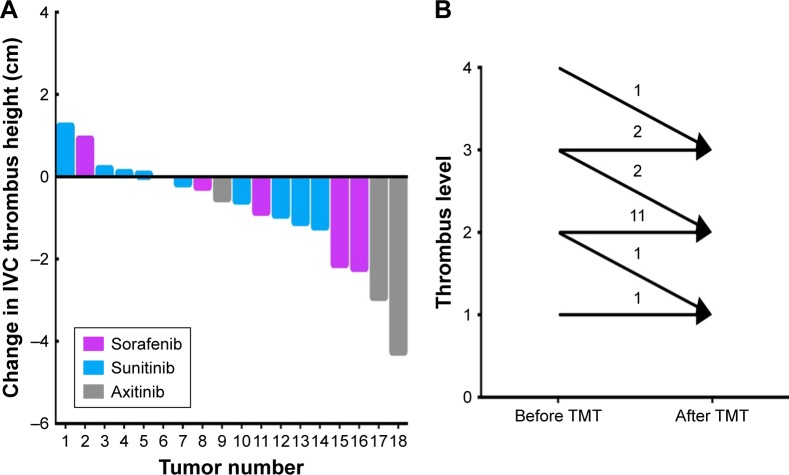
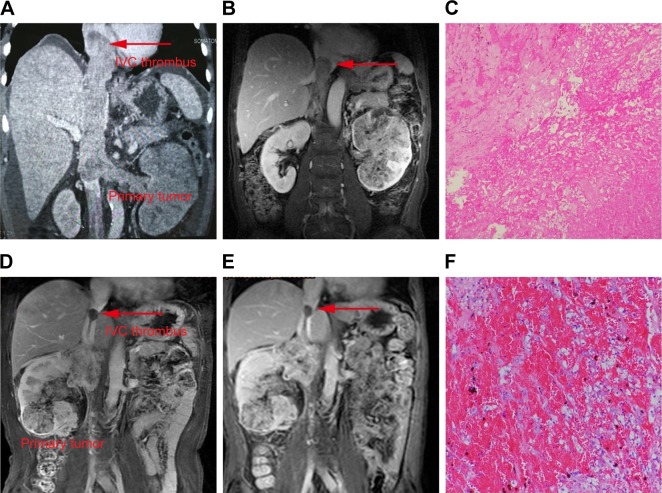
The tumor thrombus levels before TMT were stage I in 1 patient (5.6%), II in 12 patients (66.7%), III in 4 patients (22.2%), and IV in 1 patient (5.6%). After a median of two treatment cycles (range: 1-3), the thrombus height decreased measurably in 11 patients (61.1%) with an average shrinkage of 17.7%. The thrombus height remained stable in five patients (27.8%) and was enlarged in two (11.1%). Downstaging of the thrombus level occurred in four patients (22.2%); the surgical strategy was modified in three patients (16.7%) to avoid cardiopulmonary bypass and complicated liver mobilization under robot-assisted laparoscopy. Furthermore, a higher neutrophil count tended to be associated with a worse clinical TMT-associated outcome (=0.056).
Our data suggest a limited influence of presurgical TMT with a positive benefit in RCC patients with level III and IV thrombus. Thrombus-level regression may potentially alter the surgical strategy, especially robotic surgery. However, our findings require validation with additional prospective investigations.
靶向分子疗法(TMT)在伴有下腔静脉(IVC)肿瘤血栓的肾细胞癌(RCC)中的临床益处仍存在争议。本研究旨在探讨术前TMT对IVC血栓高度和水平的影响,并评估其对手术策略的影响。
我们回顾性分析了18例伴有IVC肿瘤血栓的RCC患者的数据,这些患者在我院接受了术前TMT治疗,随后进行了IVC血栓切除术。使用计算机断层扫描或磁共振成像比较IVC血栓高度和水平的变化。还评估了临床病理因素,以评估它们与TMT疗效的相关性。
TMT前肿瘤血栓水平为I期1例(5.6%),II期12例(66.7%),III期4例(22.2%),IV期1例(5.6%)。在中位两个治疗周期(范围:1 - 3个)后,11例患者(61.1%)的血栓高度明显降低,平均缩小17.7%。5例患者(27.8%)的血栓高度保持稳定,2例(11.1%)增大。4例患者(22.2%)的血栓水平降期;3例患者(16.7%)的手术策略进行了修改,以避免在机器人辅助腹腔镜下进行体外循环和复杂的肝脏游离。此外,较高的中性粒细胞计数往往与TMT相关的临床结果较差有关(P = 0.056)。
我们的数据表明,术前TMT对伴有III级和IV级血栓的RCC患者有一定影响且具有积极益处。血栓水平的消退可能会改变手术策略,尤其是机器人手术。然而,我们的研究结果需要更多前瞻性研究来验证。