Madani Fatemeh, Esnaashari Seyedeh Sara, Mujokoro Basil, Dorkoosh Farid, Khosravani Masood, Adabi Mahdi
Department of Medical Nanotechnology, School of Advanced Technologies in Medicine, Tehran University of Medical Sciences, Tehran, Iran.
Student's Scientific Research Center, Tehran University of Medical Sciences, Tehran, Iran.
Adv Pharm Bull. 2018 Mar;8(1):77-84. doi: 10.15171/apb.2018.010. Epub 2018 Mar 18.
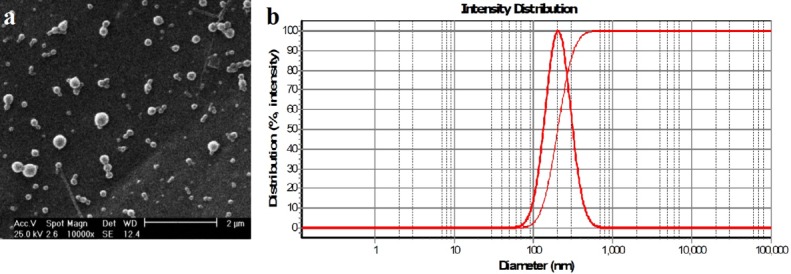
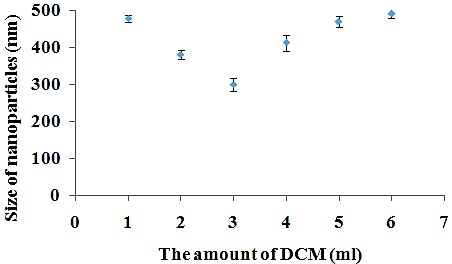
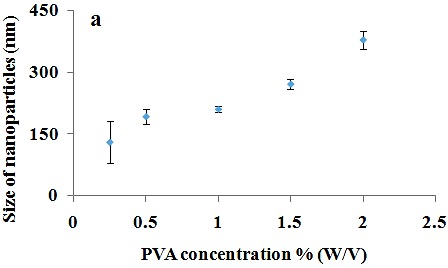
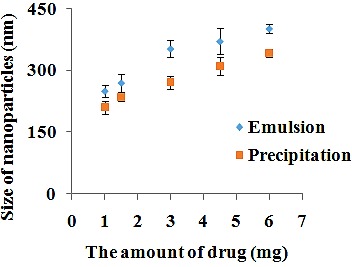
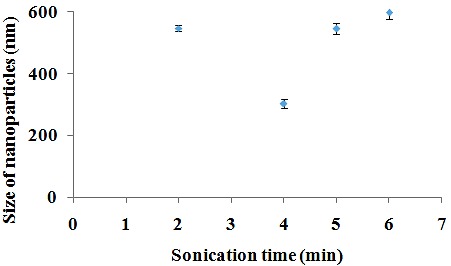
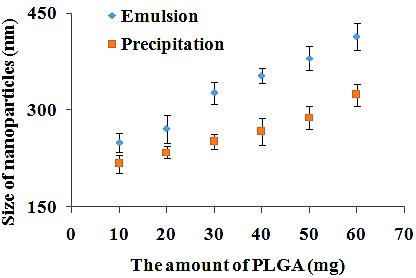
The size of polymeric nanoparticles is considered as an effective factor in cancer therapy due to enterance into tumor tissue via the EPR effect. The purpose of this work was to investigate the effective parameters on poly(lactic-co-glycolic acid)-paclitaxel (PLGA -PTX) nanoparticles size. We prepared PLGA-PTX nanoparticles via single emulsion and precipitation methods with variable paremeters including drug concentration, aqueous to organic phase volume ratio, polymer concentration, sonication time and PVA concentration. PLGA-PTX nanoparticles were characterized by dynamic light scattering (DLS) and scanning electron microscopy (SEM). The results exhibited that the diameter of nanoparticles enhanced with increasing drug, polymer and PVA concentrations whereas organic to aqueous phase volume ratio and sonication time required to the optimization for a given size. The precipitation method provides smaller nanoparticles compared to emulsion one. Variable parameters including drug concentration, aqueous to organic phase volume ratio, polymer concentration, sonication time and PVA concentration affect diameter of nanoparticles.
由于聚合物纳米颗粒可通过增强渗透滞留(EPR)效应进入肿瘤组织,其尺寸被认为是癌症治疗中的一个有效因素。本研究的目的是探究影响聚乳酸-乙醇酸共聚物-紫杉醇(PLGA-PTX)纳米颗粒尺寸的有效参数。我们通过单乳液法和沉淀法制备了PLGA-PTX纳米颗粒,所采用的可变参数包括药物浓度、水相/有机相体积比、聚合物浓度、超声处理时间和聚乙烯醇(PVA)浓度。通过动态光散射(DLS)和扫描电子显微镜(SEM)对PLGA-PTX纳米颗粒进行了表征。结果显示,纳米颗粒的直径随着药物、聚合物和PVA浓度的增加而增大,而有机相/水相体积比和超声处理时间则需要针对特定尺寸进行优化。与乳液法相比,沉淀法可提供尺寸更小的纳米颗粒。药物浓度、水相/有机相体积比、聚合物浓度、超声处理时间和PVA浓度等可变参数会影响纳米颗粒的直径。