Global Development, Novo Nordisk A/S, Bagsvaerd, Denmark.
Clin Pharmacokinet. 2019 Jan;58(1):63-75. doi: 10.1007/s40262-018-0662-5.
Somapacitan, a long-acting growth hormone (GH) derivative, has been well-tolerated in children with GH deficiency (GHD) and adults (healthy and adult GHD), in phase I, single- and multiple-dose trials, respectively, and has pharmacokinetic and pharmacodynamic properties supporting a once-weekly dosing regimen.
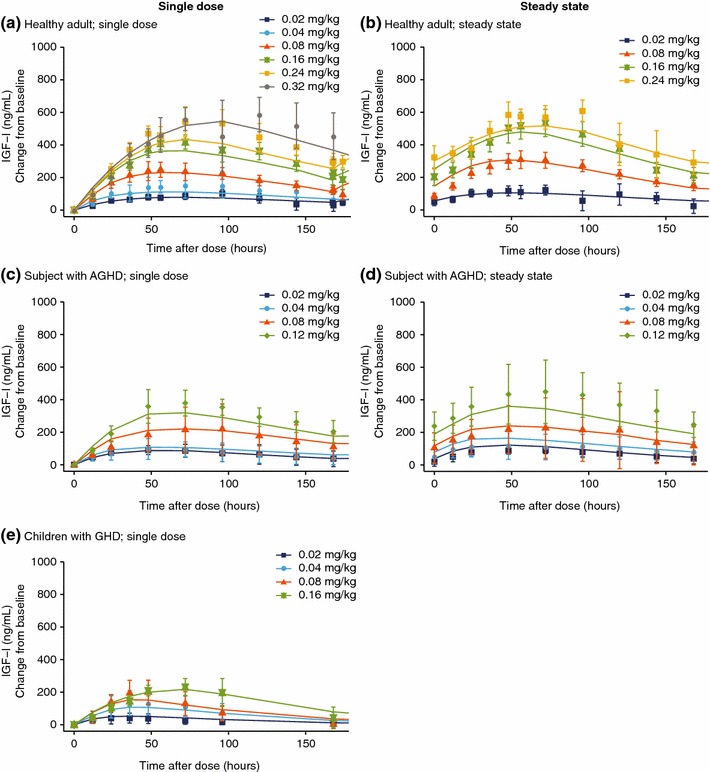
In the absence of a multiple-dose phase I trial in children with GHD, the aim was to develop a pharmacokinetic/pharmacodynamic model to predict somapacitan exposure and insulin-like growth factor-I (IGF-I) response after once-weekly multiple doses in both children and adults with GHD.
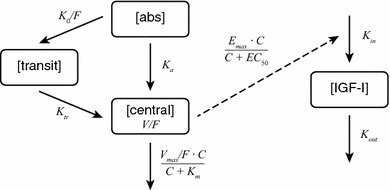
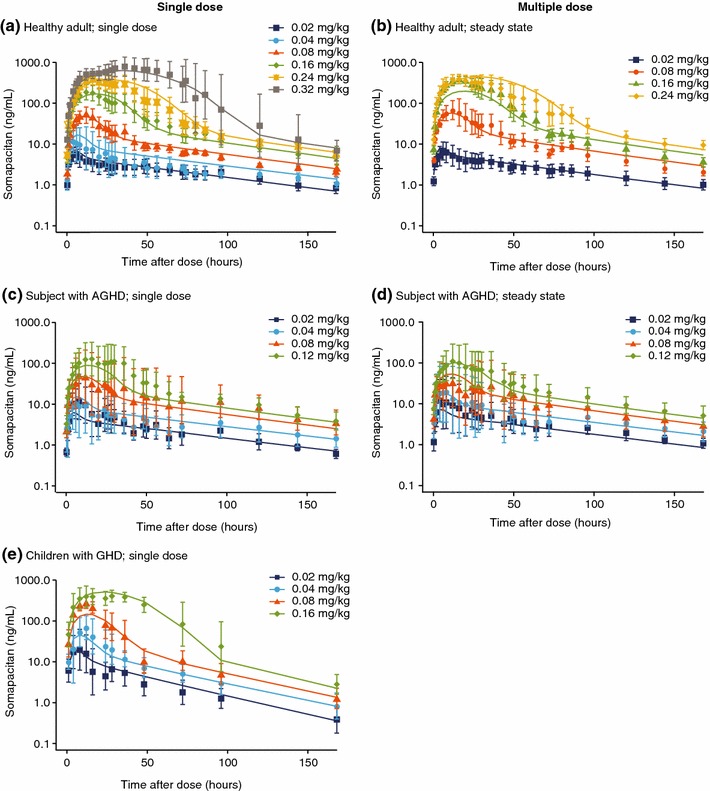
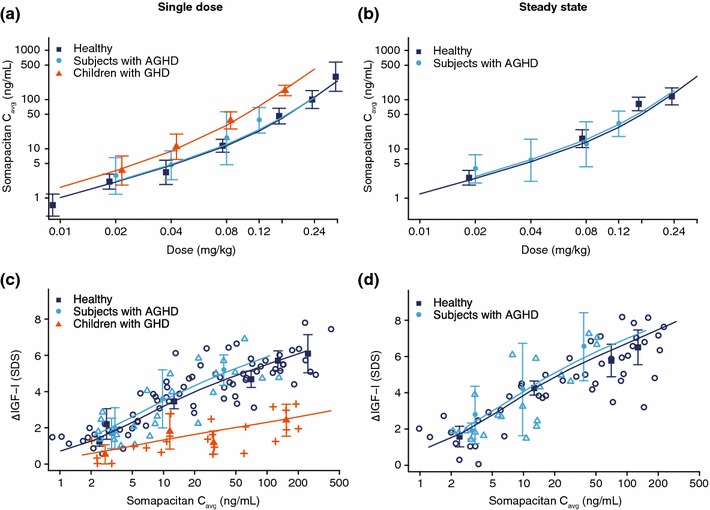
Pharmacokinetic/pharmacodynamic models were developed from pharmacokinetic and IGF-I profiles in three phase I trials of somapacitan (doses: healthy adults, 0.01-0.32 mg/kg; adult with GHD, 0.02-0.12 mg/kg; children with GHD, 0.02-0.16 mg/kg) using non-linear mixed-effects modeling. Pharmacokinetics were described using a non-linear one-compartment model with dual first- and zero-order absorption through a transit compartment, with saturable elimination. IGF-I profiles were described using an indirect response pharmacokinetic/pharmacodynamic model, with sigmoidal-effect relationship.
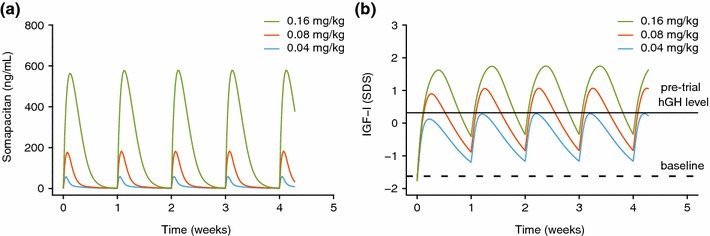
The non-linear pharmacokinetic and IGF-I data were well-described in order to confidently predict pharmacokinetic/pharmacodynamic profiles after multiple doses in adults and children with GHD. Body weight was found to be a significant covariate, predictive of the differences observed in the pharmacokinetics and pharmacodynamics between children and adults. Weekly dosing of somapacitan provided elevated IGF-I levels throughout the week, despite little or no accumulation of somapacitan, in both adults and children with GHD.
This analysis of somapacitan pharmacokinetic/pharmacodynamic data supports once-weekly dosing in adults and children with GHD.
ClinicalTrials.gov identifier numbers NCT01514500, NCT01706783, NCT01973244.
长效生长激素(GH)衍生物索马帕肽在 GH 缺乏症(GHD)儿童和成人(健康和成人 GHD)的 I 期单剂量和多剂量试验中均具有良好的耐受性,且具有支持每周一次给药方案的药代动力学和药效学特征。
由于缺乏 GHD 儿童的多剂量 I 期试验,本研究旨在建立一个药代动力学/药效学模型,以预测 GHD 儿童和成人每周一次多次给药后索马帕肽的暴露量和胰岛素样生长因子-I(IGF-I)反应。
使用非线性混合效应模型,从索马帕肽三项 I 期试验的药代动力学和 IGF-I 谱中(剂量:健康成人 0.01-0.32mg/kg;成人 GHD 0.02-0.12mg/kg;儿童 GHD 0.02-0.16mg/kg)建立药代动力学/药效学模型。药代动力学采用非线性一室模型加通过转运室的双一级和零级吸收进行描述,具有饱和消除。IGF-I 谱采用间接反应药代动力学/药效学模型进行描述,具有 S 型效应关系。
该非线性药代动力学和 IGF-I 数据得到了很好的描述,以便能够有信心地预测 GHD 成人和儿童多次给药后的药代动力学/药效学特征。体重被发现是一个重要的协变量,可预测儿童和成人之间药代动力学和药效学的差异。每周一次给予索马帕肽,尽管索马帕肽几乎没有或没有蓄积,仍能在 GHD 成人和儿童中整个星期内升高 IGF-I 水平。
对索马帕肽药代动力学/药效学数据的分析支持 GHD 成人和儿童每周一次给药。
ClinicalTrials.gov 标识符编号 NCT01514500、NCT01706783、NCT01973244。