Center for Systems and Computational Biology, Rutgers Cancer Institute of New Jersey, Rutgers the State University of New Jersey. New Brunswick, NJ 08901, USA.
Nucleic Acids Res. 2018 May 18;46(9):4370-4381. doi: 10.1093/nar/gky271.
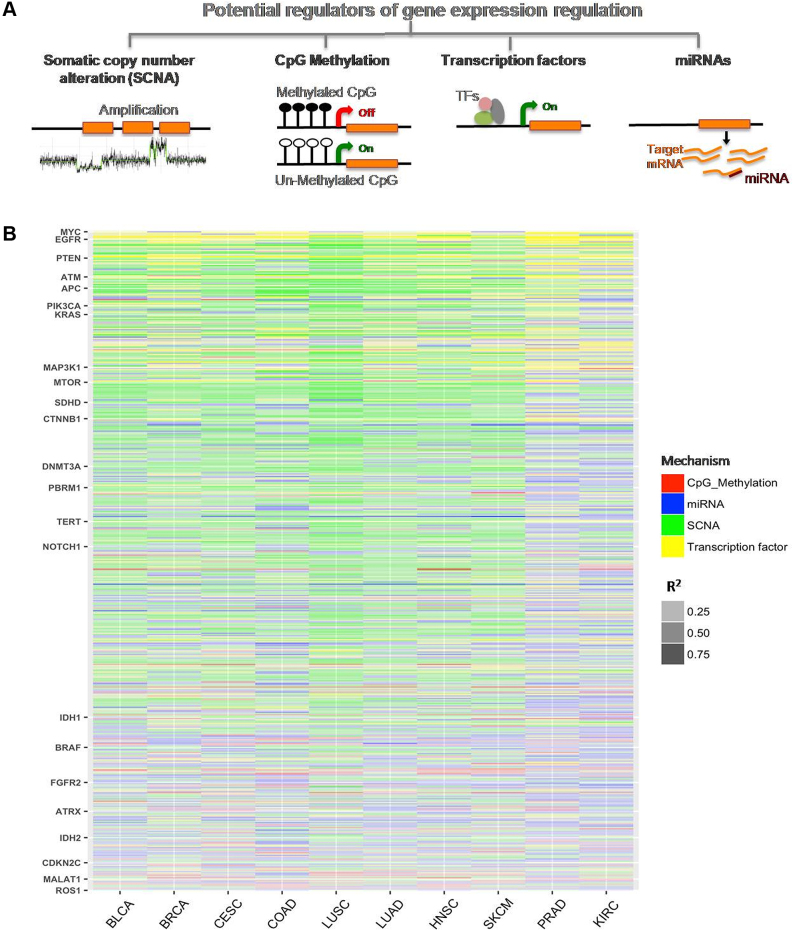
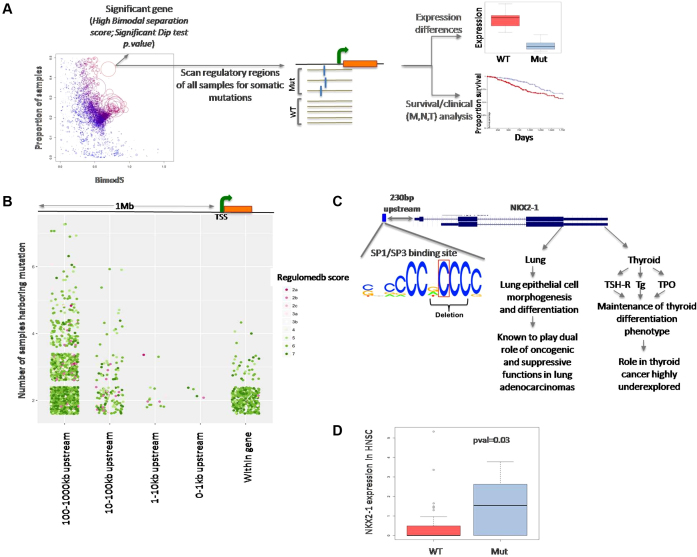
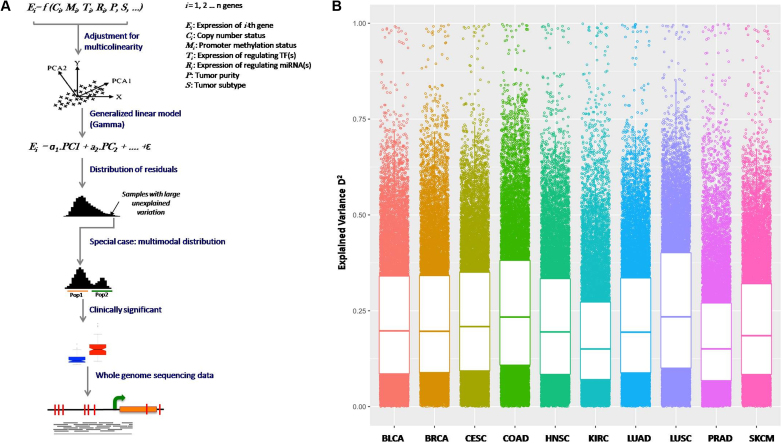
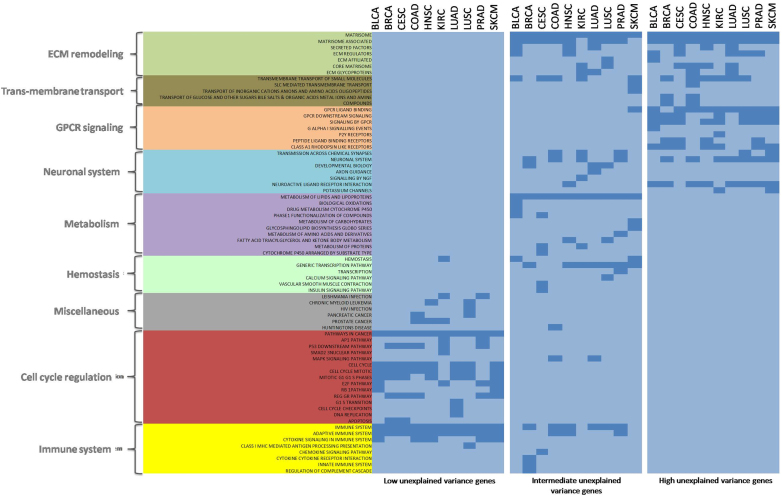
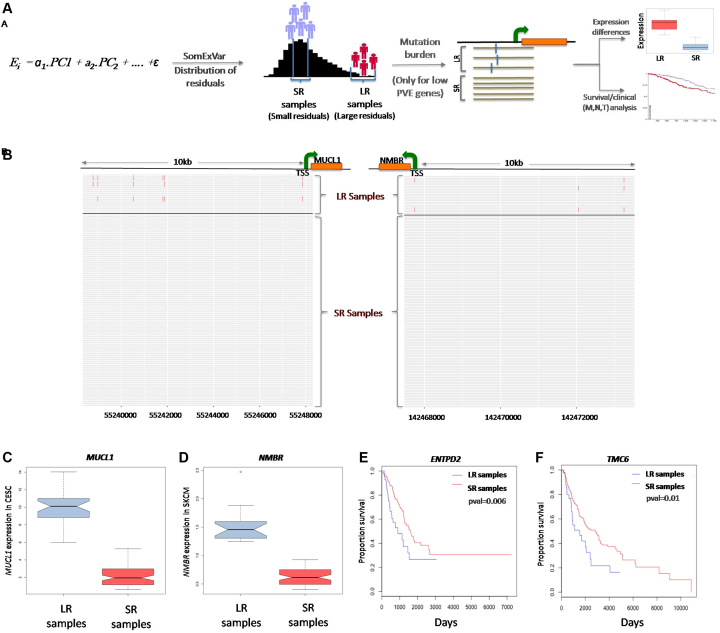
Although the catalog of cancer-associated mutations in protein-coding regions is nearly complete for all major cancer types, an assessment of regulatory changes in cancer genomes and their clinical significance remain largely preliminary. Adopting bottom-up approach, we quantify the effects of different sources of gene expression variation in a cohort of 3899 samples from 10 cancer types. We find that copy number alterations, epigenetic changes, transcription factors and microRNAs collectively explain, on average, only 31-38% and 18-26% expression variation for cancer-associated and other genes, respectively, and that among these factors copy number alteration has the highest effect. We show that the genes with systematic, large expression variation that could not be attributed to these factors are enriched for pathways related to cancer hallmarks. Integrating whole genome sequencing data and focusing on genes with systematic expression variation we identify novel, recurrent regulatory mutations affecting known cancer genes such as NKX2-1 and GRIN2D in multiple cancer types. Nonetheless, at a genome-wide scale proportions of gene expression variation attributed to recurrent point mutations appear to be modest so far, especially when compared to that attributed to copy number changes - a pattern different from that observed for other complex diseases and traits. We suspect that, owing to plasticity and redundancy in biological pathways, regulatory alterations show complex combinatorial patterns, modulating gene expression in cancer genomes at a finer scale.
尽管在所有主要癌症类型中,蛋白质编码区域的癌症相关突变目录几乎已经完成,但对癌症基因组中调节变化及其临床意义的评估仍在很大程度上处于初步阶段。我们采用自下而上的方法,在来自 10 种癌症类型的 3899 个样本的队列中量化了不同来源的基因表达变异的影响。我们发现,平均而言,拷贝数改变、表观遗传变化、转录因子和 microRNAs 共同解释了与癌症相关和其他基因的表达变异分别为 31-38%和 18-26%,并且在这些因素中,拷贝数改变的影响最高。我们表明,这些因素无法解释的系统性、大规模表达变异的基因富集了与癌症标志相关的途径。整合全基因组测序数据并专注于具有系统性表达变异的基因,我们在多种癌症类型中确定了影响已知癌症基因(如 NKX2-1 和 GRIN2D)的新型、反复出现的调节突变。尽管如此,到目前为止,与拷贝数变化相比,归因于反复点突变的基因表达变异比例似乎相当适中——这与其他复杂疾病和特征观察到的模式不同。我们怀疑,由于生物途径的可塑性和冗余性,调节变化表现出复杂的组合模式,以更精细的尺度调节癌症基因组中的基因表达。