1 Dr Suat Seren Chest Diseases and Thoracic Surgery Training and Research Hospital, Pulmonary Rehabilitation Unit, Izmir, Turkey.
2 Department of Physiotherapy and Rehabilitation, Faculty of Health Sciences, Izmir Katip Celebi University, Izmir, Turkey.
Chron Respir Dis. 2018 Nov;15(4):411-418. doi: 10.1177/1479972318767206. Epub 2018 Apr 19.
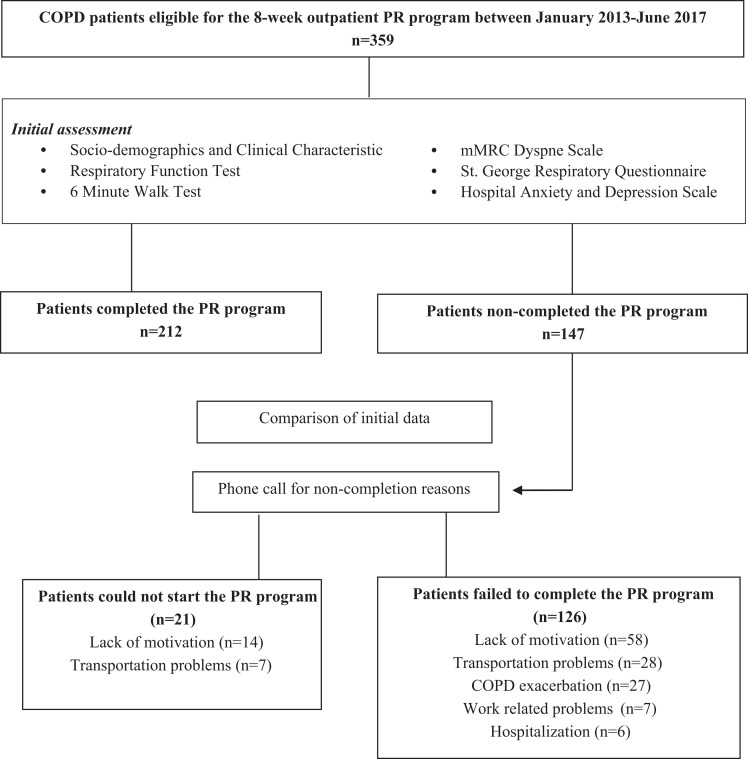
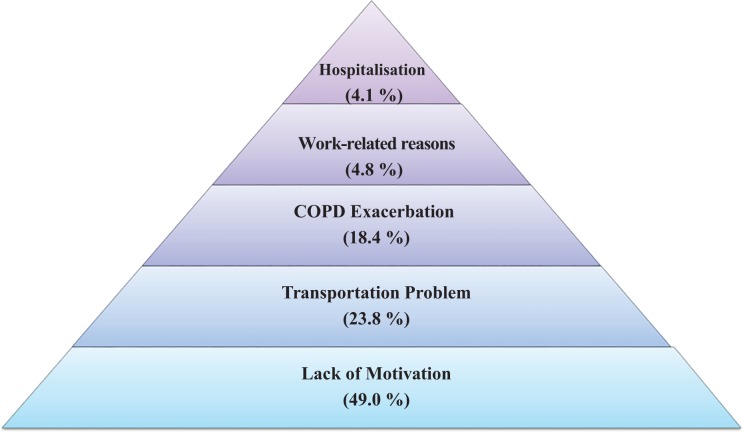
This study aims to compare demographic and clinical characteristics of chronic obstructive pulmonary disease (COPD) patients who complete and fail to complete outpatient pulmonary rehabilitation (PR) program and to determine the reasons for not completing the program. Patients with COPD referred to the PR program were divided into two groups: Those who completed the program were classified as group 1 and those who did not complete were classified as group 2, and their data were compared. Patients who failed to complete the program were contacted through phone and asked why they ceased their participation in the program. In group 2, number of smoker patients and patients using nebulizer and receiving long-term oxygen treatment, emergency admissions, and dyspnea perception were higher ( p = 0.003, p < 0.001, p = 0.033, p = 0.011, p < 0.001, respectively); forced expiratory volume in one second (%) value, exercise capacity, and quality of life were lower ( p = 0.024, p = 0.001, p = 0.014, respectively). When considered from the sociodemographic perspective, group 2 had a lower education level and a higher rate of living alone ( p < 0.001). Factors impairing the program compliance were lack of motivation (49.0%), transportation problems (23.8%), COPD exacerbation (18.4%), work-related reasons (4.8%), and hospitalization (4.1%), respectively. Smokers and severe COPD patients fail to complete PR program due to various reasons, especially lack of motivation. It is very important for health practitioners to inform patients accurately and adopt a positive attitude.
本研究旨在比较完成和未完成门诊肺康复(PR)计划的慢性阻塞性肺疾病(COPD)患者的人口统计学和临床特征,并确定未完成计划的原因。将转诊至 PR 计划的 COPD 患者分为两组:完成计划的患者被归类为第 1 组,未完成计划的患者被归类为第 2 组,并对其数据进行比较。通过电话联系未完成计划的患者,询问他们停止参与该计划的原因。在第 2 组中,吸烟者患者、使用雾化器的患者、接受长期氧疗的患者、急诊入院患者和呼吸困难感知患者的数量较高(p=0.003,p<0.001,p=0.033,p=0.011,p<0.001);一秒用力呼气量(FEV1)%值、运动能力和生活质量较低(p=0.024,p=0.001,p=0.014)。从社会人口统计学的角度来看,第 2 组的教育水平较低,独居率较高(p<0.001)。影响计划依从性的因素包括缺乏动力(49.0%)、交通问题(23.8%)、COPD 恶化(18.4%)、工作相关原因(4.8%)和住院(4.1%)。吸烟者和严重 COPD 患者由于各种原因未能完成 PR 计划,特别是缺乏动力。卫生保健工作者准确告知患者并采取积极态度非常重要。