Karin Eyal, Dear Blake F, Heller Gillian Z, Crane Monique F, Titov Nickolai
eCentreClinic, Department of Psychology, Macquarie University, Sydney, Australia.
Mindspot Clinic, Department of Psychology, Macquarie University, Sydney, Australia.
JMIR Ment Health. 2018 Apr 19;5(2):e22. doi: 10.2196/mental.8363.
Missing cases following treatment are common in Web-based psychotherapy trials. Without the ability to directly measure and evaluate the outcomes for missing cases, the ability to measure and evaluate the effects of treatment is challenging. Although common, little is known about the characteristics of Web-based psychotherapy participants who present as missing cases, their likely clinical outcomes, or the suitability of different statistical assumptions that can characterize missing cases.
Using a large sample of individuals who underwent Web-based psychotherapy for depressive symptoms (n=820), the aim of this study was to explore the characteristics of cases who present as missing cases at posttreatment (n=138), their likely treatment outcomes, and compare between statistical methods for replacing their missing data.
First, common participant and treatment features were tested through binary logistic regression models, evaluating the ability to predict missing cases. Second, the same variables were screened for their ability to increase or impede the rate symptom change that was observed following treatment. Third, using recontacted cases at 3-month follow-up to proximally represent missing cases outcomes following treatment, various simulated replacement scores were compared and evaluated against observed clinical follow-up scores.
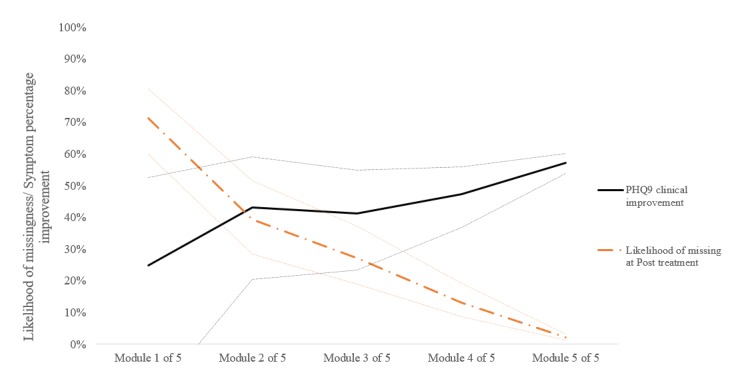
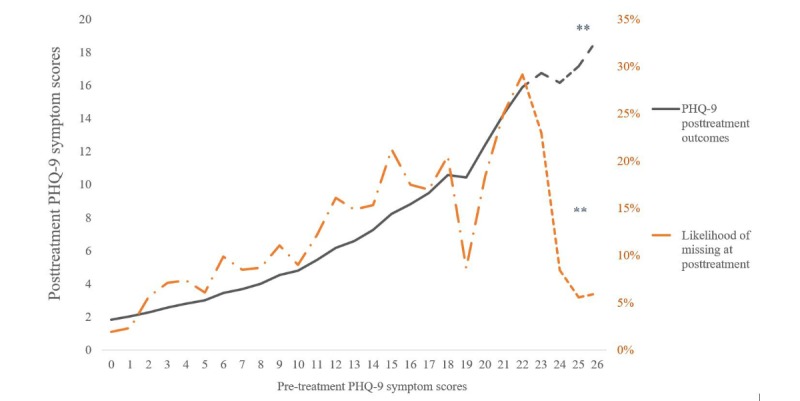
Missing cases were dominantly predicted by lower treatment adherence and increased symptoms at pretreatment. Statistical methods that ignored these characteristics can overlook an important clinical phenomenon and consequently produce inaccurate replacement outcomes, with symptoms estimates that can swing from -32% to 70% from the observed outcomes of recontacted cases. In contrast, longitudinal statistical methods that adjusted their estimates for missing cases outcomes by treatment adherence rates and baseline symptoms scores resulted in minimal measurement bias (<8%).
Certain variables can characterize and predict missing cases likelihood and jointly predict lesser clinical improvement. Under such circumstances, individuals with potentially worst off treatment outcomes can become concealed, and failure to adjust for this can lead to substantial clinical measurement bias. Together, this preliminary research suggests that missing cases in Web-based psychotherapeutic interventions may not occur as random events and can be systematically predicted. Critically, at the same time, missing cases may experience outcomes that are distinct and important for a complete understanding of the treatment effect.
在基于网络的心理治疗试验中,治疗后出现失访病例的情况很常见。由于无法直接测量和评估失访病例的治疗结果,衡量和评估治疗效果具有挑战性。尽管失访情况很常见,但对于那些表现为失访病例的基于网络的心理治疗参与者的特征、他们可能的临床结局,或者能够描述失访病例特征的不同统计假设的适用性,人们了解甚少。
本研究以大量因抑郁症状接受基于网络心理治疗的个体(n = 820)为样本,旨在探讨治疗后表现为失访病例的特征(n = 138)、他们可能的治疗结局,并比较用于替代其缺失数据的统计方法。
首先,通过二元逻辑回归模型测试常见的参与者和治疗特征,评估预测失访病例的能力。其次,筛选相同变量增加或阻碍治疗后观察到的症状变化率的能力。第三,利用3个月随访时重新联系到的病例来近似代表治疗后失访病例的结局,比较并评估各种模拟替代分数与观察到的临床随访分数。
失访病例主要由较低的治疗依从性和治疗前症状增加所预测。忽略这些特征的统计方法可能会忽略一个重要的临床现象,从而产生不准确的替代结果,症状估计值与重新联系到的病例的观察结果相比可能在 -32% 到 70% 之间波动。相比之下,通过治疗依从率和基线症状分数对失访病例结局估计值进行调整的纵向统计方法导致的测量偏差最小(<8%)。
某些变量可以描述和预测失访病例的可能性,并共同预测较小的临床改善。在这种情况下,治疗结局可能最差的个体可能会被掩盖,而不对此进行调整可能会导致严重的临床测量偏差。总之,这项初步研究表明,基于网络的心理治疗干预中的失访病例可能并非随机发生,而是可以系统地预测的。至关重要的是,与此同时,失访病例可能会经历不同的结局,这对于全面理解治疗效果很重要。