Infectious Disease Service, Department of Medicine, Memorial Sloan Kettering Cancer Center, New York, NY.
Center for Experimental and Molecular Medicine, Academic Medical Center, University of Amsterdam, Amsterdam, The Netherlands.
Blood. 2018 Jun 28;131(26):2978-2986. doi: 10.1182/blood-2018-01-828996. Epub 2018 Apr 19.
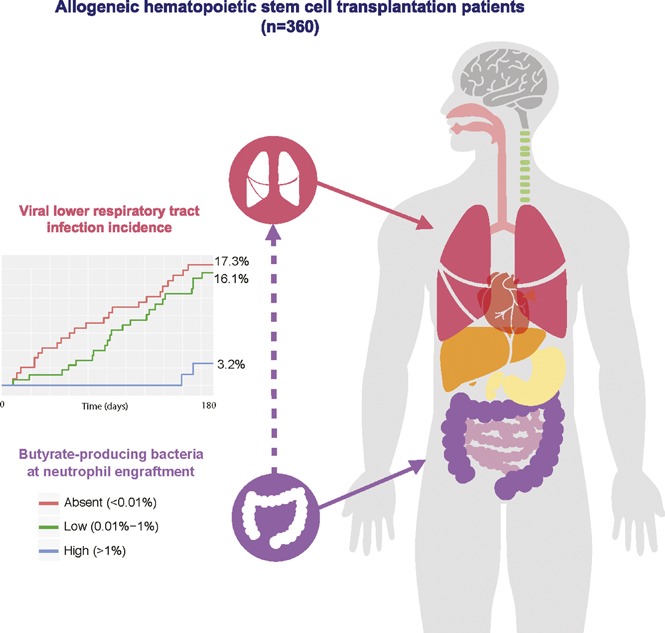
Respiratory viral infections are frequent in patients undergoing allogeneic hematopoietic stem cell transplantation (allo-HCT) and can potentially progress to lower respiratory tract infection (LRTI). The intestinal microbiota contributes to resistance against viral and bacterial pathogens in the lung. However, whether intestinal microbiota composition and associated changes in microbe-derived metabolites contribute to the risk of LRTI following upper respiratory tract viral infection remains unexplored in the setting of allo-HCT. Fecal samples from 360 allo-HCT patients were collected at the time of stem cell engraftment and subjected to deep, 16S ribosomal RNA gene sequencing to determine microbiota composition, and short-chain fatty acid levels were determined in a nested subset of fecal samples. The development of respiratory viral infections and LRTI was determined for 180 days following allo-HCT. Clinical and microbiota risk factors for LRTI were subsequently evaluated using survival analysis. Respiratory viral infection occurred in 149 (41.4%) patients. Of those, 47 (31.5%) developed LRTI. Patients with higher abundances of butyrate-producing bacteria were fivefold less likely to develop viral LRTI, independent of other factors (adjusted hazard ratio = 0.22, 95% confidence interval 0.04-0.69). Higher representation of butyrate-producing bacteria in the fecal microbiota is associated with increased resistance against respiratory viral infection with LRTI in allo-HCT patients.
异基因造血干细胞移植(allo-HCT)患者常发生呼吸道病毒感染,并可能进展为下呼吸道感染(LRTI)。肠道微生物群有助于抵抗肺部的病毒和细菌病原体。然而,在 allo-HCT 背景下,肠道微生物群组成及其相关微生物衍生代谢物的变化是否有助于上呼吸道病毒感染后发生 LRTI 的风险尚不清楚。在干细胞植入时收集了 360 名 allo-HCT 患者的粪便样本,并进行了深度 16S 核糖体 RNA 基因测序以确定微生物群组成,并在粪便样本的嵌套子集中测定了短链脂肪酸水平。在 allo-HCT 后 180 天确定了呼吸道病毒感染和 LRTI 的发生情况。随后使用生存分析评估了 LRTI 的临床和微生物群危险因素。149 名(41.4%)患者发生呼吸道病毒感染。其中,47 名(31.5%)发生 LRTI。与其他因素无关,丁酸盐产生菌丰度较高的患者发生病毒性 LRTI 的可能性降低五倍(调整后的危险比=0.22,95%置信区间 0.04-0.69)。粪便微生物群中丁酸盐产生菌的代表性增加与 allo-HCT 患者发生呼吸道病毒感染伴 LRTI 的抵抗力增强有关。