Chandra Sidhanth, Popovic Jelena, Singhal Naveen K, Watkins Elyse A, Dodiya Hemraj B, Weigle Ian Q, Salvo Miranda A, Ramakrishnan Abhirami, Chen Zhangying, Watson Thomas, Shetti Aashutosh, Piehl Natalie, Zhang Xiaoqiong, Cuddy Leah, Sadleir Katherine R, Schwulst Steven J, Prakriya Murali, Gate David, Sisodia Sangram S, Vassar Robert
Ken and Ruth Davee Department of Neurology and.
Medical Scientist Training Program, Northwestern University Feinberg School of Medicine, Chicago, Illinois, USA.
J Clin Invest. 2025 May 13;135(13). doi: 10.1172/JCI180826. eCollection 2025 Jul 1.
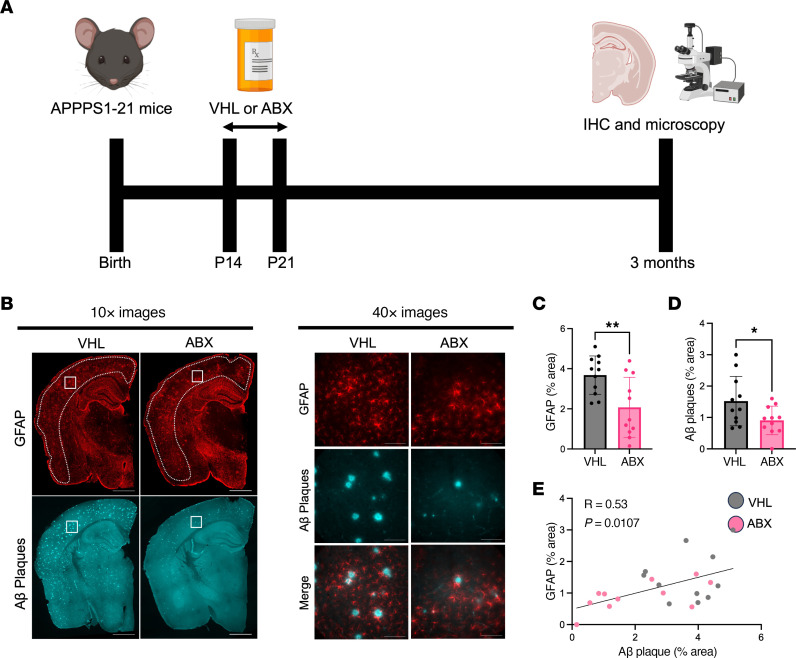
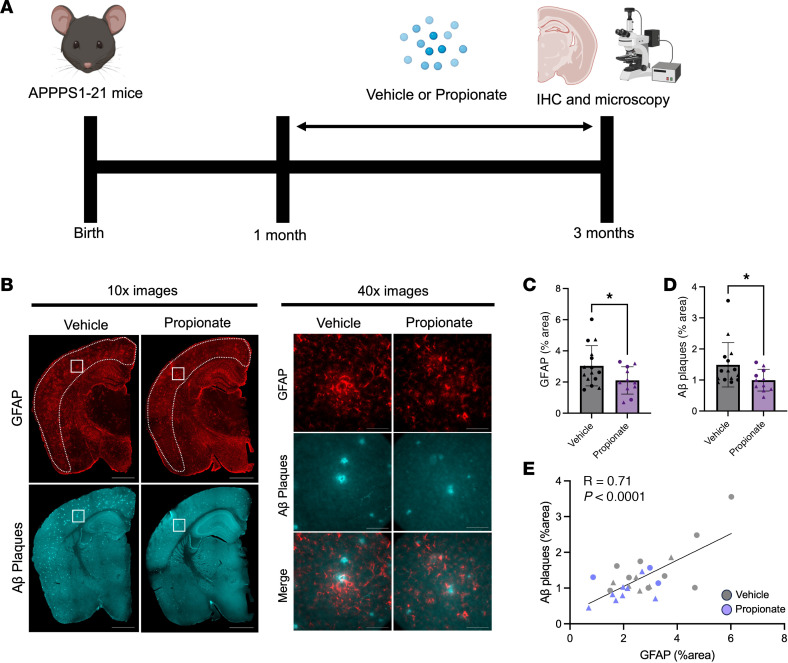
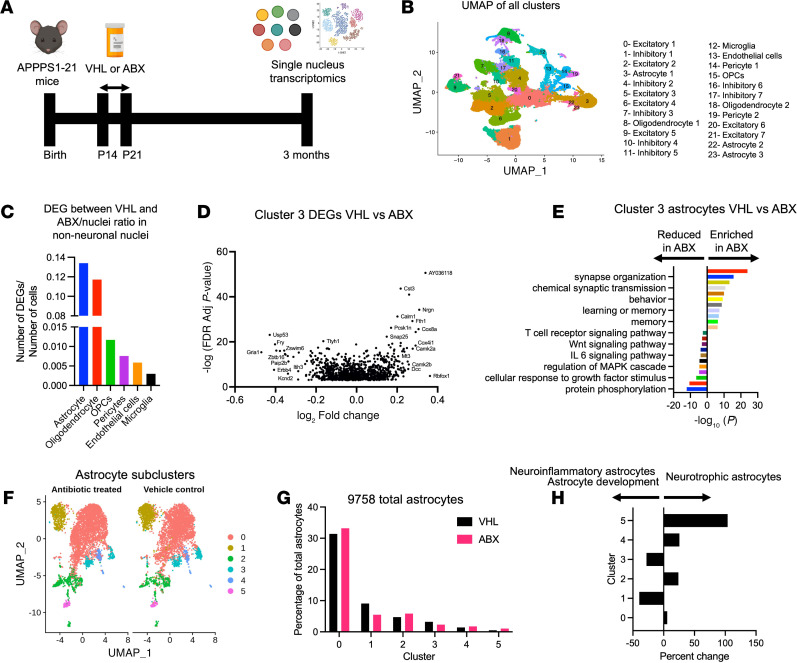
Accumulating evidence implicates the gut microbiome (GMB) in the pathogenesis and progression of Alzheimer's disease (AD). We recently showed that the GMB regulates reactive astrocytosis and Aβ plaque accumulation in a male APPPS1-21 AD mouse model. Yet, the mechanism(s) by which GMB perturbation alters reactive astrocytosis in a manner that reduces Aβ deposition remain unknown. Here, we performed metabolomics on plasma from mice treated with antibiotics (ABX) and identified a significant increase in plasma propionate, a gut-derived short-chain fatty acid, only in male mice. Administration of sodium propionate reduced reactive astrocytosis and Aβ plaques in APPPS1-21 mice, phenocopying the ABX-induced phenotype. Astrocyte-specific RNA-Seq on ABX- and propionate-treated mice showed reduced expression of proinflammatory and increased expression of neurotrophic genes. Next, we performed flow cytometry experiments, in which we found that ABX and propionate decreased peripheral RAR-related orphan receptor-γ+ (Rorγt+) CD4+ (Th17) cells and IL-17 secretion, which positively correlated with reactive astrocytosis. Last, using an IL-17 mAb to deplete IL-17, we found that propionate reduced reactive astrocytosis and Aβ plaques in an IL-17-dependent manner. Together, these results suggest that gut-derived propionate regulates reactive astrocytosis and Aβ amyloidosis by decreasing peripheral Th17 cells and IL-17 release. Thus, propionate treatment or strategies boosting propionate production may represent novel therapeutic strategies for the treatment of AD.
越来越多的证据表明肠道微生物群(GMB)与阿尔茨海默病(AD)的发病机制和进展有关。我们最近发现,在雄性APPPS1-21 AD小鼠模型中,GMB调节反应性星形胶质细胞增生和Aβ斑块积累。然而,GMB扰动以减少Aβ沉积的方式改变反应性星形胶质细胞增生的机制仍不清楚。在这里,我们对用抗生素(ABX)处理的小鼠血浆进行了代谢组学分析,发现仅在雄性小鼠中,血浆中一种肠道来源的短链脂肪酸——丙酸显著增加。给予丙酸钠可减少APPPS1-21小鼠的反应性星形胶质细胞增生和Aβ斑块,模拟ABX诱导的表型。对ABX和丙酸盐处理的小鼠进行星形胶质细胞特异性RNA测序,结果显示促炎基因表达降低,神经营养基因表达增加。接下来,我们进行了流式细胞术实验,发现ABX和丙酸盐减少了外周维甲酸相关孤儿受体γ+(Rorγt+)CD4+(Th17)细胞和IL-17分泌,而这与反应性星形胶质细胞增生呈正相关。最后,使用IL-17单克隆抗体耗尽IL-17,我们发现丙酸盐以IL-17依赖的方式减少反应性星形胶质细胞增生和Aβ斑块。总之,这些结果表明,肠道来源的丙酸盐通过减少外周Th17细胞和IL-17释放来调节反应性星形胶质细胞增生和Aβ淀粉样变性。因此,丙酸盐治疗或促进丙酸盐产生的策略可能代表了治疗AD的新治疗策略。