Division of Pulmonary and Critical Care and Sleep Medicine, Department of Medicine, School of Medicine, Johns Hopkins University, Baltimore, MD, USA.
Oxid Med Cell Longev. 2018 Feb 20;2018:5137947. doi: 10.1155/2018/5137947. eCollection 2018.
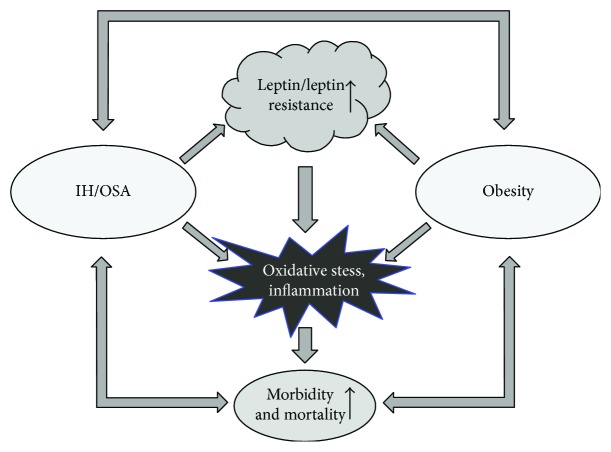
Obesity-related sleep breathing disorders such as obstructive sleep apnea (OSA) and obesity hypoventilation syndrome (OHS) cause intermittent hypoxia (IH) during sleep, a powerful trigger of oxidative stress. Obesity also leads to dramatic increases in circulating levels of leptin, a hormone produced in adipose tissue. Leptin acts in the hypothalamus to suppress food intake and increase metabolic rate. However, obese individuals are resistant to metabolic effects of leptin. Leptin also activates the sympathetic nervous system without any evidence of resistance, possibly because these effects occur peripherally without a need to penetrate the blood-brain barrier. IH is a potent stimulator of leptin expression and release from adipose tissue. Hyperleptinemia and leptin resistance may upregulate generation of reactive oxygen species, increasing oxidative stress and promoting inflammation. The current review summarizes recent data on a possible link between leptin and oxidative stress in the pathogenesis of sleep breathing disorders.
肥胖相关的睡眠呼吸障碍,如阻塞性睡眠呼吸暂停(OSA)和肥胖低通气综合征(OHS),会导致睡眠期间间歇性缺氧(IH),这是氧化应激的一个强大触发因素。肥胖还会导致循环中瘦素水平的急剧增加,瘦素是一种在脂肪组织中产生的激素。瘦素在下丘脑发挥作用,抑制食欲并增加代谢率。然而,肥胖个体对瘦素的代谢作用有抗性。瘦素还会激活交感神经系统,而没有任何抵抗的迹象,这可能是因为这些作用发生在周围,而不需要穿透血脑屏障。IH 是脂肪组织中瘦素表达和释放的有力刺激物。高瘦素血症和瘦素抵抗可能会上调活性氧的产生,增加氧化应激并促进炎症。本综述总结了最近关于瘦素与氧化应激在睡眠呼吸障碍发病机制中可能存在联系的相关数据。