Tang Mingxing, Wu Yongliang, Liang Junyi, Yang Shuai, Huang Zuofeng, Hu Jing, Yang Qiong, Liu Fei, Li Shuo
Department of Otolaryngology, Shenzhen Nanshan People's Hospital, Shenzhen, China.
Department of Otolaryngology, The 6th Affiliated Hospital, Shenzhen University Medical School, Shenzhen, China.
Front Microbiol. 2024 Dec 6;15:1457348. doi: 10.3389/fmicb.2024.1457348. eCollection 2024.
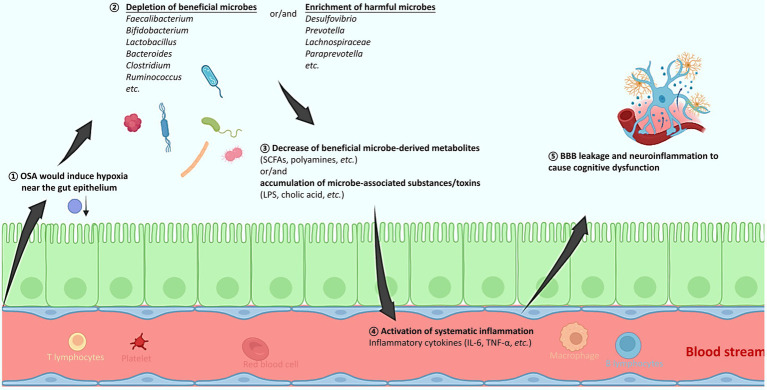
Obstructive sleep apnea (OSA) is a state of sleep disorder, characterized by repetitive episodes of apnea and chronic intermittent hypoxia. OSA has an extremely high prevalence worldwide and represents a serious challenge to public health, yet its severity is frequently underestimated. It is now well established that neurocognitive dysfunction, manifested as deficits in attention, memory, and executive functions, is a common complication observed in patients with OSA, whereas the specific pathogenesis remains poorly understood, despite the likelihood of involvement of inflammation. Here, we provide an overview of the current state of the art, demonstrating the intimacy of OSA with inflammation and cognitive impairment. Subsequently, we present the recent findings on the investigation of gut microbiota alteration in the OSA conditions, based on both patients-based clinical studies and animal models of OSA. We present an insightful discussion on the role of changes in the abundance of specific gut microbial members, including short-chain fatty acid (SCFA)-producers and/or microbes with pathogenic potential, in the pathogenesis of inflammation and further cognitive dysfunction. The transplantation of fecal microbiota from the mouse model of OSA can elicit inflammation and neurobehavioral disorders in naïve mice, thereby validating the causal relationship to inflammation and cognitive abnormality. This work calls for greater attention on OSA and the associated inflammation, which require timely and effective therapy to protect the brain from irreversible damage. This work also suggests that modification of the gut microbiota using prebiotics, probiotics or fecal microbiota transplantation may represent a potential adjuvant therapy for OSA.
阻塞性睡眠呼吸暂停(OSA)是一种睡眠障碍状态,其特征为反复出现呼吸暂停和慢性间歇性缺氧。OSA在全球范围内具有极高的患病率,对公众健康构成严重挑战,但其严重程度常常被低估。现已明确,以注意力、记忆力和执行功能缺陷为表现的神经认知功能障碍是OSA患者中常见的并发症,然而尽管炎症可能参与其中,但其具体发病机制仍知之甚少。在此,我们概述了当前的技术水平,展示了OSA与炎症及认知障碍之间的密切关系。随后,我们基于以患者为基础的临床研究和OSA动物模型,介绍了OSA情况下肠道微生物群改变研究的最新发现。我们对特定肠道微生物成员丰度变化的作用进行了深入讨论,这些成员包括短链脂肪酸(SCFA)产生菌和/或具有致病潜力的微生物,它们在炎症发病机制及进一步的认知功能障碍中发挥作用。将OSA小鼠模型的粪便微生物群移植到未接触过的小鼠体内可引发炎症和神经行为障碍,从而验证了其与炎症及认知异常之间的因果关系。这项工作呼吁人们更加关注OSA及其相关炎症,这需要及时有效的治疗以保护大脑免受不可逆损伤。这项工作还表明,使用益生元、益生菌或粪便微生物群移植来调节肠道微生物群可能是OSA的一种潜在辅助治疗方法。