Li Bijin, Zhou Linsen, Cheng Hu, Huang Quan, Lan Jingbo, Zhou Liang, You Jingsong
Key Laboratory of Green Chemistry and Technology of Ministry of Education , College of Chemistry , Sichuan University , 29 Wangjiang Road , Chengdu 610064 , PR China . Email:
Center of Interface Dynamics for Sustainability , Institute of Materials , China Academy of Engineering Physics , 596 Yinhe Road , Chengdu 610200 , PR China.
Chem Sci. 2017 Dec 1;9(5):1213-1220. doi: 10.1039/c7sc04464j. eCollection 2018 Feb 7.
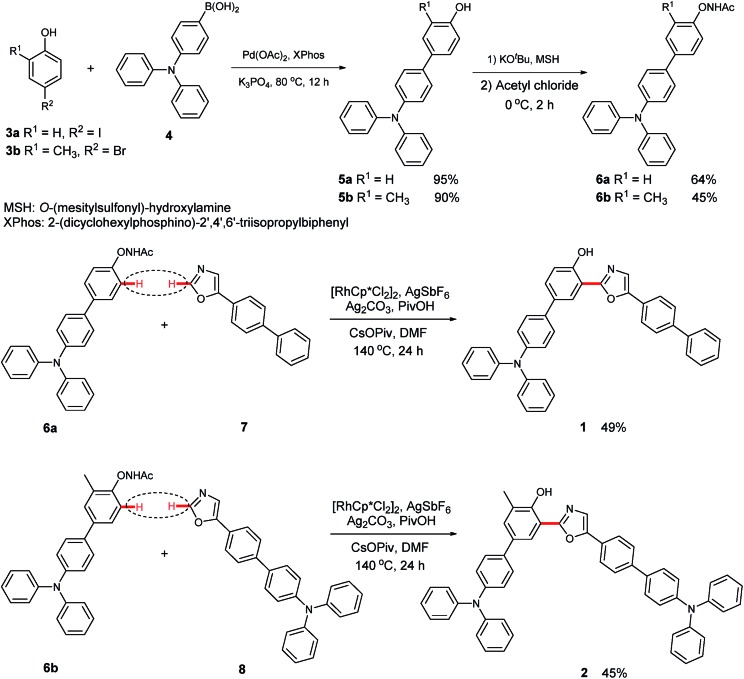
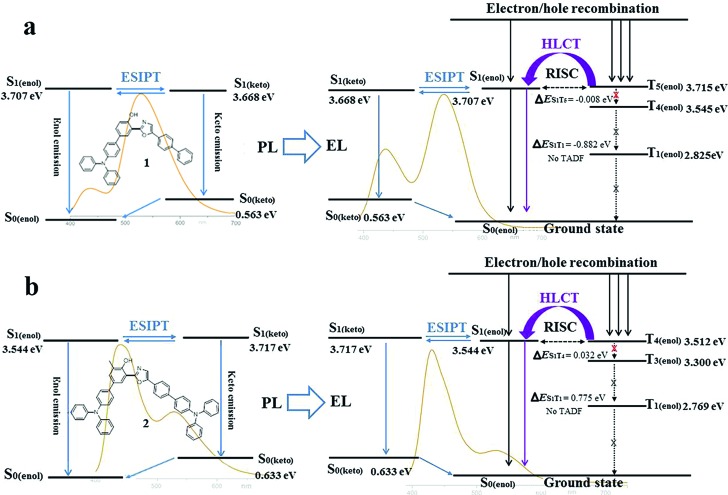
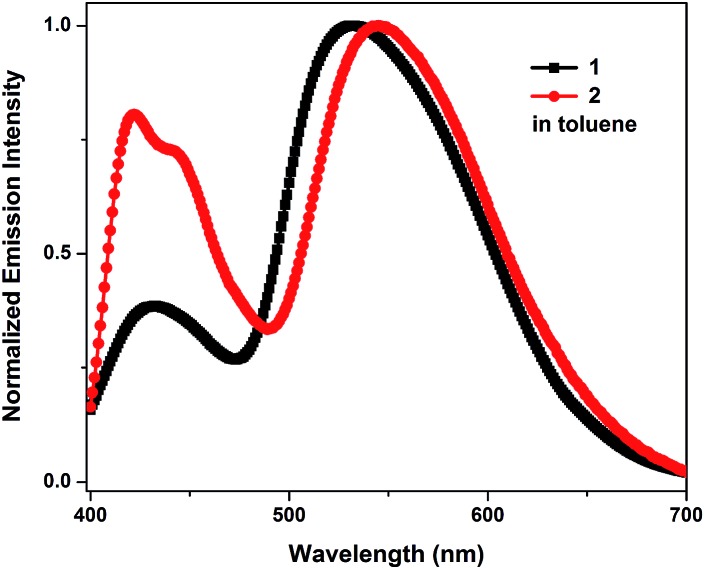
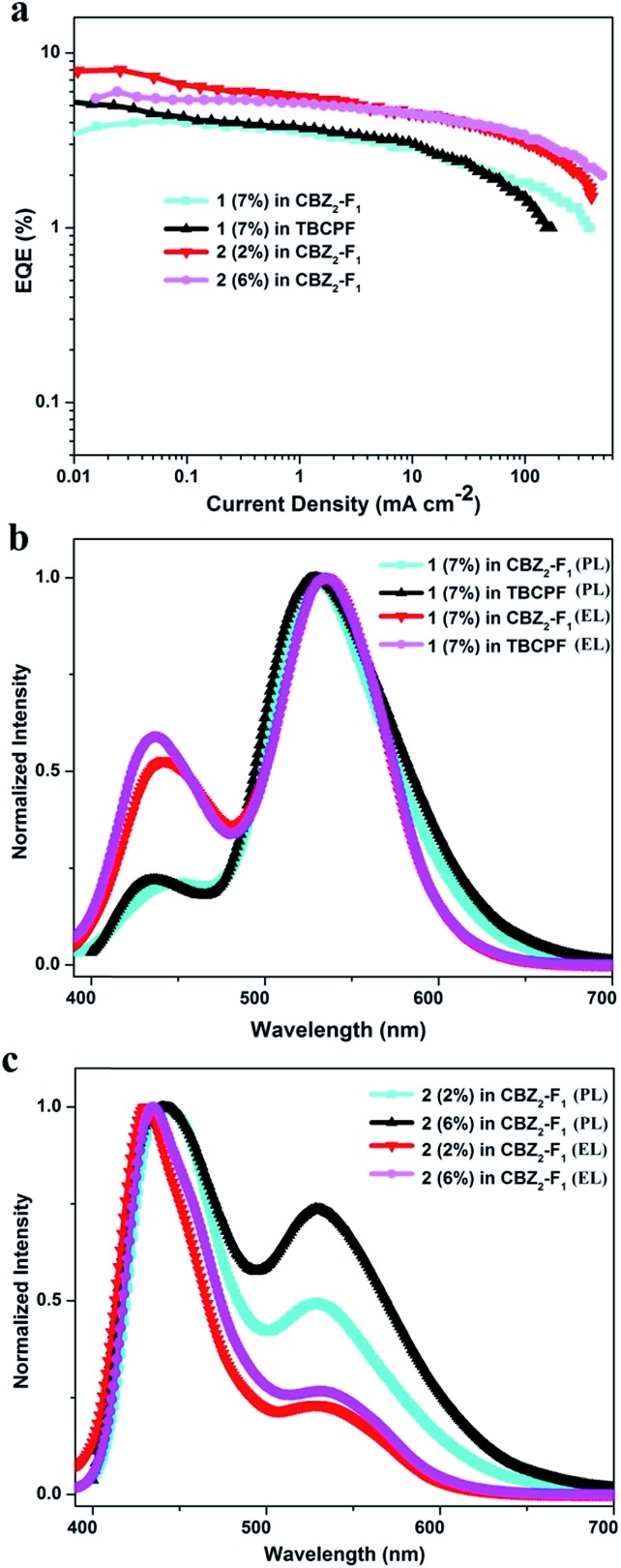
The photoluminescence (PL) and electroluminescence (EL) properties of two highly efficient excited state intramolecular proton transfer (ESIPT) molecules, 2-(2'-hydroxyphenyl)oxazoles containing one triphenylamine (TPA) () and two TPAs () respectively, are studied systematically. The enol-forms of both and possess highly hybridized local and charge transfer (HLCT) excited state character, while their excited-state keto-forms are not of obvious HLCT character. A -based device exhibits green-white electroluminescence with Commission Internationale d'Eclairage (CIE) coordinates of (0.25, 0.41) and a high external quantum efficiency (EQE) up to 5.3%, which is the highest EQE value recorded for single molecular white light-emitting materials. A -based device shows sky-blue emission with CIE coordinates of (0.18, 0.16) and an EQE of 8.0%, which is the highest EQE in the reported HLCT materials. The fluorescence intensities of the enol-forms of and in EL spectra are increased remarkably relative to their PL spectra. Experimental data and theoretical calculations reveal a new ESIPT equilibrium with a reverse intersystem crossing (RISC) process arising from the HLCT character. In EL, the RISC of the enol-form excitons from the triplet state to the singlet state triggers an increase in the number of enol-form singlet excitons, which further leads to a shift of the ESIPT equilibrium towards an enhanced enol-form emission. Thus, the difference between the ESIPT equilibria in PL and EL may be ascribed to the HLCT character of the enol-form excited state.
系统研究了两种高效激发态分子内质子转移(ESIPT)分子的光致发光(PL)和电致发光(EL)特性,这两种分子分别是含有一个三苯胺(TPA)()和两个TPA()的2-(2'-羟基苯基)恶唑。和的烯醇式均具有高度杂化的局域和电荷转移(HLCT)激发态特征,而它们的激发态酮式则没有明显的HLCT特征。基于的器件呈现出绿白色电致发光,国际照明委员会(CIE)坐标为(0.25,0.41),外部量子效率(EQE)高达5.3%,这是单分子白色发光材料记录的最高EQE值。基于的器件发出天蓝色光,CIE坐标为(0.18,0.16),EQE为8.0%,这是报道的HLCT材料中最高的EQE。和的烯醇式在EL光谱中的荧光强度相对于其PL光谱显著增加。实验数据和理论计算揭示了一种新的ESIPT平衡,其源于HLCT特征产生了反向系间窜越(RISC)过程。在EL中,烯醇式激子从三重态到单重态的RISC触发了烯醇式单重态激子数量的增加,这进一步导致ESIPT平衡向增强的烯醇式发射方向移动。因此,PL和EL中ESIPT平衡的差异可能归因于烯醇式激发态的HLCT特征。