State Key Laboratory of Integrated Management of Pest Insects and Rodents, Institute of Zoology, Chinese Academy of Sciences, Beijing, China.
University of Chinese Academy of Sciences, Beijing, China.
Insect Sci. 2019 Jun;26(3):510-522. doi: 10.1111/1744-7917.12598. Epub 2018 May 21.
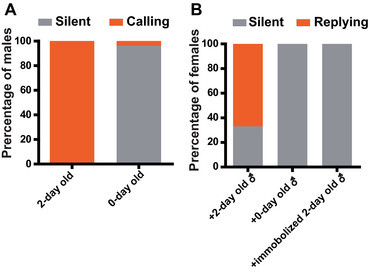
The pea leafminer (Liriomyza huidobrensis) is a notorious pest of vegetables and ornamental plants worldwide. Despite a large number of studies on its biology and ecology, the courtship behavior and sexual communication of this species remain unclear. Here, we studied vibrational communication in the sexual interaction of the pea leafminer. On host plant leaves, females and males behaviorally displayed the bobbing-quivering alternation, which finally led to copulation. Moreover, records of laser vibrometry revealed three-signal duets underlying the behavioral alternation. Sexually mature males spontaneously emitted calls (MCs) to initiate the duets. The females rapidly responded to MCs by emitting replies (FRs) that are longer in duration. The FRs further triggered male replies (MRs) in their search for potential partners. Leafminer-produced vibrational signals convey efficient information to partners and generate pair formation on stretched substrates, such as plant leaves and nylon mesh, but cannot elicit responses on dense substrates, such as glass and plastic. Vibrational playbacks of both MCs and FRs can elicit replies in females and males, respectively. This study completely characterizes substrate-borne vibrational duets in a dipteran insect. The discovery of vibrational sex signals in the pea leafminer provides new insights for the development of novel approaches to control the pest and its relative species.
豌豆潜叶蝇(Liriomyza huidobrensis)是一种臭名昭著的蔬菜和观赏植物害虫。尽管对其生物学和生态学进行了大量研究,但该物种的求偶行为和性通讯仍不清楚。在这里,我们研究了豌豆潜叶蝇在性相互作用中的振动通讯。在寄主植物叶片上,雌性和雄性表现出摆动-颤抖的交替行为,最终导致交配。此外,激光测振仪的记录揭示了行为交替背后的三个信号二重奏。性成熟的雄性自发发出叫声(MCs)来启动二重奏。雌性通过发出持续时间更长的回复(FRs)对 MCs 迅速做出响应。FRs 进一步触发了雄性寻找潜在伴侣的回复(MRs)。潜叶蝇产生的振动信号向伴侣传递有效的信息,并在伸展的基质上产生配对,例如植物叶片和尼龙网,但不能在密集的基质上,如玻璃和塑料上产生反应。MCs 和 FRs 的振动回放分别可以在雌性和雄性中引起反应。这项研究完全描述了双翅目昆虫在基质传播的振动二重奏。在豌豆潜叶蝇中发现的振动性信号为开发控制该害虫及其相关物种的新方法提供了新的见解。