Mahidol Oxford Research Unit, Faculty of Tropical Medicine, Mahidol University, Bangkok, Thailand.
Centre for Tropical Medicine and Global Health, Nuffield Department of Medicine, Oxford University, Oxford, United kingdom.
PLoS Negl Trop Dis. 2018 Apr 20;12(4):e0006440. doi: 10.1371/journal.pntd.0006440. eCollection 2018 Apr.
The 8-aminoquinoline antimalarials, the only drugs which prevent relapse of vivax and ovale malaria (radical cure), cause dose-dependent oxidant haemolysis in individuals with glucose-6-phosphate dehydrogenase (G6PD) deficiency. Patients with <30% and <70% of normal G6PD activity are not given standard regimens of primaquine and tafenoquine, respectively. Both drugs are currently considered contraindicated in pregnant and lactating women.
Quantitative G6PD enzyme activity data from 5198 individuals were used to estimate the proportions of heterozygous females who would be ineligible for treatment at the 30% and 70% activity thresholds, and the relationship with the severity of the deficiency. This was used to construct a simple model relating allele frequency in males to the potential population coverage of tafenoquine and primaquine under current prescribing restrictions.
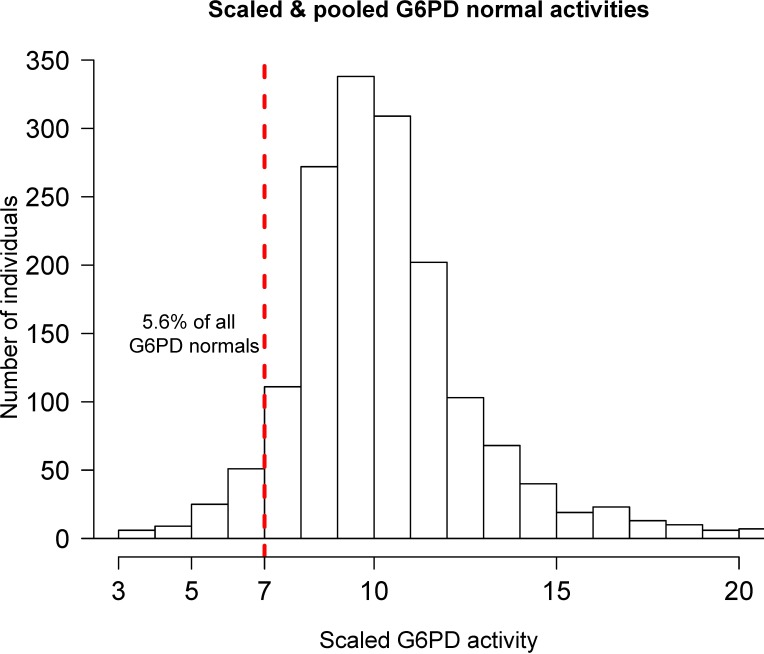
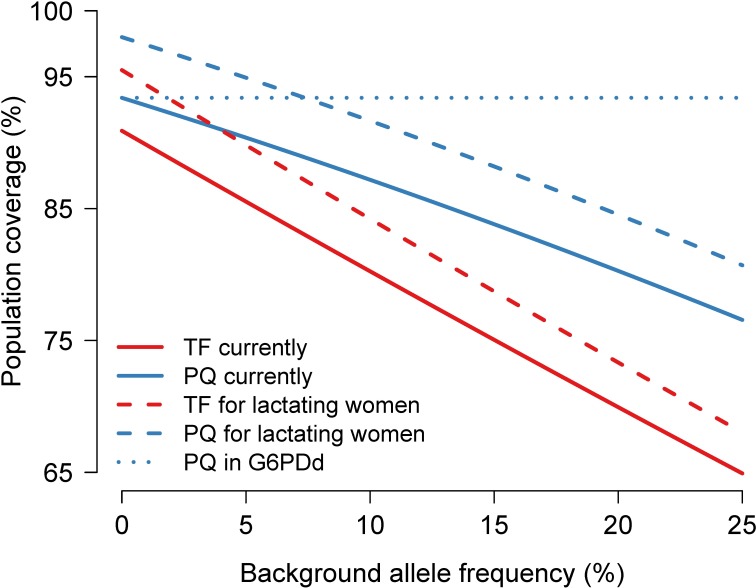
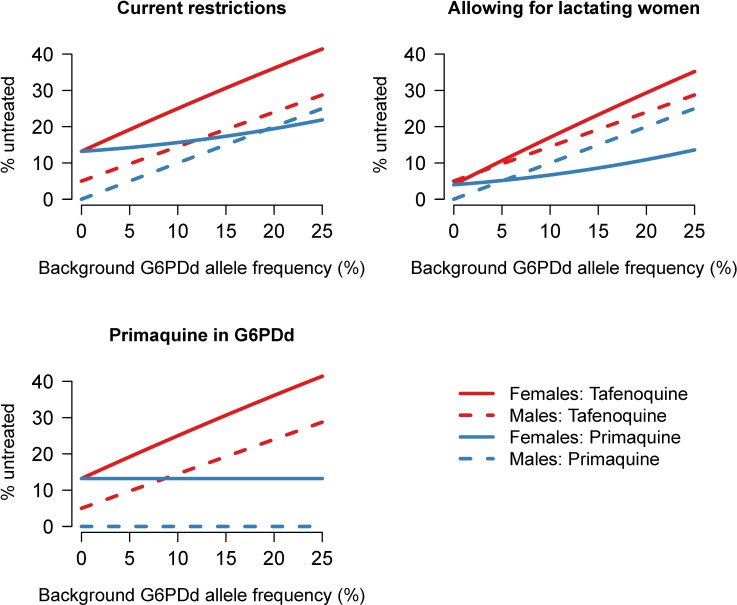
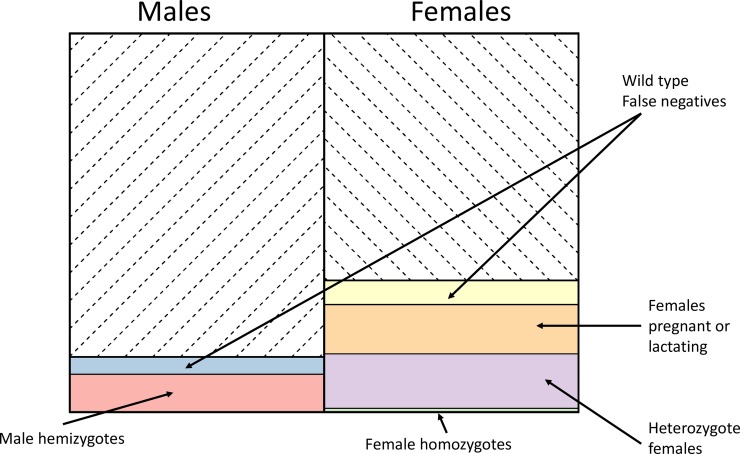
Independent of G6PD deficiency, the current pregnancy and lactation restrictions will exclude ~13% of females from radical cure treatment. This could be reduced to ~4% if 8-aminoquinolines can be prescribed to women breast-feeding infants older than 1 month. At a 30% activity threshold, approximately 8-19% of G6PD heterozygous women are ineligible for primaquine treatment; at a 70% threshold, 50-70% of heterozygous women and approximately 5% of G6PD wild type individuals are ineligible for tafenoquine treatment. Thus, overall in areas where the G6PDd allele frequency is >10% more than 15% of men and more than 25% of women would be unable to receive tafenoquine. In vivax malaria infected patients these proportions will be lowered by any protective effect against P. vivax conferred by G6PD deficiency.
If tafenoquine is deployed for radical cure, primaquine will still be needed to obtain high population coverage. Better radical cure antimalarial regimens are needed.
8-氨基喹啉类抗疟药是唯一能预防间日疟和卵形疟复发(根治)的药物,会导致葡萄糖-6-磷酸脱氢酶(G6PD)缺乏症患者出现剂量依赖性氧化剂溶血性贫血。G6PD 活性分别低于 30%和 70%的患者分别不能给予标准剂量的伯氨喹和他非诺喹。这两种药物目前均被认为不适合孕妇和哺乳期妇女使用。
利用 5198 名个体的定量 G6PD 酶活性数据,估计在 30%和 70%活性阈值下不适合治疗的杂合女性的比例,以及与缺乏症严重程度的关系。这被用于构建一个简单的模型,将男性中的等位基因频率与当前处方限制下他非诺喹和伯氨喹的潜在人群覆盖率联系起来。
独立于 G6PD 缺乏症,目前的妊娠和哺乳期限制将使约 13%的女性无法接受根治性治疗。如果 8-氨基喹啉类药物可以开给 1 个月以上哺乳期的女性,这个比例可以降低到 4%左右。在 30%的活性阈值下,约有 8-19%的 G6PD 杂合女性不适合接受伯氨喹治疗;在 70%的阈值下,约有 50-70%的杂合女性和约 5%的 G6PD 野生型个体不适合接受他非诺喹治疗。因此,在 G6PDd 等位基因频率超过 10%的地区,超过 15%的男性和超过 25%的女性将无法接受他非诺喹治疗。在感染间日疟的患者中,G6PD 缺乏症对间日疟原虫的任何保护作用都会降低这些比例。
如果部署他非诺喹进行根治,仍需要伯氨喹来获得高人群覆盖率。需要更好的根治性抗疟药物方案。