Friedrich Miescher Laboratory of the Max Planck Society, Max-Planck-Ring 9, 72076, Tübingen, Germany.
University of Konstanz, Universitätsstraße 10, 78457, Konstanz, Germany.
Nat Commun. 2018 Apr 20;9(1):1582. doi: 10.1038/s41467-018-03975-6.
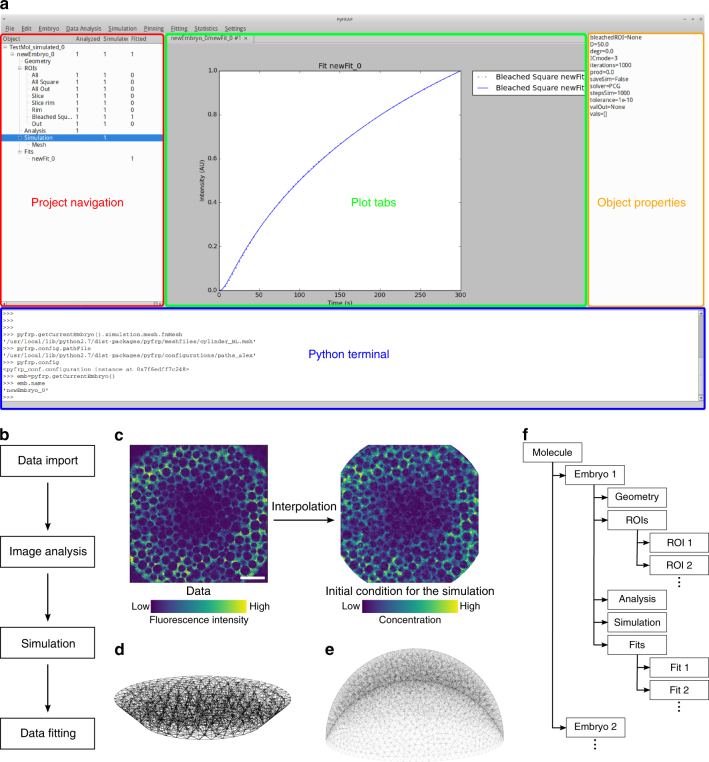
Fluorescence Recovery After Photobleaching (FRAP) and inverse FRAP (iFRAP) assays can be used to assess the mobility of fluorescent molecules. These assays measure diffusion by monitoring the return of fluorescence in bleached regions (FRAP), or the dissipation of fluorescence from photoconverted regions (iFRAP). However, current FRAP/iFRAP analysis methods suffer from simplified assumptions about sample geometry, bleaching/photoconversion inhomogeneities, and the underlying reaction-diffusion kinetics. To address these shortcomings, we developed the software PyFRAP, which fits numerical simulations of three-dimensional models to FRAP/iFRAP data and accounts for bleaching/photoconversion inhomogeneities. Using PyFRAP we determined the diffusivities of fluorescent molecules spanning two orders of magnitude in molecular weight. We measured the tortuous effects that cell-like obstacles exert on effective diffusivity and show that reaction kinetics can be accounted for by model selection. These applications demonstrate the utility of PyFRAP, which can be widely adapted as a new extensible standard for FRAP analysis.
荧光漂白恢复(FRAP)和反向 FRAP(iFRAP)实验可用于评估荧光分子的流动性。这些实验通过监测漂白区域荧光的恢复(FRAP)或光转化区域荧光的耗散(iFRAP)来测量扩散。然而,目前的 FRAP/iFRAP 分析方法在样本几何形状、漂白/光转化不均匀性以及潜在的反应扩散动力学方面存在简化假设。为了解决这些缺点,我们开发了 PyFRAP 软件,该软件可以将三维模型的数值模拟拟合到 FRAP/iFRAP 数据中,并考虑到漂白/光转化的不均匀性。使用 PyFRAP,我们确定了分子量跨越两个数量级的荧光分子的扩散系数。我们测量了类细胞障碍物对有效扩散系数的扭曲效应,并表明反应动力学可以通过模型选择来解释。这些应用展示了 PyFRAP 的实用性,它可以被广泛采用作为 FRAP 分析的新可扩展标准。