Schmalz G, Berisha L, Wendorff H, Widmer F, Marcinkowski A, Teschler H, Sommerwerck U, Haak R, Kollmar O, Ziebolz D
University Leipzig, Dept. of Cariology, Endodontology and Periodontology, Liebigstr. 12, D 04103 Leipzig, Germany,
Med Oral Patol Oral Cir Bucal. 2018 May 1;23(3):e326-e334. doi: 10.4317/medoral.22238.
Aim of this study was to investigate the association of the time under immunosuppression and different immunosuppressive medication on periodontal parameters and selected periodontal pathogenic bacteria of immunosuppressed patients after solid organ transplantation (SOT).
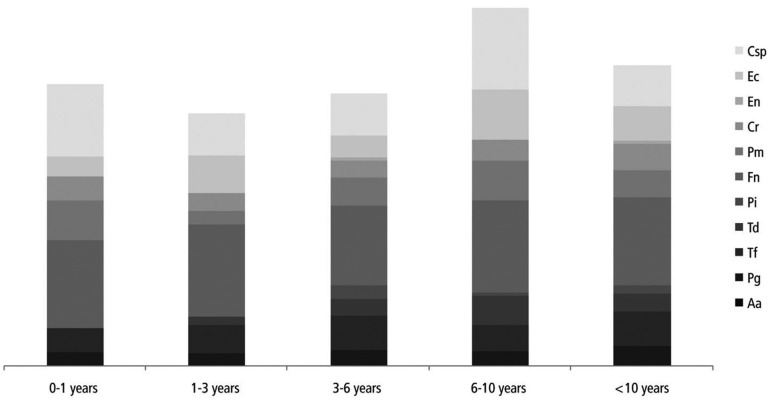
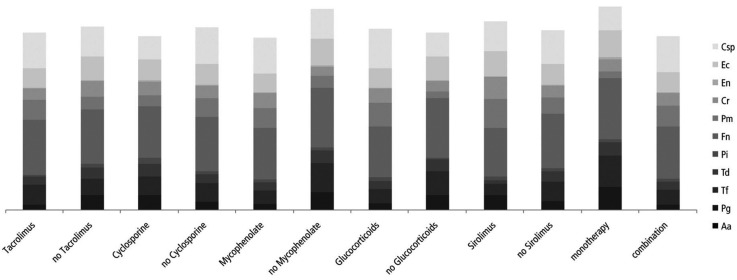
169 Patients after SOT (lung, liver or kidney) were included and divided into subgroups according their time under (0-1, 1-3, 3-6, 6-10 and >10 years) and form of immunosuppression (Tacrolimus, Cyclosporine, Mycophenolate, Glucocorticoids, Sirolimus and monotherapy vs. combination). Periodontal probing depth (PPD) and clinical attachment loss (CAL) were assessed. Periodontal disease severity was classified as healthy/mild, moderate or severe periodontitis. Subgingival biofilm samples were investigated for eleven selected potentially periodontal pathogenic bacteria using polymerasechainreaction.
The mean PPD and CAL as well as prevalence of Treponema denticola and Capnocytophaga species was shown to be different but heterogeneous depending on time under immunosuppression (p<0.05). Furthermore, only the medication with Cyclosporine was found to show worse periodontal condition compared to patients without Cyclosporine (p<0.05). Prevalence of Porphyromonas gingivalis, Tannerella forsythia and Fusobacterium nucleatum was reduced and prevalence of Parvimonas micra and Capnocytophaga species was increased in patients under immunosuppression with Glucocorticoids, Mycophenolate as well as combination therapy.
Time under and form of immunosuppression might have an impact on the clinical periodontal and microbiological parameters of patients after SOT. Patients under Cyclosporine medication should receive increased attention. Differences in subgingival biofilm, but not in clinical parameters were found for Glucocorticoids, Mycophenolate and combination therapy, making the clinical relevance of this finding unclear.
本研究旨在调查实体器官移植(SOT)后免疫抑制患者的免疫抑制时间及不同免疫抑制药物与牙周参数和所选牙周病原菌之间的关联。
纳入169例SOT(肺、肝或肾)后患者,并根据其免疫抑制时间(0 - 1年、1 - 3年、3 - 6年、6 - 10年和>10年)及免疫抑制形式(他克莫司、环孢素、霉酚酸酯、糖皮质激素、西罗莫司以及单药治疗与联合治疗)分为亚组。评估牙周探诊深度(PPD)和临床附着丧失(CAL)。牙周疾病严重程度分为健康/轻度、中度或重度牙周炎。使用聚合酶链反应对龈下生物膜样本进行11种所选潜在牙周病原菌的检测。
根据免疫抑制时间,平均PPD和CAL以及齿垢密螺旋体和二氧化碳嗜纤维菌属的患病率显示出差异但具有异质性(p<0.05)。此外,与未使用环孢素的患者相比,仅发现使用环孢素的患者牙周状况更差(p<0.05)。在接受糖皮质激素、霉酚酸酯以及联合治疗的免疫抑制患者中,牙龈卟啉单胞菌、福赛坦氏菌和具核梭杆菌的患病率降低,而微小单胞菌和二氧化碳嗜纤维菌属的患病率增加。
免疫抑制时间及形式可能对SOT后患者的临床牙周和微生物学参数产生影响。使用环孢素药物的患者应受到更多关注。对于糖皮质激素、霉酚酸酯和联合治疗,在龈下生物膜方面存在差异,但在临床参数方面未发现差异,这使得该发现的临床相关性尚不清楚。