Mendes Luzia, Azevedo Nuno Filipe, Felino António, Pinto Miguel Gonçalves
a Department of Periodontology; Faculty of Dental Medicine; University of Porto ; Portugal.
Virulence. 2015;6(3):208-15. doi: 10.4161/21505594.2014.984566.
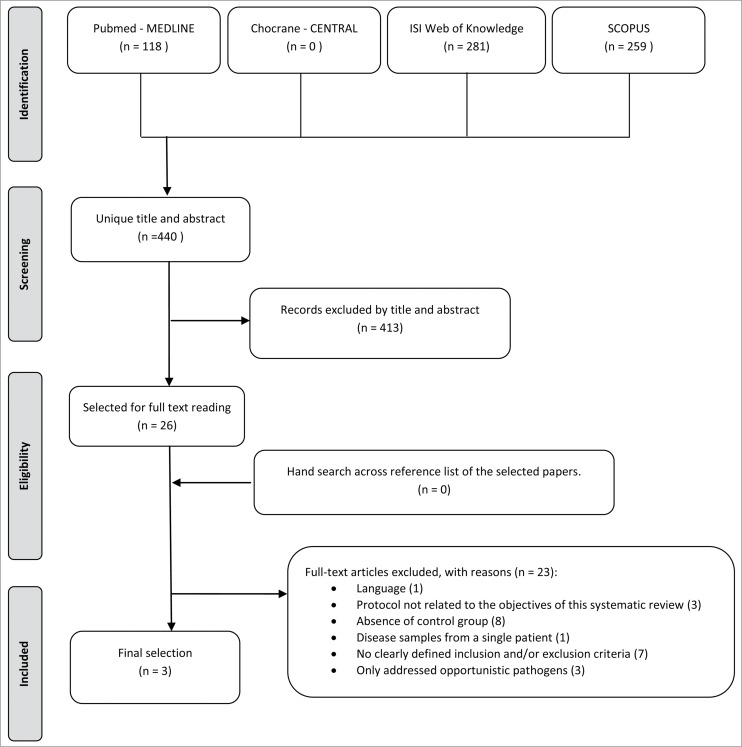
Bacterial invasion of the periodontal tissues has been suggested as a relevant step in the etiopathogenesis of periodontal disease. However, its exact importance remains to be defined. The present systematic review assessed the scientific evidence concerning the relationship between the quality or quantity of periodontal microbiota in periodontal tissues and development of periodontal disease. The databases Medline-PubMed, Cochrane-CENTRAL, ISI Web of Knowledge and SCOPUS were searched, up to January 2014. Studies that reported evaluation of periodontal pathogens invasion on human tissues were selected. The screening of 440 title/abstracts elected 26 papers for full-text reading. Twenty three papers were subsequently excluded because of insufficient data or a study protocol not related to the objectives of this systematic review. All included studies were case-control studies that evaluated intracellular or adherent bacteria to epithelial cells from periodontal pockets versus healthy sulci. Study protocols presented heterogeneity regarding case and control definitions and methodological approaches for microbial identification. No consistent significant differences were found related to the presence/absence or proportion of specific periopathogens across the studies, as only one study found statistically significant differences regarding the presence of A. actinomycetemcomitans (p = 0.043), T. forsythia (P < 0.001), P. intermedia (P < 0.001), C. ochracea (P < 0.001) and C. rectus (P = 0.003) in epithelial cells from periodontal pockets vs. healthy sulci. All studies reported a larger unspecific bacterial load in or on the epithelial cells taken from a diseased site compared to a healthy sulcus. The current available data is of low to moderate quality and inconsistent mainly due to study design, poor reporting and methodological diversity. As so, there is insufficient evidence to support or exclude the invasion by periodontal pathogens as a key step in the etiopathogenesis of periodontal disease. Further research is needed.
细菌侵袭牙周组织被认为是牙周病病因发病机制中的一个相关步骤。然而,其确切重要性仍有待确定。本系统评价评估了有关牙周组织中牙周微生物群的质量或数量与牙周病发展之间关系的科学证据。检索了截至2014年1月的Medline-PubMed、Cochrane-CENTRAL、ISI Web of Knowledge和SCOPUS数据库。选择了报告对人体组织中牙周病原体侵袭进行评估的研究。对440篇标题/摘要进行筛选后,选出26篇论文进行全文阅读。随后排除了23篇论文,原因是数据不足或研究方案与本系统评价的目标无关。所有纳入研究均为病例对照研究,评估了牙周袋上皮细胞与健康龈沟上皮细胞内或附着的细菌。研究方案在病例和对照定义以及微生物鉴定的方法学方法方面存在异质性。在各项研究中,未发现与特定牙周病原体的存在/不存在或比例相关的一致显著差异,因为只有一项研究发现,在牙周袋上皮细胞与健康龈沟上皮细胞中,伴放线放线杆菌(p = 0.043)、福赛坦氏菌(P < 0.001)、中间普氏菌(P < 0.001)、微黄弯曲菌(P < 0.001)和直肠弯曲菌(P = 0.003)的存在存在统计学显著差异。所有研究均报告,与健康龈沟相比,取自患病部位的上皮细胞内或表面的非特异性细菌载量更大。目前可得的数据质量低至中等且不一致,主要原因是研究设计、报告不佳和方法学多样性。因此,没有足够的证据支持或排除牙周病原体侵袭是牙周病病因发病机制中的关键步骤。需要进一步研究。