Birsen Rudy, Blanc Estelle, Willems Lise, Burroni Barbara, Legoff Marielle, Le Ray Emmanuelle, Pilorge Sylvain, Salah Sawsen, Quentin Aude, Deau Benedicte, Franchi Patricia, Vignon Marguerite, Mabille Laurence, Nguyen Charles, Kirova Yioula, Varlet Pascale, Edjlali Myriam, Dezamis Edouard, Hoang-Xuan Khê, Soussain Carole, Houillier Caroline, Damotte Diane, Pallud Johan, Bouscary Didier, Tamburini Jerome
Paris Descartes University, Sorbonne Paris Cité, Paris, France.
Hematology Department, Cochin Hospital, Assistance Publique-Hôpitaux de Paris, Paris, France.
Oncotarget. 2018 Mar 30;9(24):16822-16831. doi: 10.18632/oncotarget.24706.
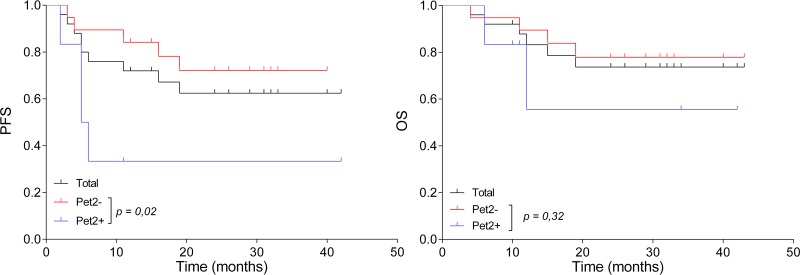
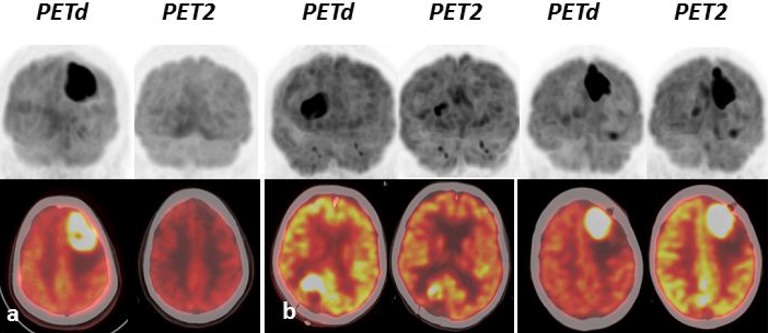
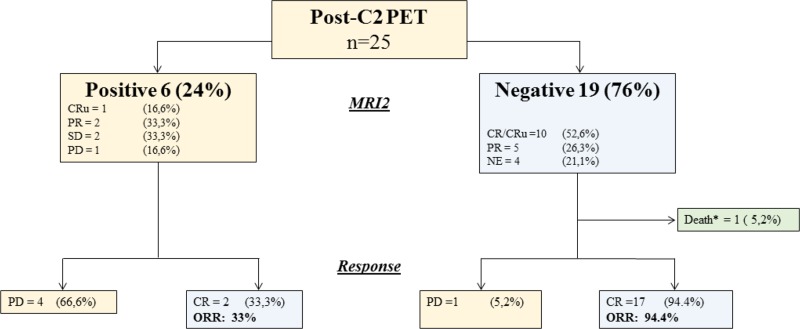
Primary central nervous system lymphoma (PCNSL) is a rare topographic variant of diffuse large B-cell lymphoma (DLBCL). While prognostic scales are useful in clinical trials, no dynamic prognostic marker is available in this disease. We report here the prognostic value of early metabolic response by 18F-FDG PET scanner (PET) in 25 newly diagnosed immunocompetent PCNSL patients. Induction treatment consisted of four cycles of Rituximab, Methotrexate and Temozolamide (RMT). Based on patient's general condition, consolidation by high-dose Etoposide and Aracytine was given to responding patients. Brain MRI and PET were performed at diagnosis, after two and four cycles of RMT, and after treatment completion. Two-year progression-free (PFS) and overall survival (OS) were 62% and 74%, respectively for the whole cohort. Best responses after RMT induction were 18 (72%) complete response (CR)/CR undetermined (CRu), 4 (16%) partial response, 1 (4%) progressive disease and 2 (8%) stable disease. Response evaluation was concordant between MRI and PET at the end of induction therapy. Nineteen patients (76%) had a negative PET2. Predictive positive and negative values of PET2 on end-of-treatment (ETR) CR were 66.67% and 94.74%, respectively. We observed a significant association between PET2 negativity and ETR ( = 0.001) and longer PFS ( = 0.02), while having no impact on OS ( = 0.32). Two years PFS was 72% and 33% for PET2- and PET2+ patients, respectively ( < 0.02). PET2 evaluation may help to early define a subgroup of CR PCNSL patients with a favorable outcome.
原发性中枢神经系统淋巴瘤(PCNSL)是弥漫性大B细胞淋巴瘤(DLBCL)一种罕见的部位变异型。虽然预后量表在临床试验中很有用,但该疾病尚无动态预后标志物。我们在此报告18F-氟代脱氧葡萄糖正电子发射断层扫描(PET)对25例新诊断的免疫功能正常的PCNSL患者早期代谢反应的预后价值。诱导治疗包括四个周期的利妥昔单抗、甲氨蝶呤和替莫唑胺(RMT)。根据患者的一般情况,对有反应的患者给予大剂量依托泊苷和阿糖胞苷巩固治疗。在诊断时、RMT两个周期和四个周期后以及治疗完成后进行脑部MRI和PET检查。整个队列的两年无进展生存期(PFS)和总生存期(OS)分别为62%和74%。RMT诱导后的最佳反应为18例(72%)完全缓解(CR)/未确定的CR(CRu)、4例(16%)部分缓解、1例(4%)疾病进展和2例(8%)疾病稳定。诱导治疗结束时,MRI和PET之间的反应评估一致。19例患者(76%)PET2呈阴性。PET2对治疗结束时(ETR)CR的预测阳性和阴性值分别为66.67%和94.74%。我们观察到PET2阴性与ETR(P = 0.001)和更长的PFS(P = 0.02)之间存在显著关联,而对OS无影响(P = 0.32)。PET2阴性和阳性患者的两年PFS分别为72%和33%(P < 0.02)。PET2评估可能有助于早期确定一组预后良好的CR PCNSL患者亚组。