van der Meulen Matthijs, Postma Alida A, Smits Marion, Bakunina Katerina, Minnema Monique C, Seute Tatjana, Cull Gavin, Enting Roelien H, van der Poel Marjolein, Stevens Wendy B C, Brandsma Dieta, Beeker Aart, Doorduijn Jeanette K, Issa Samar, van den Bent Martin J, Bromberg Jacoline E C
Department of Neuro-Oncology, Erasmus MC Cancer Institute, Brain Tumor Center, University Medical Center Rotterdam, Rotterdam, The Netherlands.
Department of Radiology and Nuclear Medicine, Maastricht University Medical Center, School for Mental Health and Sciences, Maastricht, The Netherlands.
Neurooncol Adv. 2021 Feb 15;3(1):vdab007. doi: 10.1093/noajnl/vdab007. eCollection 2021 Jan-Dec.
In primary central nervous system lymphoma (PCNSL), small enhancing lesions can persist after treatment. It is unknown whether a difference in response category (complete response [CR], complete response unconfirmed [CRu], or partial response [PR]) reflects survival. We aimed to determine the value of a central radiology review on response assessment and whether the extent of response influenced progression-free and/or overall survival.
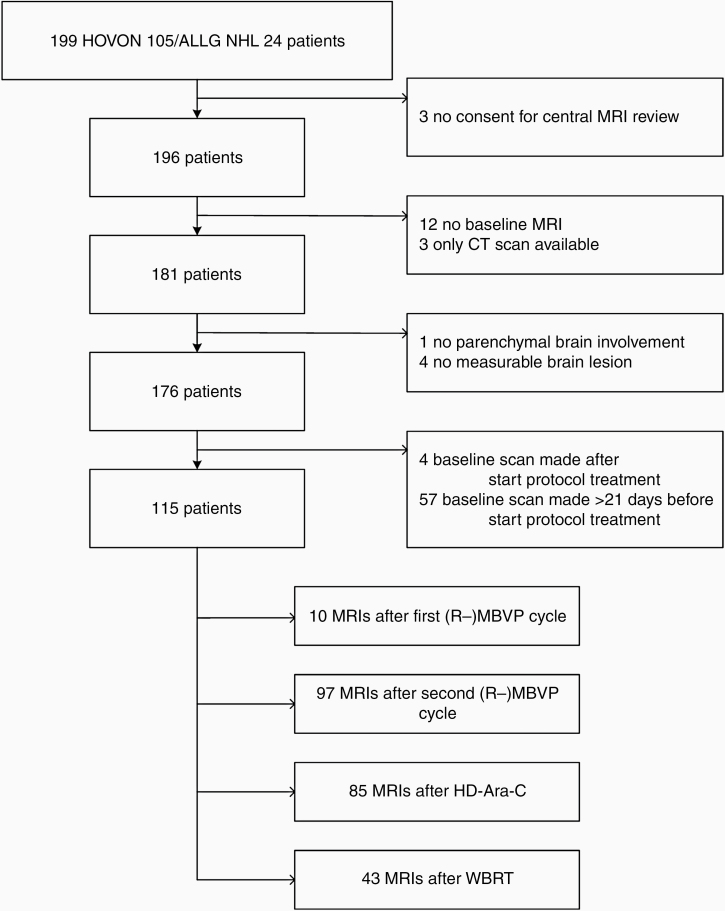
All patients in the HOVON 105/ALLG NHL 24 study with at least a baseline MRI and one MRI made for response evaluation available for central review were included. Tumor measurements were done by 2 independent central reviewers, disagreements were adjudicated by a third reviewer. Crude agreement and interobserver agreement (Cohen's kappa) were calculated. Differences in progression-free and overall survival between different categories of response at the end-of-protocol-treatment were assessed by the log-rank test in a landmark survival-analysis.
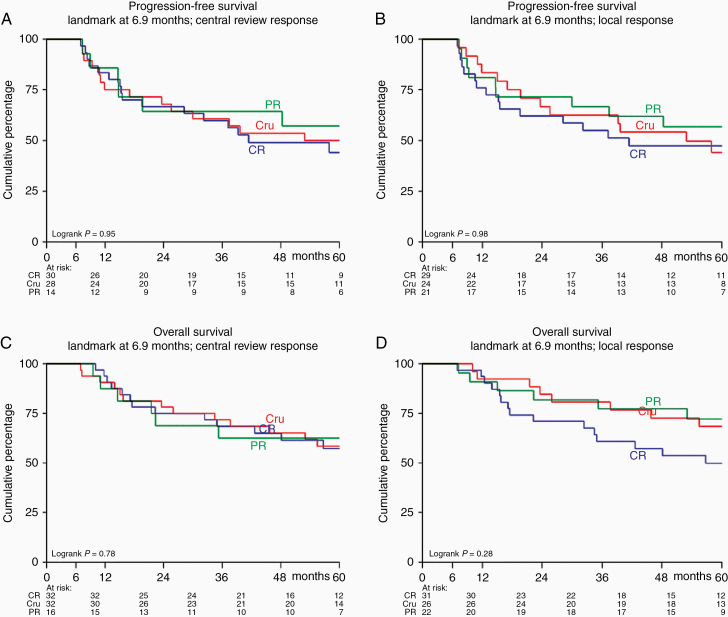
Agreement between the central reviewers was 61.7% and between local and central response assessment was 63.0%. Cohen's kappa's, which corrects for expected agreement, were 0.44 and 0.46 (moderate), respectively. Progression agreement or not was 93.3% (kappa 0.87) between local and central response assessment. There were no significant differences in progression-free and overall survival between patients with CR, CRu, or PR at the end-of-protocol-treatment, according to both local and central response assessment.
Reliability of response assessment (CR/CRu/PR) is moderate even by central radiology review and these response categories do not reliably predict survival. Therefore, primary outcome in PCNSL studies should be survival rather than CR or CR/CRu-rate.
在原发性中枢神经系统淋巴瘤(PCNSL)中,治疗后小的强化病灶可能持续存在。反应类别(完全缓解[CR]、未确认的完全缓解[CRu]或部分缓解[PR])的差异是否反映生存情况尚不清楚。我们旨在确定中心放射学评估对反应评估的价值,以及反应程度是否影响无进展生存期和/或总生存期。
纳入HOVON 105/ALLG NHL 24研究中所有至少有一次基线MRI且有一次用于反应评估的MRI可供中心审查的患者。肿瘤测量由2名独立的中心审查员进行,分歧由第三名审查员裁决。计算粗一致性和观察者间一致性(Cohen's kappa)。在一项标志性生存分析中,通过对数秩检验评估协议治疗结束时不同反应类别之间无进展生存期和总生存期的差异。
中心审查员之间的一致性为61.7%,局部与中心反应评估之间的一致性为63.0%。校正预期一致性的Cohen's kappa分别为0.44和0.46(中等)。局部与中心反应评估之间的进展一致性与否为93.3%(kappa 0.87)。根据局部和中心反应评估,协议治疗结束时CR、CRu或PR患者的无进展生存期和总生存期均无显著差异。
即使通过中心放射学审查,反应评估(CR/CRu/PR)的可靠性也为中等程度,且这些反应类别不能可靠地预测生存情况。因此PCNSL研究的主要结局应是生存,而非CR或CR/CRu率。