Department of Chemistry, University of Wisconsin-Madison, 1101 University Avenue, Madison, WI 53706, USA.
Department of Chemistry, University of Wisconsin-Madison, 1101 University Avenue, Madison, WI 53706, USA.
Biochim Biophys Acta Biomembr. 2018 Jul;1860(7):1470-1479. doi: 10.1016/j.bbamem.2018.04.009. Epub 2018 Apr 22.
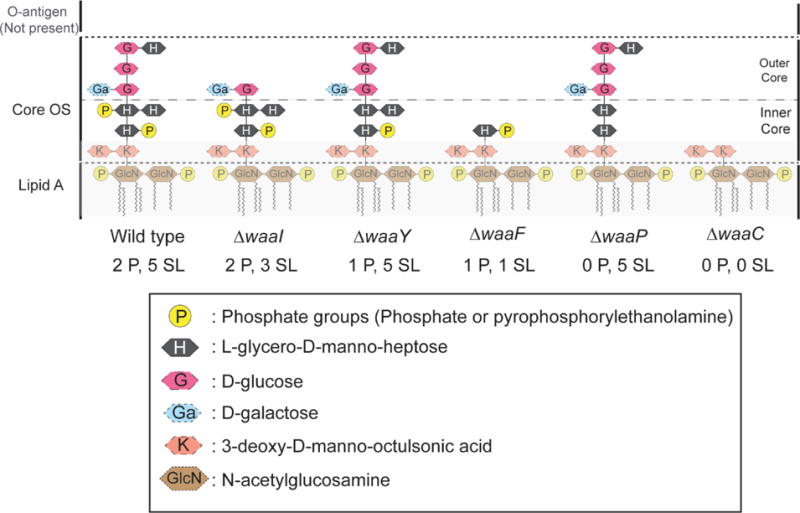
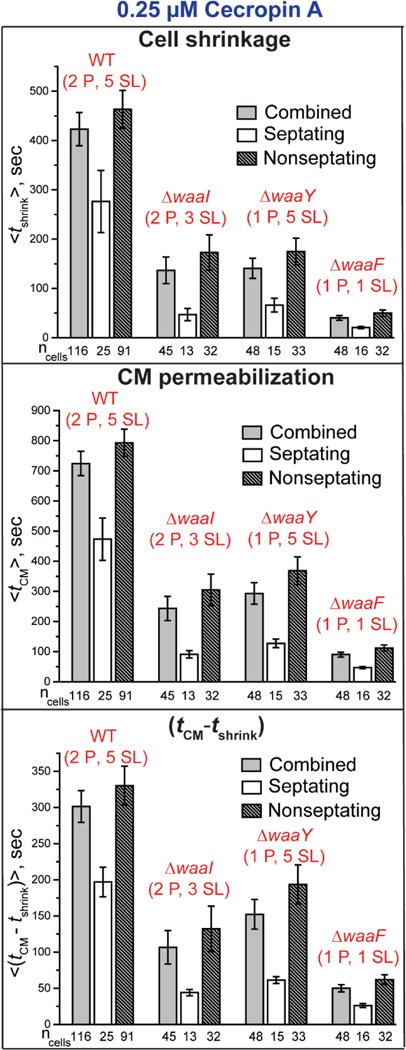
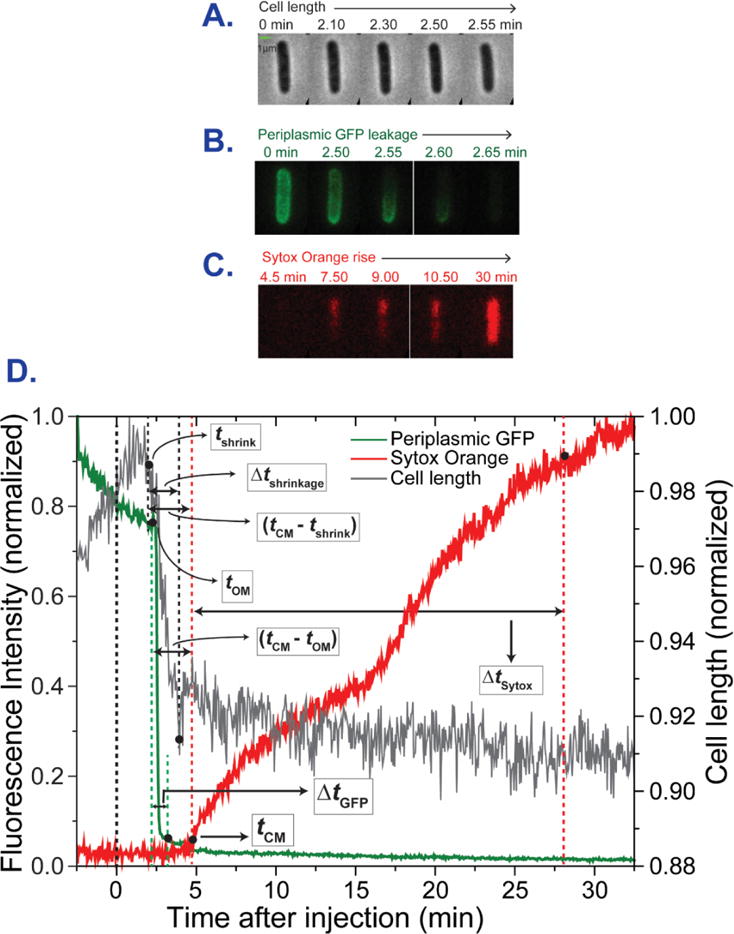
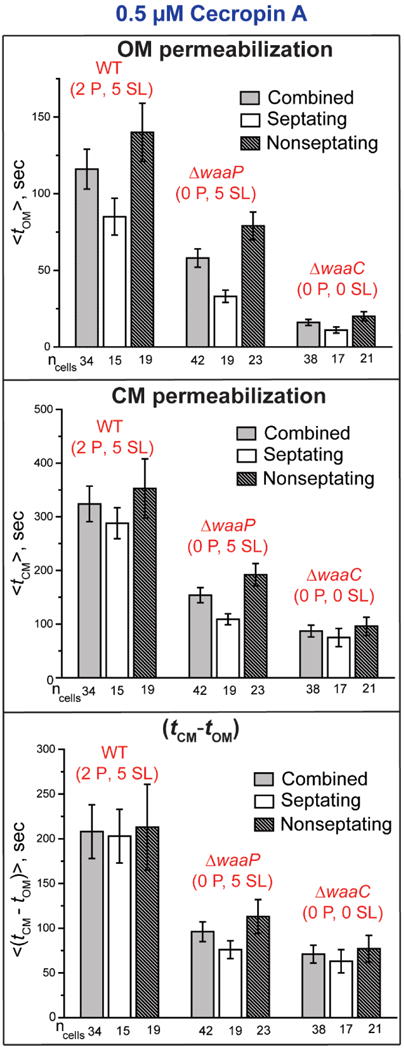
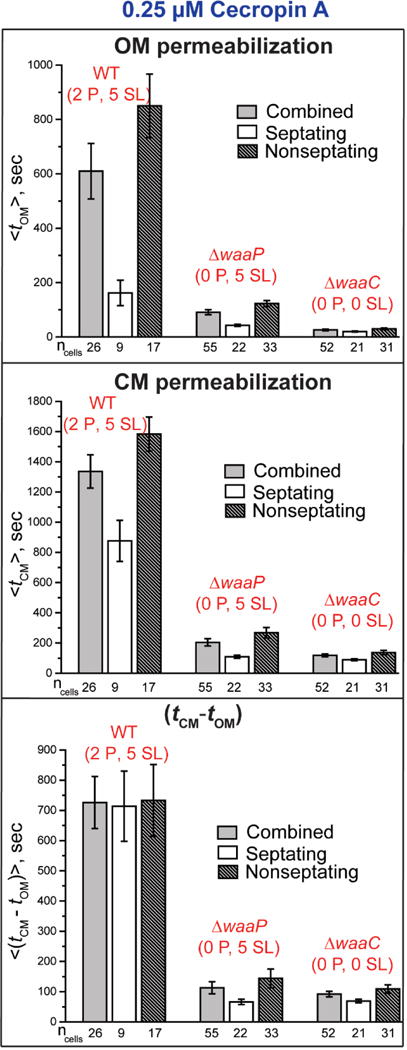
The outermost layer of Gram negative bacteria is composed of a lipopolysaccharide (LPS) network that forms a dense protective hydrophilic barrier against entry of hydrophobic drugs. At low μM concentrations, a large family of cationic polypeptides known as antimicrobial peptides (AMPs) are able to penetrate the LPS layer and permeabilize the outer membrane (OM) and the cytoplasmic membrane (CM), causing cell death. Cecropin A is a well-studied cationic AMP from moth. Here a battery of time-resolved, single-cell microscopy experiments explores how deletion of sugar layers and/or phosphoryl negative charges from the core oligosaccharide layer (core OS) of K12 E. coli alters the timing of OM and CM permeabilization induced by Cecropin A. Deletion of sugar layers, or phosphoryl charges, or both from the core OS shortens the time to the onset of OM permeabilization to periplasmic GFP and also the lag time between OM permeabilization and CM permeabilization. Meanwhile, the 12-h minimum inhibitory concentration (MIC) changes only twofold with core OS alterations. The results suggest a two-step model in which the core oligosaccharide layers act as a kinetic barrier to penetration of Cecropin A to the lipid A outer leaflet of the OM. Once a threshold concentration has built up at the lipid A leaflet, nucleation occurs and the OM is locally permeabilized to GFP and, by inference, to Cecropin A. Whenever Cecropin A permeabilizes the OM, CM permeabilization always follows, and cell growth subsequently halts and never recovers on the 45 min observation timescale.
革兰氏阴性细菌的最外层由脂多糖 (LPS) 网络组成,该网络形成了密集的亲水性保护层,可防止疏水性药物进入。在低 μM 浓度下,一大类被称为抗菌肽 (AMP) 的阳离子多肽能够穿透 LPS 层并使外膜 (OM) 和细胞质膜 (CM) 通透,导致细胞死亡。蚕素 A 是一种来自蛾的研究良好的阳离子 AMP。在这里,一系列时间分辨的单细胞显微镜实验探讨了 K12 E. coli 核心寡糖层 (core OS) 中糖层和/或磷酸基负电荷的缺失如何改变蚕素 A 诱导的 OM 和 CM 通透性的时间。core OS 中糖层或磷酸基电荷或两者的缺失都会缩短 OM 对质周 GFP 通透性的起始时间,也会缩短 OM 通透性和 CM 通透性之间的滞后时间。同时,核心 OS 改变后,12 小时最低抑菌浓度 (MIC) 仅变化两倍。结果表明,核心寡糖层作为一种动力学障碍,阻止蚕素 A 渗透到 OM 的脂质 A 外叶。一旦在脂质 A 叶层积聚了阈值浓度,就会发生成核,OM 会局部通透 GFP,并且推断,也会通透蚕素 A。只要蚕素 A 使 OM 通透,CM 通透性就会随之发生,随后细胞生长停止,在 45 分钟的观察时间内从未恢复。