Department of Psychology, Florida State University, 1107 West Call Street, Tallahassee, FL 32306, USA.
Department of Psychology, University of Houston, 3695 Cullen Boulevard, Houston, TX 77204, USA.
Compr Psychiatry. 2018 Jul;84:39-46. doi: 10.1016/j.comppsych.2018.03.014. Epub 2018 Apr 7.
Firefighters represent an occupational group at increased suicide risk. How suicidality develops among firefighters is poorly understood. The depression-distress amplification model posits that the effects of depression symptoms on suicide risk will be intensified in the context of anxiety sensitivity (AS) cognitive concerns. The current study tested this model among firefighters.
Overall, 831 firefighters participated (mean [SD] age = 38.37 y [8.53 y]; 94.5% male; 75.2% White). The Center for Epidemiologic Studies Depression Scale (CES-D), Anxiety Sensitivity Index-3 (ASI-3), and Suicidal Behaviors Questionnaire-Revised (SBQ-R) were utilized to assess for depression symptoms, AS concerns (cognitive, physical, social), and suicide risk, respectively. Linear regression interaction models were tested.
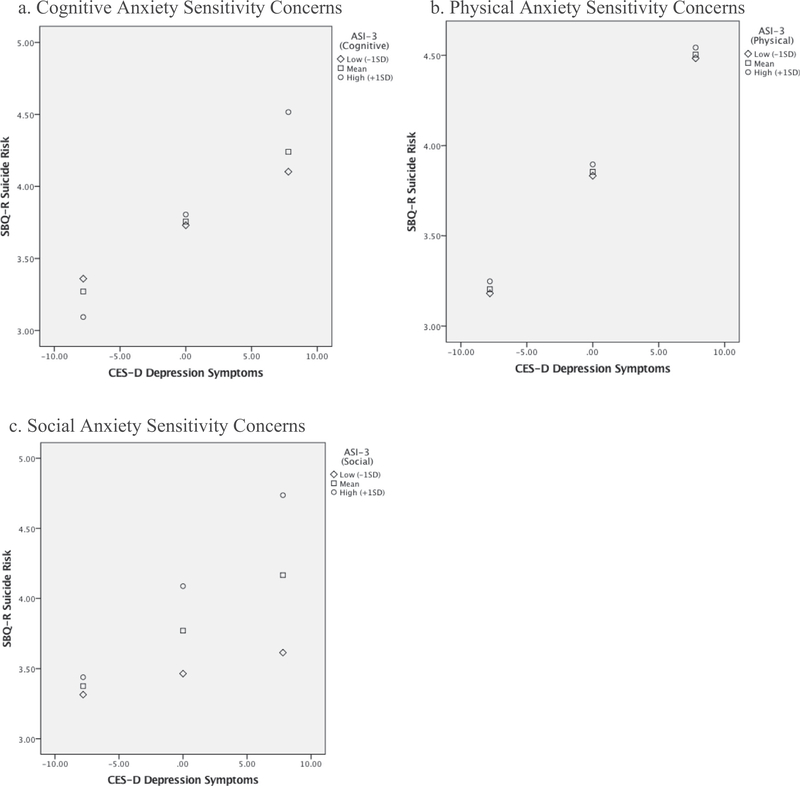
The effects of elevated depression symptoms on increased suicide risk were augmented when AS cognitive concerns were also elevated. Unexpectedly, depression symptoms also interacted with AS social concerns; however, consistent with expectations, depression symptoms did not interact with AS physical concerns in the prediction of suicide risk.
In the context of elevated depression symptoms, suicide risk is potentiated among firefighters reporting elevated AS cognitive and AS social concerns. Findings support and extend the depression-distress amplification model of suicide risk within a sample of firefighters. Interventions that successfully impact AS concerns may, in turn, mitigate suicide risk among this at-risk population.
消防员是自杀风险较高的职业群体。目前人们对消防员的自杀倾向是如何发展的知之甚少。抑郁-痛苦放大模型认为,在焦虑敏感(AS)认知担忧的背景下,抑郁症状对自杀风险的影响将会加剧。本研究在消防员中对此模型进行了测试。
共有 831 名消防员参与了研究(平均[标准差]年龄=38.37[8.53]岁;94.5%为男性;75.2%为白人)。使用抑郁症状自评量表(CES-D)、焦虑敏感量表-3(ASI-3)和修订后的自杀行为问卷(SBQ-R)分别评估抑郁症状、AS 认知(认知、躯体、社交)担忧和自杀风险。测试了线性回归交互模型。
当 AS 认知担忧升高时,抑郁症状对自杀风险增加的影响增强。出乎意料的是,抑郁症状也与 AS 社会担忧存在交互作用;然而,与预期一致,抑郁症状与 AS 躯体担忧在预测自杀风险方面没有交互作用。
在抑郁症状升高的情况下,报告 AS 认知和 AS 社会担忧升高的消防员自杀风险会增加。研究结果支持并扩展了在消防员样本中自杀风险的抑郁-痛苦放大模型。成功影响 AS 担忧的干预措施可能会反过来降低该高危人群的自杀风险。