Kwon Ki-Hyug, Bae Hansu, Kang Hyun Gu, In Junyong
Department of Anesthesiology and Pain Medicine, Dongguk University Ilsan Hospital, Goyang, Korea.
Korean J Anesthesiol. 2018 Jun;71(3):207-212. doi: 10.4097/kja.d.18.27068. Epub 2018 Apr 25.
The elimination of anesthetic agents is a decisive factor in the emergence from general anesthesia. In this pilot study, we hypothesized that hypercapnia would decrease the emergence time from propofol anesthesia by increasing cardiac output and cerebral blood flow.
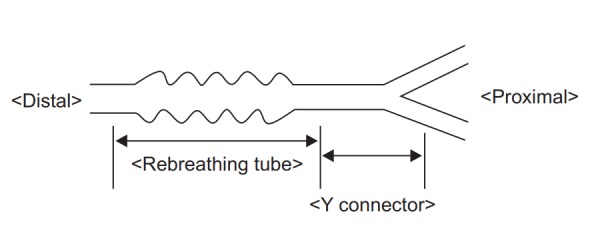
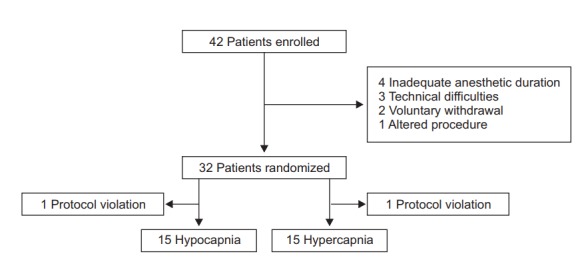
A total of 32 patients were randomly divided into two groups based on the end-tidal carbon dioxide values: 30 mmHg (the hypocapnia group) and 50 mmHg (the hypercapnia group). Propofol and remifentanil were infused to maintain a bispectral index of 40-50. Remifentanil infusion was stopped 10 min before the discontinuation of propofol. After cessation of propofol infusion, ventilation settings in the hypocapnia group were maintained constant; a rebreathing tube was connected to the respiratory circuit in the hypercapnia group. The time to spontaneous respiration, eye opening (primary endpoint), mouth opening, and tracheal extubation was recorded and analyzed.
Time to eye opening was 9.7 (1.3) min in the hypocapnia group and 9.0 (1.0) min in the hypercapnia group. The difference in the mean times to eye opening between groups was -0.7 min (95% CI, -4.0 to 2.7, P = 0.688). On multiple regression analysis, there was a significant difference in the mean time to eye opening between males and females. Females recovered about 3.6 min faster than males (95% CI, -6.1 to -1.1, P = 0.009).
We could not detect a beneficial effect of hypercapnia on propofol emergence time. Irrespective of hypercapnia, females seemed to recover faster than males.
麻醉药物的消除是全身麻醉苏醒的决定性因素。在这项初步研究中,我们假设高碳酸血症会通过增加心输出量和脑血流量来缩短丙泊酚麻醉后的苏醒时间。
根据呼气末二氧化碳值将32例患者随机分为两组:30 mmHg(低碳酸血症组)和50 mmHg(高碳酸血症组)。输注丙泊酚和瑞芬太尼以维持脑电双频指数在40 - 50。在停止输注丙泊酚前10分钟停止输注瑞芬太尼。停止输注丙泊酚后,低碳酸血症组的通气设置保持不变;高碳酸血症组将一个再呼吸管连接到呼吸回路。记录并分析自主呼吸时间、睁眼(主要终点)、张口和气管拔管时间。
低碳酸血症组的睁眼时间为9.7(±1.3)分钟,高碳酸血症组为9.0(±1.0)分钟。两组之间平均睁眼时间的差异为 -0.7分钟(95%置信区间,-4.0至2.7,P = 0.688)。在多元回归分析中,男性和女性之间的平均睁眼时间存在显著差异。女性比男性恢复快约3.6分钟(95%置信区间,-6.1至 -1.1,P = 0.009)。
我们未检测到高碳酸血症对丙泊酚苏醒时间有有益影响。无论是否存在高碳酸血症,女性似乎比男性恢复得更快。