Department of Biology, Oberlin College and Conservatory, K123 Science Center, 119 Woodland Street, Oberlin, OH, 44074, USA.
Blue Marble Space Institute of Science, Seattle, WA, 98154, USA.
J Mol Evol. 2018 Jun;86(5):277-282. doi: 10.1007/s00239-018-9842-z. Epub 2018 Apr 25.
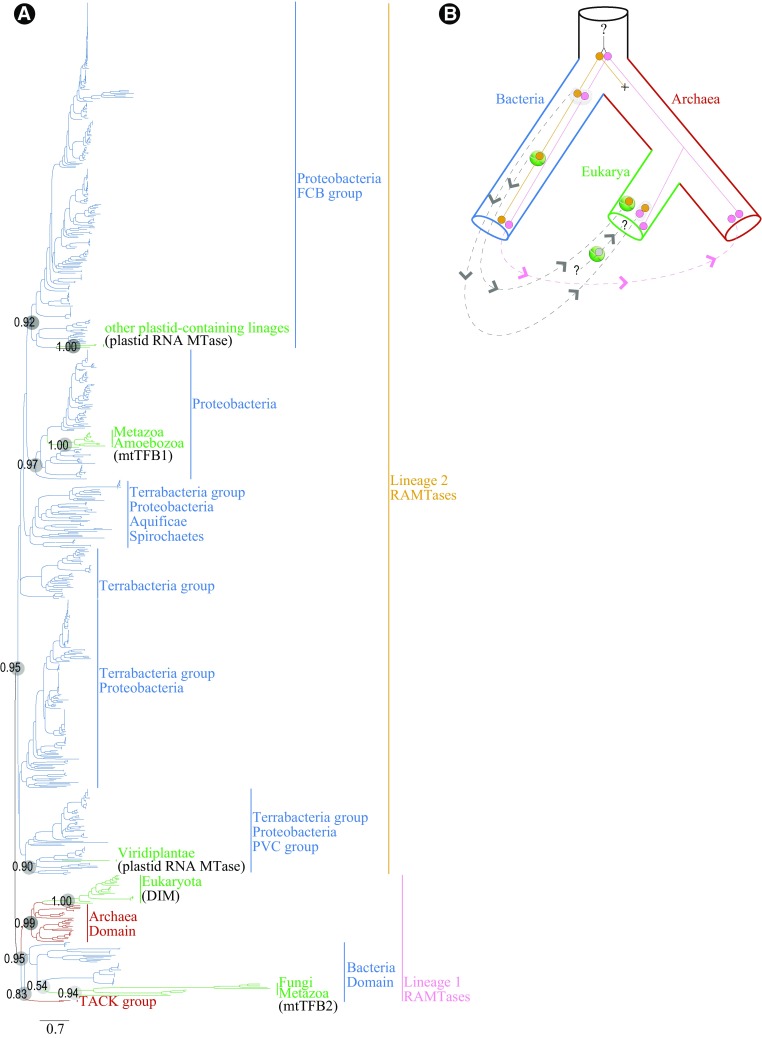
Here, we generate a robust phylogenetic framework for the rRNA adenine N(6)-methyltransferase (RAMTase) protein family that shows a more ancient and complex evolutionary history within the family than previously reported. RAMTases occur universally by descent across the three domains of life, and typical orthologs within the family perform methylation of the small subunits of ribosomal RNA (rRNA). However, within the RAMTase family, two different groups of mitochondrial transcription factors, mtTFB1 and mtTFB2, have evolved in eukaryotes through neofunctionalization. Previous phylogenetic analyses have suggested that mtTFB1 and mtTFB2 comprise sister clades that arose via gene duplication, which occurred sometime following the endosymbiosis event that produced the mitochondrion. Through dense and taxonomically broad sampling of RAMTase family members especially within bacteria, we found that these eukaryotic mitochondrial transcription factors, mtTFB1 and mtTFB2, have independent origins in phylogenetically distant clades such that their divergence most likely predates the last universal common ancestor of life. The clade of mtTFB2s comprises orthologs in Opisthokonts and the clade of mtTFB1s includes orthologs in Amoebozoa and Metazoa. Thus, we clearly demonstrate that the neofunctionalization producing the transcription factor function evolved twice independently within the RAMTase family. These results are consistent with and help to elucidate outcomes from prior experimental studies, which found that some members of mtTFB1 still perform the ancestral rRNA methylation function, and the results have broader implications for understanding the evolution of new protein functions. Our phylogenetic reconstruction is also in agreement with prior studies showing two independent origins of plastid RAMTases in Viridiplantae and other photosynthetic autotrophs. We believe that this updated phylogeny of RAMTases should provide a robust evolutionary framework for ongoing studies to identify and characterize the functions of these proteins within diverse organisms.
在这里,我们生成了一个强大的 rRNA 腺嘌呤 N(6)-甲基转移酶(RAMTase)蛋白家族的系统发育框架,该框架显示了该家族内比以前报道的更为古老和复杂的进化历史。RAMTases 通过遗传在生命的三个领域中普遍存在,并且家族内的典型直系同源物对核糖体 RNA(rRNA)的小亚基进行甲基化。然而,在 RAMTase 家族内,两种不同的线粒体转录因子 mtTFB1 和 mtTFB2 通过新功能化在真核生物中进化而来。先前的系统发育分析表明,mtTFB1 和 mtTFB2 构成姐妹分支,它们通过基因复制产生,该复制发生在产生线粒体的内共生事件之后。通过对 RAMTase 家族成员的密集和广泛的分类采样,特别是在细菌中,我们发现这些真核线粒体转录因子 mtTFB1 和 mtTFB2 具有独立的起源,它们的分化很可能发生在生命的最后共同祖先之前。mtTFB2 分支包含后生动物的直系同源物,而 mtTFB1 分支包含变形虫和后生动物的直系同源物。因此,我们清楚地表明,产生转录因子功能的新功能化在 RAMTase 家族内独立进化了两次。这些结果与先前的实验研究结果一致,并有助于阐明这些结果,这些研究发现一些 mtTFB1 成员仍具有祖先 rRNA 甲基化功能,并且该结果对于理解新蛋白质功能的进化具有更广泛的意义。我们的系统发育重建也与先前的研究一致,这些研究表明质体 RAMTases 在绿藻门和其他光合自养生物中有两个独立的起源。我们相信,这个更新的 RAMTase 系统发育应该为正在进行的研究提供一个强大的进化框架,以识别和表征这些蛋白质在不同生物体中的功能。