Dalili Kajan Zahra, Taramsari Mehran, Khosravi Fard Negar, Khaksari Farnoosh, Moghasem Hamidi Forough
Department of Maxillofacial Radiology, Dental School, Guilan University of Medical Sciences, Rasht, Iran.
Department of Endodontics, Dental School, Guilan University of Medical Sciences, Rasht, Iran.
Iran Endod J. 2018 Winter;13(1):47-53. doi: 10.22037/iej.v13i1.17352.
The purpose of this study was to evaluate the efficacy of cone-beam computed tomography CBCT in the diagnosis of RF in the presence of an intracanal posts with and without applying "metal artifact reduction" (MAR) mode.
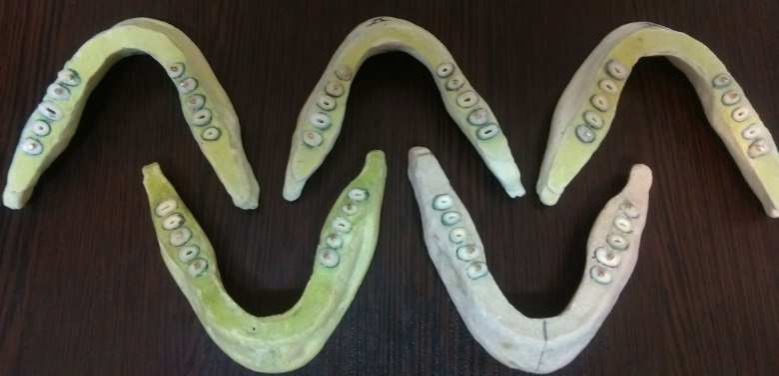
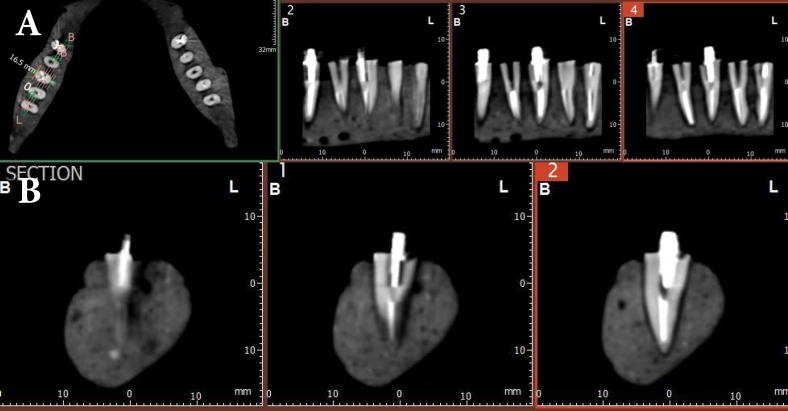
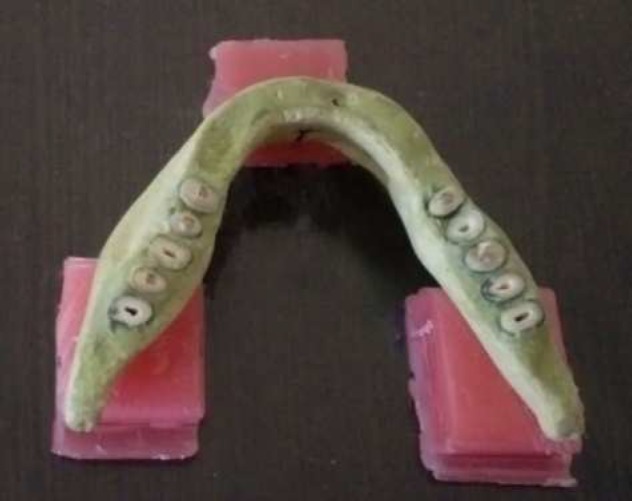
This study included 60 single-canal endodontically treated premolars. Post spaces were created in all roots. RFs were simulated in 30 of the 60 teeth. Dentatus posts were cemented in 15 of 30 roots with and without RFs. Teeth were arranged randomly in 6 artificial dental arches. Images were taken using a Vatech CBCT machine with and without MAR (MAR and WMAR, respectively). A radiologist and an endodontist evaluated the CBCT images for the presence of RFs. Sensitivity, Specificity, positive and negative predictive values were determined for each mode. MC Nemar's and Kappa tests were used for data analysis.
The percentage of correct diagnosis using the WMAR mode in both the post space and pin groups in the presence of root fracture was 46.6%; with MAR, it increased to 86.6% and 66.6%, respectively. There was no significant difference between two modes in post space (=0.503) and metal pin groups (0.549). The overall sensitivity of VRF diagnosis in WMAR mode was 46.67%; in MAR mode, sensitivity was 76.67%. The specificity of WMAR and MAR modes were 60% and 53.33%. The levels of agreement between two modes and real findings were less than 0.45.
There were no significant differences between the efficacies of imaging modes. The sensitivity of the MAR mode for diagnosis of VRF in both the pin and post space groups was higher than the WMAR mode. The specificity of MAR in comparison with WMAR was less or equal in dental groups. The agreement between CBCT and real findings was poor.
本研究的目的是评估锥形束计算机断层扫描(CBCT)在存在根管内桩且应用和不应用“金属伪影减少”(MAR)模式的情况下诊断根折(RF)的有效性。
本研究纳入了60颗经根管治疗的单根管前磨牙。在所有牙根中制备桩道。在60颗牙齿中的30颗上模拟根折。在30颗有和没有根折的牙根中的15颗上粘结齿科桩。将牙齿随机排列在6个人造牙弓中。使用Vatech CBCT机分别在有和没有MAR(分别为MAR和WMAR)的情况下采集图像。一名放射科医生和一名牙髓病医生评估CBCT图像中是否存在根折。确定每种模式的敏感性、特异性、阳性和阴性预测值。使用Mc Nemar检验和Kappa检验进行数据分析。
在存在根折的情况下,使用WMAR模式在桩道组和桩钉组中正确诊断的百分比为46.6%;使用MAR时,分别增至86.6%和66.6%。在桩道组(P = 0.503)和金属桩钉组(P = 0.549)中,两种模式之间无显著差异。WMAR模式下垂直根折(VRF)诊断的总体敏感性为46.67%;在MAR模式下,敏感性为76.67%。WMAR和MAR模式的特异性分别为60%和53.33%。两种模式与实际结果之间的一致性水平均低于0.45。
成像模式的有效性之间无显著差异。MAR模式在桩钉组和桩道组中诊断VRF的敏感性高于WMAR模式。在牙组中,MAR与WMAR相比特异性较低或相当。CBCT与实际结果之间的一致性较差。