Costantini Adrien, Corny Jennifer, Fallet Vincent, Renet Sophie, Friard Sylvie, Chouaid Christos, Duchemann Boris, Giroux-Leprieur Etienne, Taillade Laurent, Doucet Ludovic, Nguenang Marina, Jouveshomme Stéphane, Wislez Marie, Tredaniel Jean, Cadranel Jacques
Assistance Publique-Hôpitaux de Paris, Hôpital Tenon and GRC-04 Theranoscan, Paris, France.
Hôpital Saint-Joseph, Paris, France.
ERJ Open Res. 2018 Apr 20;4(2). doi: 10.1183/23120541.00120-2017. eCollection 2018 Apr.
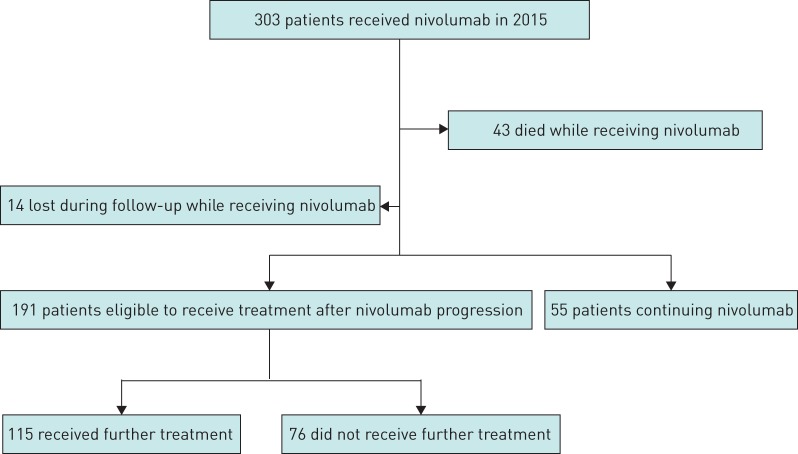
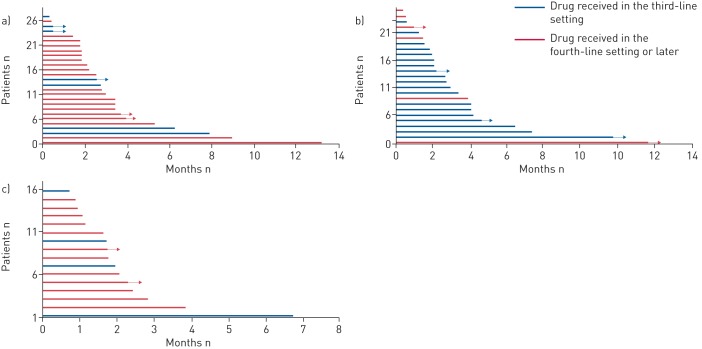
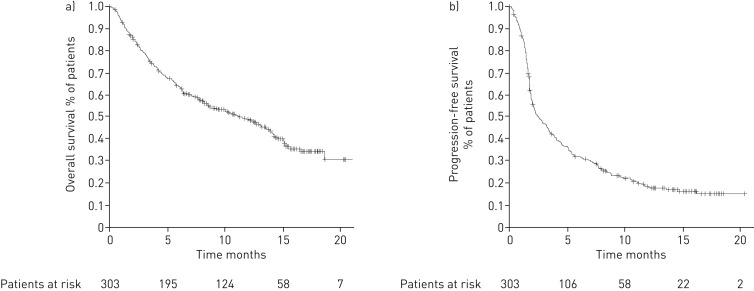
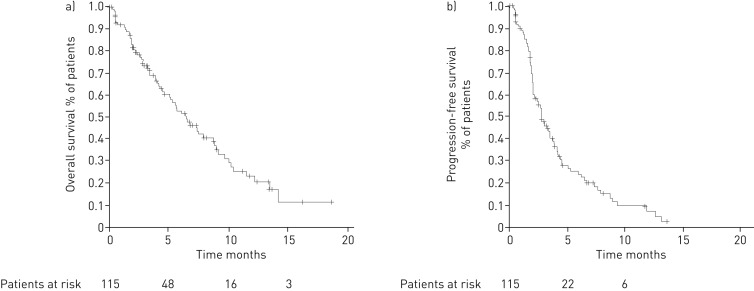
Nivolumab for the treatment of advanced nonsmall cell lung cancer (NSCLC) evaluated in phase III trials showed 50% progression at first evaluation, but better overall survival (OS), suggesting regained efficacy of treatments given thereafter. We aimed to evaluate the efficacy of nivolumab and of next treatment received after nivolumab progression in patients with advanced NSCLC. Our multicentre retrospective study included all patients receiving nivolumab between January and December 2015. The primary end-point was progression-free survival (PFS) of treatment given after nivolumab. The 303 patients had the following characteristics: median age 63 years, 69% males, 92% smokers, 67% performance status 0-1 and 61% adenocarcinoma. Nivolumab was given as second-line treatment in 40% of patients. With 13.7 months of median follow-up, nivolumab PFS and OS were 2.6 and 11.3 months, respectively. At the cut-off analysis 18% were controlled under nivolumab, 14% were deceased and 5% were lost to follow-up under nivolumab. Among the 191 (63%) patients eligible for post-nivolumab (PN) treatment, 115 (38%) received further treatment and were characterised by better performance status (p=0.028) and by receiving more injections of nivolumab (p=0.001). Global PN-OS and PN-PFS were 5.2 and 2.8 months, respectively. Drugs most frequently used after nivolumab were gemcitabine (23%), docetaxel (22%) and erlotinib (16%), with median PFS of 2.8, 2.7 and 2.0 months, respectively. Nivolumab produced similar efficacy as in phase III trials, although patients received nivolumab later and had worse performance status. 38% received treatment after nivolumab progression with efficacy comparable to historical second-line trials.
在III期试验中评估的用于治疗晚期非小细胞肺癌(NSCLC)的纳武单抗在首次评估时有50%的患者出现疾病进展,但总体生存期(OS)更佳,这表明后续给予的治疗恢复了疗效。我们旨在评估纳武单抗以及纳武单抗进展后接受的后续治疗对晚期NSCLC患者的疗效。我们的多中心回顾性研究纳入了2015年1月至12月期间所有接受纳武单抗治疗的患者。主要终点是纳武单抗治疗后给予的治疗的无进展生存期(PFS)。303例患者具有以下特征:中位年龄63岁,69%为男性,92%为吸烟者,67%的体能状态为0 - 1,61%为腺癌。40%的患者将纳武单抗作为二线治疗。中位随访13.7个月时,纳武单抗的PFS和OS分别为2.6个月和11.3个月。在截止分析时,18%的患者在纳武单抗治疗下病情得到控制,14%的患者死亡,5%的患者在纳武单抗治疗期间失访。在191例(63%)符合纳武单抗后(PN)治疗条件的患者中,115例(38%)接受了进一步治疗,其特征为体能状态更佳(p = 0.028)且接受纳武单抗注射次数更多(p = 0.001)。总体PN - OS和PN - PFS分别为5.2个月和2.8个月。纳武单抗进展后最常使用的药物是吉西他滨(23%)、多西他赛(22%)和厄洛替尼(16%),其PFS中位数分别为2.8个月、2.7个月和2.0个月。尽管患者接受纳武单抗治疗的时间较晚且体能状态较差,但纳武单抗产生的疗效与III期试验相似。38%的患者在纳武单抗进展后接受了治疗,其疗效与既往二线试验相当。