Department of Hepatobiliary Surgery, Central Hospital of China National Petroleum Corporation, Langfang, Hebei 065000, P.R. China.
Int J Mol Med. 2018 Jul;42(1):141-148. doi: 10.3892/ijmm.2018.3637. Epub 2018 Apr 20.
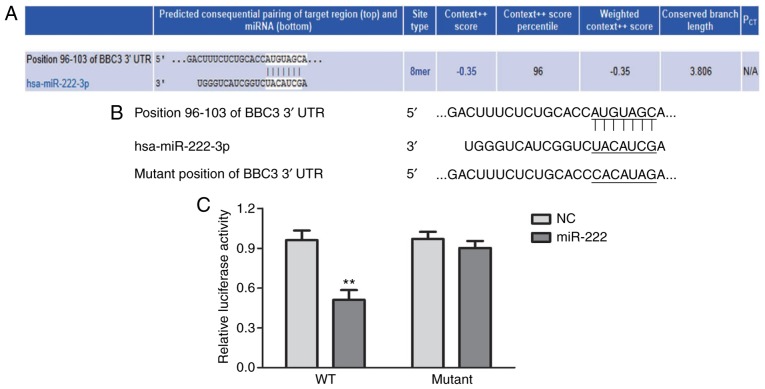
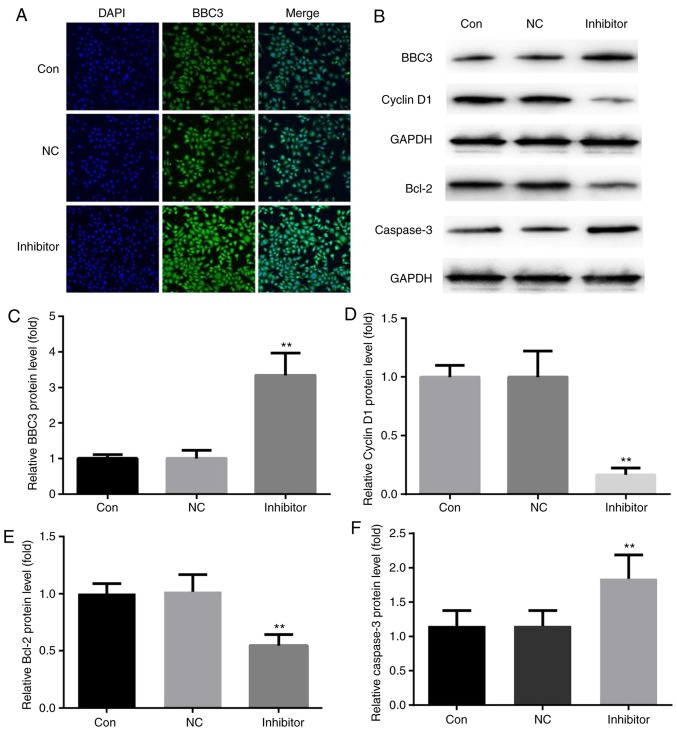
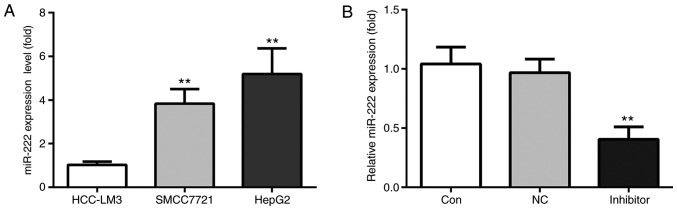
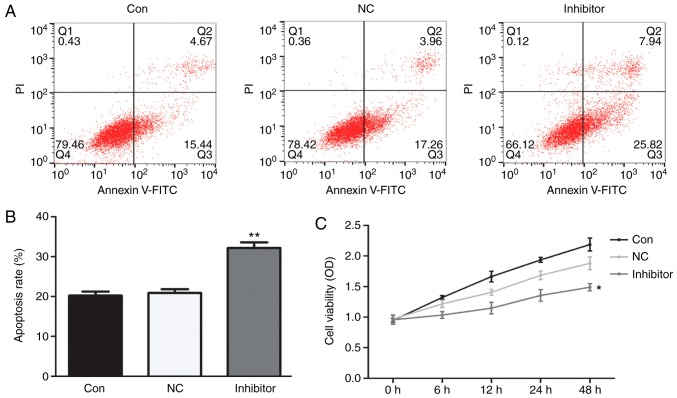
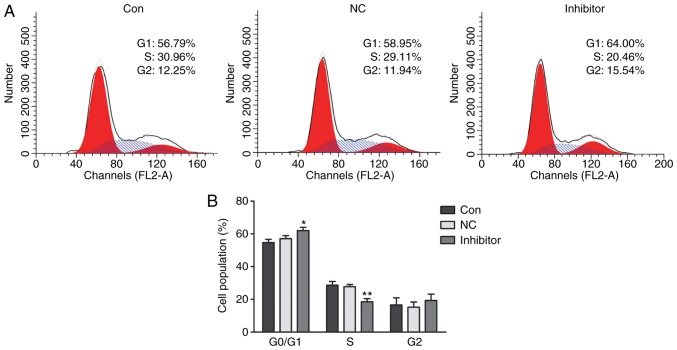
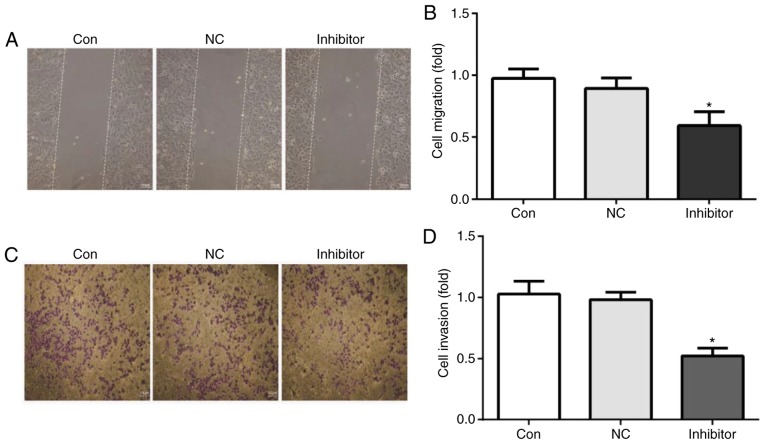
The present study aimed to investigate molecular mechanisms associated with liver cancer and provide a possible therapeutic target for the treatment of liver cancer. Liver cancer patients that were diagnosed and treated at the Central Hospital of China National Petroleum Corp. were included in the present study. microRNA (miR)‑222 was predicted to target B‑cell lymphoma-2 (Bcl‑2) binding component 3 (BBC3, also known as p53 upregulated modulator of apoptosis) by a bioinformatics analysis with TargetScan, which was verified by a dual‑luciferase reporter assay system. The correlations between BBC3 and miR‑222 levels and the patients' characteristics were analyzed. Furthermore, reverse transcription‑quantitative polymerase chain reaction was used to assess the mRNA levels of miRNA‑222 in the HCC‑LM3, MHCC97H and HepG2 cell lines. HepG2 cells were then transfected with miR‑222 inhibitor or miR‑negative control inhibitor. Cell proliferation, apoptosis, cell cycle, migration and invasion were evaluated by an MTT assay, flow cytometry, wound healing assay and Transwell assay, respectively. BBC3 was quantified by immunofluorescence and western blot analysis, and cyclin D1, Bcl‑2 and caspase‑3 levels were also evaluated by western blotting. miR‑222 inhibitor obviously inhibited HepG2 cell proliferation, migration, invasion, BBC3 and cyclin D1 protein expression levels and enhanced HepG2 cell apoptosis as well as the protein levels of Bcl‑2 and caspase‑3. miR‑222 level in tumors ≥5 cm (maximum) was significantly higher compared with tumors <5 cm (maximum) and was significantly higher in metastatic tumors compared with non‑metastatic tumors, while BBC3 level showed the adverse changes. The results of the present study suggested that miR‑222 inhibitor exerted anti‑cancer effects against liver cancer cells, probably by targeting the 3' untranslated region (UTR) of BBC3.
本研究旨在探讨与肝癌相关的分子机制,并为肝癌的治疗提供可能的治疗靶点。本研究纳入了在中国石油集团中心医院诊断和治疗的肝癌患者。通过 TargetScan 进行的生物信息学分析预测 microRNA(miR)-222 可靶向 B 细胞淋巴瘤-2(Bcl-2)结合成分 3(BBC3,也称为 p53 上调凋亡调节剂),并通过双荧光素酶报告基因检测系统进行了验证。分析了 BBC3 和 miR-222 水平与患者特征之间的相关性。此外,采用逆转录-定量聚合酶链反应(RT-qPCR)检测 HCC-LM3、MHCC97H 和 HepG2 细胞系中 miR-222 的 mRNA 水平。然后用 miR-222 抑制剂或 miR-阴性对照抑制剂转染 HepG2 细胞。通过 MTT 测定、流式细胞术、划痕愈合测定和 Transwell 测定分别评估细胞增殖、凋亡、细胞周期、迁移和侵袭。通过免疫荧光和 Western blot 分析测定 BBC3,通过 Western blot 测定评估细胞周期蛋白 D1、Bcl-2 和 caspase-3 水平。miR-222 抑制剂明显抑制 HepG2 细胞增殖、迁移、侵袭、BBC3 和 cyclin D1 蛋白表达水平,并增强 HepG2 细胞凋亡以及 Bcl-2 和 caspase-3 蛋白水平。肿瘤最大径≥5cm 的 miR-222 水平明显高于肿瘤最大径<5cm,转移瘤的 miR-222 水平明显高于非转移瘤,而 BBC3 水平则相反。本研究结果表明,miR-222 抑制剂对肝癌细胞发挥抗癌作用,可能通过靶向 BBC3 的 3'非翻译区(UTR)。