Department of Urology, The Second Affiliated Hospital of Soochow University, Suzhou, Jiangsu 215004, P.R. China.
Department of Ultrasound, The Second Affiliated Hospital of Soochow University, Suzhou, Jiangsu 215004, P.R. China.
Mol Med Rep. 2018 Jun;17(6):8111-8120. doi: 10.3892/mmr.2018.8905. Epub 2018 Apr 20.
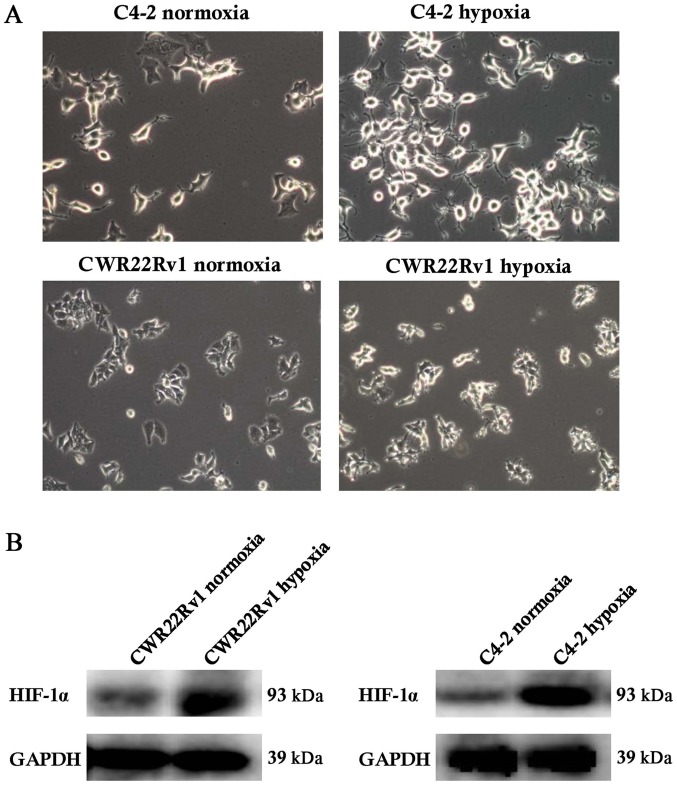
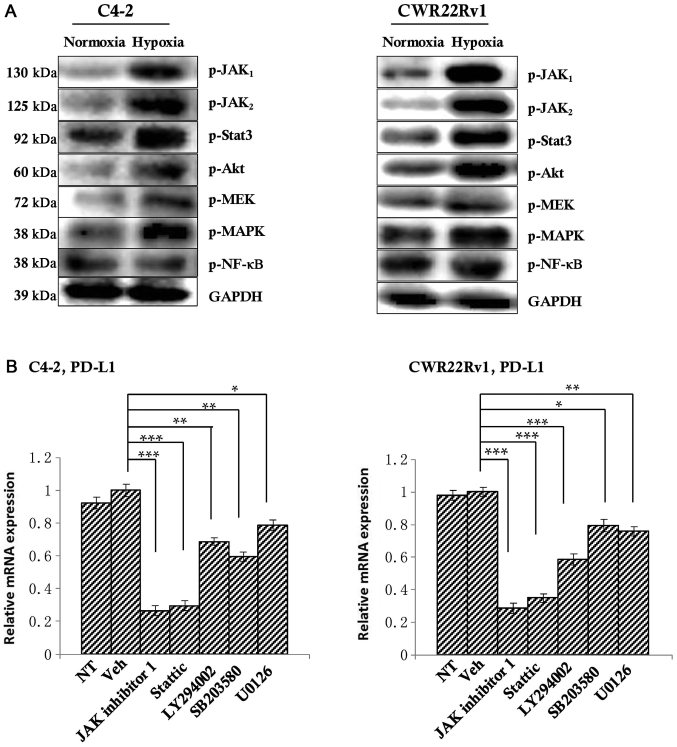
Castration‑resistant prostate cancer (CRPC) is difficult to treat in current clinical practice. Hypoxia is an important feature of the CRPC microenvironment and is closely associated with the progress of CRPC invasion. However, no research has been performed on the immune escape of CRPC from NK cells. The present study focused on this subject. Firstly, when the CRPC cell lines C4‑2 and CWR22Rv1 were induced by hypoxia, the expression of the UL16 binding protein (ULBP) ligand family of natural killer (NK) group 2D (NKG2D; ULBP‑1, ULBP‑2 and ULBP‑3) and MHC class I chain‑related proteins A and B (MICA/MICB) decreased. NKG2D is the main activating receptor of NK cells. Tumor cells were then co‑cultured with NK cells to conduct NK cell‑mediated cytotoxicity experiments, which revealed the decreased immune cytolytic activity of NK cells on hypoxia‑induced CRPC cells. In exploring the mechanism behind this observation, an increase in programmed death‑ligand 1 (PD‑L1) expression in CRPC cells induced by hypoxia was observed, while the addition of PD‑L1 antibody effectively reversed the expression of NKG2D ligand and enhanced the cytotoxic effect of NK cells on CRPC cells. In the process of exploring the upstream regulatory factors of PD‑L1, inhibition of the Janus kinase (JAK)1,2/signal transducer and activator of transcription 3 (Stat3) signaling pathway decreased the expression of PD‑L1 in CRPC cells. Finally, it was observed that combined inhibition of JAK1,2/PD‑L1 or Stat3/PD‑L1 was more effective than inhibition of a single pathway in enhancing the immune cytolytic activity of NK cells. Taking these results together, it is thought that combined inhibition of the JAK1,2/PD‑L1 and Stat3/PD‑L1 signaling pathways may enhance the immune cytolytic activity of NK cells toward hypoxia‑induced CRPC cells, which is expected to provide novel ideas and targets for the immunotherapy of CRPC.
去势抵抗性前列腺癌(CRPC)在当前的临床实践中难以治疗。缺氧是 CRPC 微环境的一个重要特征,与 CRPC 侵袭的进展密切相关。然而,目前还没有研究针对 CRPC 从 NK 细胞中免疫逃逸的问题。本研究对此进行了探讨。首先,当 CRPC 细胞系 C4-2 和 CWR22Rv1 被诱导缺氧时,NK 细胞的自然杀伤(NK)组 2D(NKG2D)的 UL16 结合蛋白(ULBP)配体家族和 MHC 类 I 链相关蛋白 A 和 B(MICA/MICB)的表达降低。NKG2D 是 NK 细胞的主要激活受体。然后将肿瘤细胞与 NK 细胞共培养,进行 NK 细胞介导的细胞毒性实验,结果显示 NK 细胞对缺氧诱导的 CRPC 细胞的免疫细胞溶解活性降低。在探索这种观察结果的机制时,发现缺氧诱导的 CRPC 细胞中程序性死亡配体 1(PD-L1)的表达增加,而添加 PD-L1 抗体可有效逆转 NKG2D 配体的表达,增强 NK 细胞对 CRPC 细胞的细胞毒性作用。在探索 PD-L1 的上游调节因子的过程中,抑制 Janus 激酶(JAK)1、2/信号转导和转录激活因子 3(Stat3)信号通路降低了 CRPC 细胞中 PD-L1 的表达。最后观察到,联合抑制 JAK1、2/PD-L1 或 Stat3/PD-L1 比抑制单一通路更能增强 NK 细胞的免疫细胞溶解活性。综上所述,认为联合抑制 JAK1、2/PD-L1 和 Stat3/PD-L1 信号通路可能增强 NK 细胞对缺氧诱导的 CRPC 细胞的免疫细胞溶解活性,有望为 CRPC 的免疫治疗提供新的思路和靶点。