Peron Mirco, Torgersen Jan, Berto Filippo
Department of Industrial and Mechanical Engineering, Norwegian University of Science and Technology, Richard Birkelands vei 2b, 7491 Trondheim, Norway.
Materials (Basel). 2018 Apr 25;11(5):663. doi: 10.3390/ma11050663.
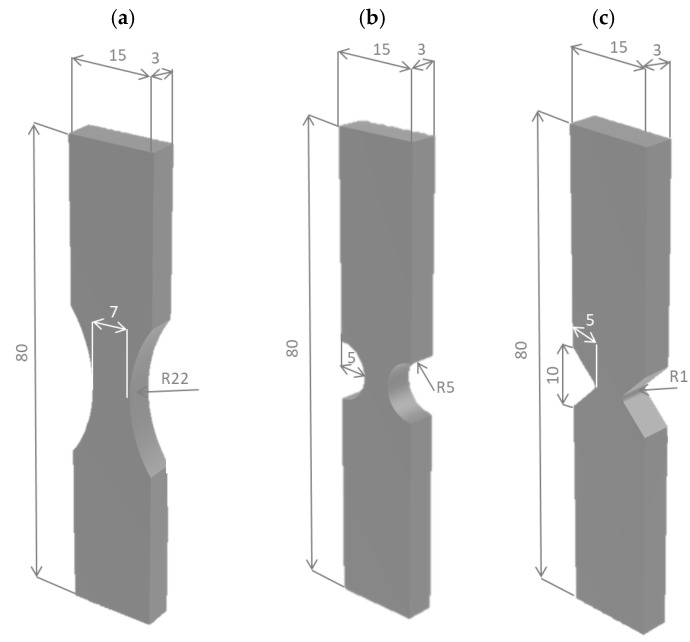
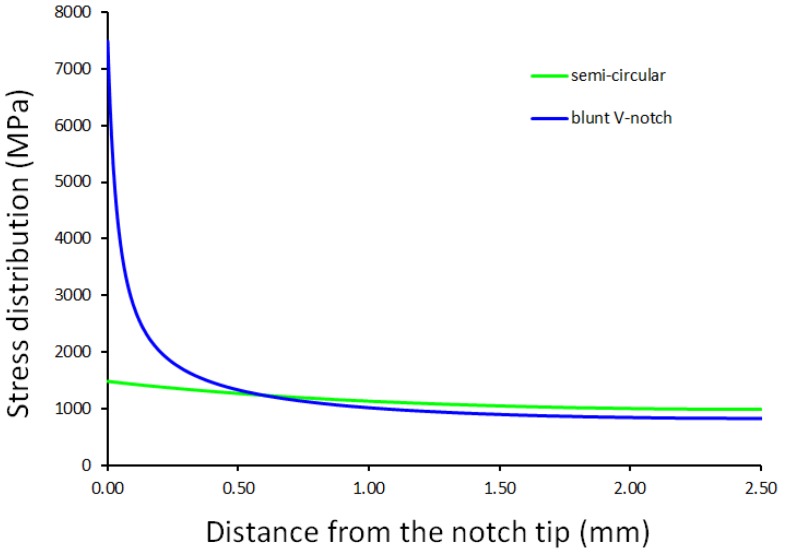
Ti-6Al-4V has been extensively used in structural applications in various engineering fields, from naval to automotive and from aerospace to biomedical. Structural applications are characterized by geometrical discontinuities such as notches, which are widely known to harmfully affect their tensile strength. In recent years, many attempts have been done to define solid criteria with which to reliably predict the tensile strength of materials. Among these criteria, two local approaches are worth mentioning due to the accuracy of their predictions, i.e., the strain energy density (SED) approach and the theory of critical distance (TCD) method. In this manuscript, the robustness of these two methods in predicting the tensile behavior of notched Ti-6Al-4V specimens has been compared. To this aim, two very dissimilar notch geometries have been tested, i.e., semi-circular and blunt V-notch with a notch root radius equal to 1 mm, and the experimental results have been compared with those predicted by the two models. The experimental values have been estimated with low discrepancies by either the SED approach and the TCD method, but the former results in better predictions. The deviations for the SED are in fact lower than 1.3%, while the TCD provides predictions with errors almost up to 8.5%. Finally, the weaknesses and the strengths of the two models have been reported.
Ti-6Al-4V已广泛应用于从海军到汽车、从航空航天到生物医学等各个工程领域的结构应用中。结构应用的特点是存在几何不连续性,如缺口,众所周知,缺口会对其拉伸强度产生有害影响。近年来,人们进行了许多尝试来定义可靠预测材料拉伸强度的可靠标准。在这些标准中,有两种局部方法因其预测的准确性值得一提,即应变能密度(SED)方法和临界距离理论(TCD)方法。在本论文中,比较了这两种方法在预测带缺口Ti-6Al-4V试样拉伸行为方面的稳健性。为此,测试了两种非常不同的缺口几何形状,即半圆形和钝V形缺口,缺口根部半径等于1mm,并将实验结果与两种模型预测的结果进行了比较。通过SED方法和TCD方法估计的实验值差异较小,但前者的预测效果更好。实际上,SED的偏差低于1.3%,而TCD提供的预测误差几乎高达8.5%。最后,报告了这两种模型的优缺点。