Department of Medicine and Biosystemic Science, Kyushu University Graduate School of Medical Sciences, Fukuoka, Japan.
Department of Internal Medicine and Clinical Immunology, Kyushu University Beppu Hospital, Beppu, Japan.
PLoS One. 2018 Apr 25;13(4):e0196368. doi: 10.1371/journal.pone.0196368. eCollection 2018.
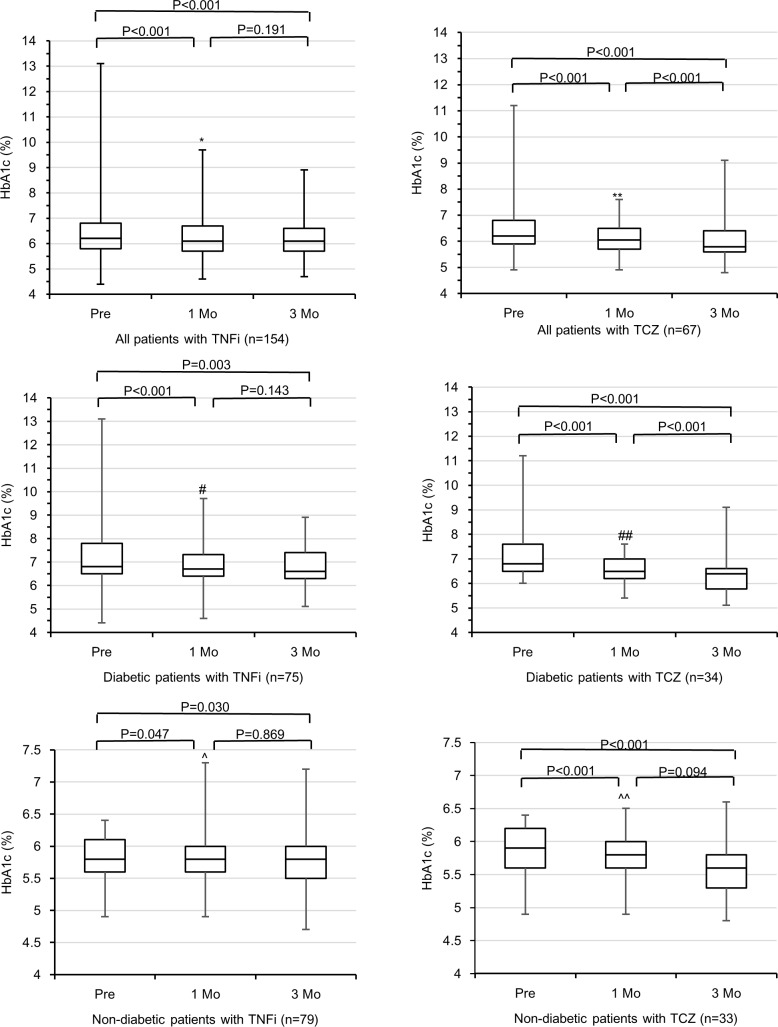
Rheumatoid arthritis (RA) and diabetes mellitus (DM) are associated with inflammation. We tried to investigate the influence of tumor necrosis factor inhibitors (TNFi) and tocilizumab (TCZ) on the glucose metabolism of RA patients. RA patients in whom treatment with TNFi or TCZ was initiated from 2008 to 2015 were studied based on their medical records. We analyzed patients whose glycosylated hemoglobin (HbA1c) levels were measured both before and 3 months after the initiation of these biologic agents. The association between HbA1c reduction and the treatment was evaluated. From 971 cases treated with these biologic agents, 221 cases whose medical records of HbA1c were available, were included (TNFi, n = 154; TCZ, n = 67). Both the TNFi and TCZ groups had significantly lower HbA1c values at 1 month and 3 months after the initiation of treatment (TNFi, p<0.001; TCZ, p<0.001). Although the pretreatment HbA1c values did not differ (TNFi, 6.2%; TCZ, 6.2%; p = 0.532), the 3-month treatment HbA1c values were lower (TNFi, 6.1%; TCZ, 5.8%; p = 0.010) and the changes in HbA1c (ΔHbA1c) were greater (TNFi, 0.1%; TCZ, 0.4%; p<0.001) in the TCZ group. The reduction of HbA1c-defined by the achievement of a ΔHbA1c of ≥0.5%-was associated with baseline diagnosis of diabetes mellitus, baseline diabetes treatment, hospitalization, medical change during the observation period, and TCZ. In the multivariate logistic regression analysis, TCZ was associated with the reduction of HbA1c in comparison to TNFi (adjusted OR = 5.59, 95% CI = 2.56-12.2; p<0.001). The HbA1c levels in RA patients were significantly lower after the initiation of TNFi or TCZ. Our study suggests that TCZ decreases the HbA1c levels in RA patients to a greater extent than TNFi.
类风湿关节炎 (RA) 和糖尿病 (DM) 与炎症有关。我们试图研究肿瘤坏死因子抑制剂 (TNFi) 和托珠单抗 (TCZ) 对 RA 患者糖代谢的影响。基于病历资料,对 2008 年至 2015 年间开始使用 TNFi 或 TCZ 治疗的 RA 患者进行了研究。我们分析了这些生物制剂治疗前和治疗后 3 个月均有糖化血红蛋白 (HbA1c) 水平测量值的患者。评估了 HbA1c 降低与治疗之间的关系。在接受这些生物制剂治疗的 971 例患者中,有 221 例患者的 HbA1c 病历资料可用(TNFi,n = 154;TCZ,n = 67)。TNFi 和 TCZ 组治疗后 1 个月和 3 个月的 HbA1c 值均显著降低(TNFi,p<0.001;TCZ,p<0.001)。尽管治疗前的 HbA1c 值没有差异(TNFi,6.2%;TCZ,6.2%;p = 0.532),但 3 个月的治疗 HbA1c 值较低(TNFi,6.1%;TCZ,5.8%;p = 0.010),且 HbA1c 的变化(ΔHbA1c)更大(TNFi,0.1%;TCZ,0.4%;p<0.001)在 TCZ 组。通过实现 HbA1c 的降低≥0.5%来定义的 HbA1c 降低与基线诊断的糖尿病、基线糖尿病治疗、住院、观察期间的医疗变化和 TCZ 有关。在多变量逻辑回归分析中,与 TNFi 相比,TCZ 与 HbA1c 的降低相关(调整后的 OR = 5.59,95%CI = 2.56-12.2;p<0.001)。RA 患者开始使用 TNFi 或 TCZ 后,HbA1c 水平显著降低。我们的研究表明,与 TNFi 相比,TCZ 可更大程度地降低 RA 患者的 HbA1c 水平。