Molina Maria Del Carmen Bisi, Pereira Taísa Sabrina Silva, Porto Aline Silva, Silva Raiane Pereira, Santana Nathália Miguel Teixeira, Cade Nágela Valadão, Mill José Geraldo
Department of Integrated Health Education, Universidade Federal do Espírito Santo, Vitória, ES, Brazil.
Universidade Federal do Espírito Santo, Vitória, ES, Brazil.
Sao Paulo Med J. 2018 Apr 23;136(2):150-156. doi: 10.1590/1516-3180.2017.0210031117. Print 2018 Mar-Apr.
Evaluation of sodium and potassium intake can be carried out using different methods. Biological markers are able to capture intra and inter-individual variability and are used as separate measurements of consumption. The aim of this study was to test the validity of a single measurement of urinary sodium and potassium excretion as representative of habitual intake.
Longitudinal study, federal university.
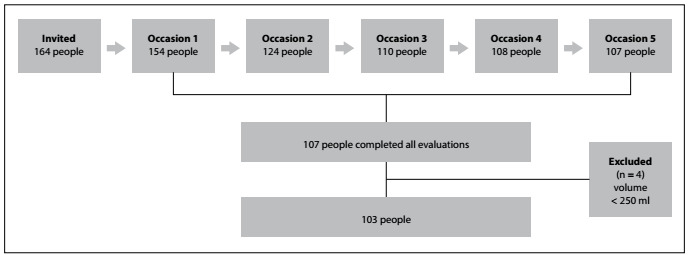
Food consumption data from a sample of adult university students and public servants (25 to 74 years old) were collected through 24-hour records and 12-hour urinary sodium and potassium excretion at five different times over a one-year period. The dietary data were entered into a nutritional research data software system and the sodium and potassium intakes were estimated. The variables were tested for normal distribution using the Kolmogorov-Smirnov test. One-way analysis of variance or the Kruskal-Wallis test was used to evaluate means. Correlations between measurements using Pearson or Spearman coefficients were calculated. The degree of agreement between the five measurements was given by the intraclass correlation coefficient.
Satisfactory agreement was found between the five measurements of urinary sodium and potassium excretion over a year, with little variability in consumption.
A single measurement of urinary sodium and potassium accurately estimated the usual average consumption of these electrolytes. This can be used in population-based studies.
钠和钾摄入量的评估可采用不同方法。生物标志物能够捕捉个体内和个体间的变异性,并被用作摄入量的单独测量指标。本研究的目的是检验单次测量尿钠和钾排泄量作为习惯性摄入量代表的有效性。
纵向研究,联邦大学。
通过24小时饮食记录以及在一年中的五个不同时间点收集成年大学生和公务员(25至74岁)样本的12小时尿钠和钾排泄量,获取食物消费数据。将饮食数据录入营养研究数据软件系统,并估算钠和钾的摄入量。使用柯尔莫哥洛夫-斯米尔诺夫检验对变量进行正态分布检验。采用单因素方差分析或克鲁斯卡尔-沃利斯检验评估均值。使用皮尔逊或斯皮尔曼系数计算测量值之间的相关性。五次测量之间的一致性程度由组内相关系数给出。
一年中五次尿钠和钾排泄量测量之间发现了令人满意的一致性,摄入量变化很小。
单次测量尿钠和钾能准确估算这些电解质的通常平均摄入量。这可用于基于人群的研究。