From the Cleveland Clinic Lou Ruvo Center for Brain Health (J.L.C.), Las Vegas, NV; Toronto Memory Program (S.C.), ON, Canada; Alzheimer's Disease Research Unit (C.H.v.D.), Yale University School of Medicine, New Haven, CT; Brain Matters Research Inc (M.B.), Delray Beach, FL; Compass Research, LLC (C.C.), Orlando, FL; Genentech (W.C., M.W., M.F., F.B., A.Q., L.A.H., R.N.F., D.C., D.M., C.H., R.P.), South San Francisco, CA; and Roche Diagnostics (C.R.), Penzberg, Germany.
Neurology. 2018 May 22;90(21):e1889-e1897. doi: 10.1212/WNL.0000000000005550. Epub 2018 Apr 25.
To evaluate the safety and efficacy of crenezumab in patients with mild to moderate Alzheimer disease (AD).
In this phase 2 trial, 431 patients with mild to moderate AD 50 to 80 years of age were randomized 2:1 (crenezumab:placebo). Patients received low-dose subcutaneous crenezumab 300 mg or placebo every 2 weeks (n = 184) or high-dose intravenous crenezumab 15 mg/kg or placebo every 4 weeks (n = 247) for 68 weeks. Primary outcome measures were change in Alzheimer's Disease Assessment Scale-Cognitive Subscale (ADAS-Cog12) and Clinical Dementia Rating-Sum of Boxes scores from baseline to week 73.
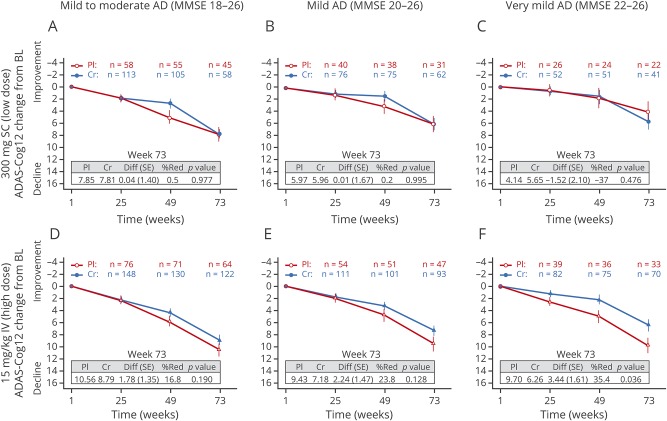
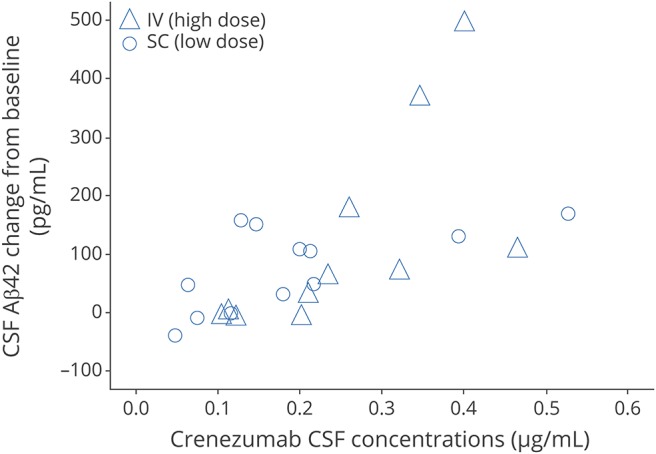
The primary and secondary endpoints were not met. In an exploratory post hoc analysis, a reduction in decline on the ADAS-Cog12 was observed in the high-dose group. Separation from the placebo group on the ADAS-Cog12 was greatest in the milder subsets of AD patients and reached statistical significance in the group with Mini-Mental State Examination scores of 22 to 26. In both groups, there was a significant increase in CSF β-amyloid levels that correlated with crenezumab CSF levels. The overall rate of adverse events was balanced between groups. One case of amyloid-related imaging abnormalities indicative of vasogenic edema or effusions was reported.
Although prespecified criteria for testing treatment effects were not met, these data suggest a potential treatment effect in patients with mild AD treated with high-dose crenezumab. Together with the safety profile for crenezumab, these data support the exploration of crenezumab treatment at even higher doses in patients with early AD.
NCT 01343966.
This study provides Class II evidence that, for people with AD, crenezumab does not significantly improve cognition or function at 18 months. The study is rated Class II because <80% of enrolled patients completed the study.
评估 crenezumab 在轻度至中度阿尔茨海默病(AD)患者中的安全性和疗效。
在这项 2 期试验中,431 名 50 至 80 岁的轻度至中度 AD 患者被随机分为 2:1(crenezumab:安慰剂)。患者接受低剂量皮下 crenezumab 300 mg 或安慰剂每 2 周(n = 184)或高剂量静脉内 crenezumab 15 mg/kg 或安慰剂每 4 周(n = 247)治疗 68 周。主要终点是从基线到第 73 周时阿尔茨海默病评估量表-认知子量表(ADAS-Cog12)和临床痴呆评定量表-总评分的变化。
主要和次要终点均未达到。在探索性事后分析中,高剂量组观察到 ADAS-Cog12 下降减少。在 AD 患者的较轻亚组中,ADAS-Cog12 与安慰剂组分离最大,并在 Mini-Mental State Examination 评分 22 至 26 的组中达到统计学意义。在两组中,CSF β-淀粉样蛋白水平均显著升高,与 crenezumab CSF 水平相关。不良事件的总发生率在两组之间平衡。报告了一例提示血管源性水肿或渗出的淀粉样相关成像异常。
尽管未达到测试治疗效果的预设标准,但这些数据表明,高剂量 crenezumab 治疗轻度 AD 患者可能有潜在的治疗效果。结合 crenezumab 的安全性概况,这些数据支持在早期 AD 患者中甚至更高剂量探索 crenezumab 治疗。
CLINICALTRIALSGOV 标识符:NCT 01343966。
这项研究提供了 II 级证据,表明对于 AD 患者,crenezumab 在 18 个月时不会显著改善认知或功能。该研究被评为 II 级,因为 <80%的入组患者完成了研究。