Department of Geriatric Psychiatry, Central Institute of Mental Health, Mannheim, Germany.
Boehringer Ingelheim (Canada) Ltd., Burlington, ON, Canada.
Alzheimers Res Ther. 2019 Feb 12;11(1):18. doi: 10.1186/s13195-019-0467-2.
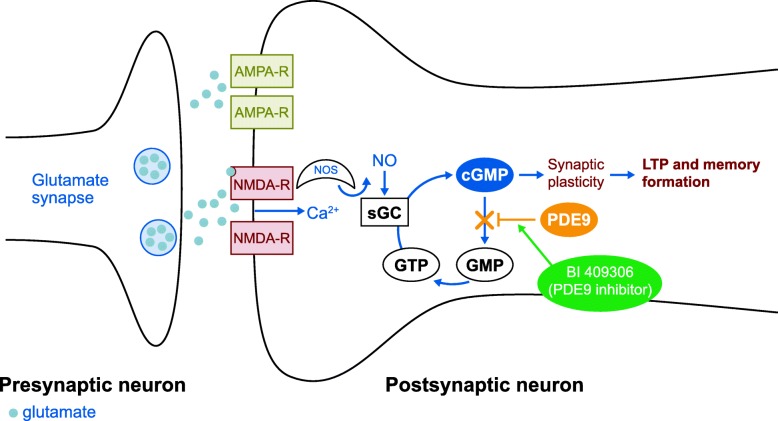
There are currently no approved treatments for the prodromal stage of Alzheimer's disease (AD). Approved symptomatic treatments for mild-to-moderate AD include acetylcholinesterase inhibitors and memantine, but more efficacious treatments are needed. BI 409306 is a potent and selective phosphodiesterase 9 inhibitor assessed for the symptomatic treatment of AD. Efficacy and safety of BI 409306 was analysed in two phase II proof-of-concept clinical trials in cognitive impairment associated with prodromal AD (study 1) and mild AD (study 2).
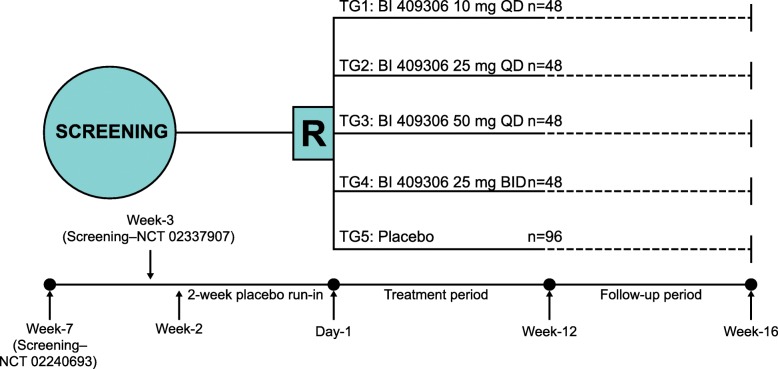
Two multicentre, double-blind, parallel-group, randomised controlled phase II studies were conducted (North America/Europe). Following study run-in, eligible subjects were randomised to one of four oral doses of BI 409306 (10-50 mg daily) or placebo (1:1:1:1:2 ratio) for 12 weeks. The primary efficacy endpoint was the change from baseline in Neuropsychological Test Battery (NTB) total z-score after 12 weeks' treatment. Secondary efficacy assessments included change from baseline in Clinical Dementia Rating scale-Sum of Boxes (CDR-SB), Alzheimer's Disease Assessment Scale-cognitive subscale (ADAS-Cog11) and Alzheimer's Disease Cooperative Study-Activities of Daily Living scale (ADCS-ADL; mild cognitive impairment [MCI] version for prodromal patients) after 12 weeks' treatment. Safety and tolerability assessments included adverse event reporting and vital sign monitoring. Change from baseline in NTB total z-score (primary endpoint) and CDR-SB were analysed using the restricted maximum likelihood-based mixed-effects model with repeated measurement. An analysis of covariance model was used to assess other secondary endpoints.
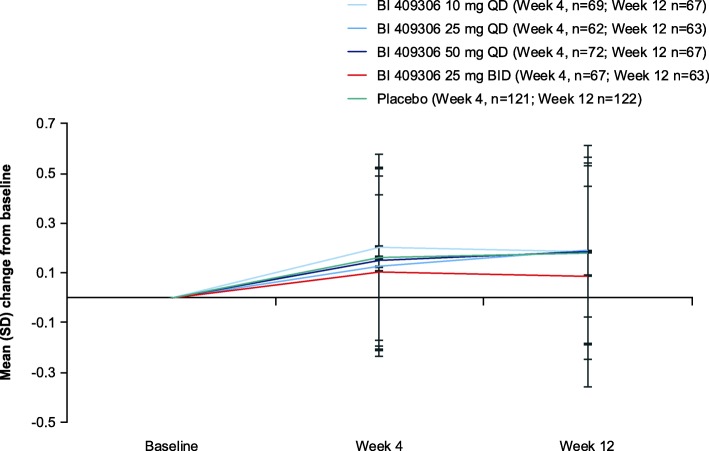
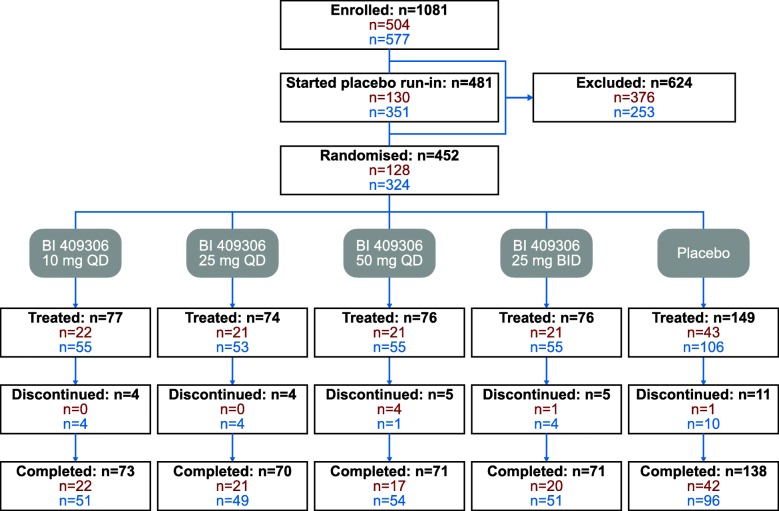
Four hundred fifty-seven patients were randomised (study 1 for prodromal AD, N = 128; study 2 for mild AD, N = 329); 427 (93.4%) completed. A prespecified pooled analysis of the primary endpoint revealed no significant changes in NTB total composite z-score at week 12 in the BI 409306 treatment groups compared with placebo, with similar findings observed in the individual studies. The analysis of all secondary endpoints, including pooled analysis of CDR-SB and ADAS-Cog11, ADCS-MCI-ADL (study 1), ADCS-ADL (study 2), also gave no indication of a treatment benefit for BI 409306, compared with placebo. BI 409306 was well tolerated.
Overall, the data do not demonstrate efficacy of BI 409306 in improving cognition in patients with prodromal and mild AD. BI 409306 is well tolerated.
ClinicalTrials.gov, NCT02240693 and NCT02337907 . Registered 15 September 2014 and 09 January 2015, respectively.
目前尚无针对阿尔茨海默病(AD)前驱期的获批治疗方法。用于治疗轻中度 AD 的获批对症治疗方法包括乙酰胆碱酯酶抑制剂和美金刚,但需要更有效的治疗方法。BI 409306 是一种强效和选择性磷酸二酯酶 9 抑制剂,用于 AD 的对症治疗。BI 409306 的疗效和安全性在两项与前驱期 AD 相关的认知障碍(研究 1)和轻度 AD(研究 2)的 II 期概念验证临床试验中进行了分析。
两项多中心、双盲、平行分组、随机对照 II 期研究在美国和欧洲进行。在研究入组后,符合条件的受试者被随机分配至 BI 409306 的四个口服剂量之一(每日 10-50mg)或安慰剂(1:1:1:1:2 比例),治疗 12 周。主要疗效终点是 12 周治疗后神经心理测试成套测验(NTB)总分 z 评分的基线变化。次要疗效评估包括临床痴呆评定量表-总评分(CDR-SB)、阿尔茨海默病评估量表-认知分量表(ADAS-Cog11)和阿尔茨海默病合作研究-日常生活活动量表(ADCS-ADL;用于前驱期患者的 MCI 版本)的基线变化,治疗 12 周后。安全性和耐受性评估包括不良事件报告和生命体征监测。使用基于受限极大似然的混合效应模型重复测量分析 NTB 总分 z 评分(主要终点)和 CDR-SB 的变化。使用协方差分析模型评估其他次要终点。
457 名患者被随机分配(研究 1 用于前驱期 AD,N=128;研究 2 用于轻度 AD,N=329);427 名(93.4%)完成了研究。主要终点的预先指定的汇总分析显示,BI 409306 治疗组与安慰剂组在第 12 周时 NTB 总分复合 z 评分无显著变化,在两项单独研究中也观察到了类似的结果。对所有次要终点的分析,包括 CDR-SB 和 ADAS-Cog11 的汇总分析、ADCS-MCI-ADL(研究 1)、ADCS-ADL(研究 2),也表明 BI 409306 与安慰剂相比没有治疗获益的迹象。BI 409306 耐受良好。
总体而言,数据并未显示 BI 409306 可改善前驱期和轻度 AD 患者的认知功能。BI 409306 耐受良好。
ClinicalTrials.gov,NCT02240693 和 NCT02337907。分别于 2014 年 9 月 15 日和 2015 年 1 月 9 日注册。