Vigu Alexandra Lucia, Stanciu Dorin, Lotrean Lucia Maria, Campian Radu Septimiu
Department of Dental Materials and Ergonomics, "Iuliu Haţieganu" University of Medicine and Pharmacy.
Department of Psychology and Pedagogy, Technical University of Cluj-Napoca.
Patient Prefer Adherence. 2018 Apr 12;12:539-549. doi: 10.2147/PPA.S159621. eCollection 2018.
The purpose of this study was to develop and test a moderated mediation model that was able to describe the relationships between oral health-related attitudes and behaviors, oral health status (OHS), and oral health-related quality of life. The hypothesized relations corresponded to research questions such as "is a person's oral health predicted by the actions that person takes in order to prevent oral health conditions?" and "do individuals with better oral health also have higher levels of oral health-related quality of life?".
A cross-sectional correlational study with selected predictor variables was conducted in Cluj-Napoca, Romania, among 191 participants, enrolled in the fourth and sixth years of study at the Dentistry School of the Medicine and Pharmacology, University of Cluj-Napoca. Participants completed the Hiroshima University Dental Behavior Inventory (HUDBI) questionnaire targeting specific behavior and attitude with respect to their dental self-care, Oral Health Impact Profile (OHIP) short questionnaire for measuring oral health-related quality of life, and the current OHS was assessed objectively using Decayed, Missing, Filled Teeth/Surfaces (DMFT) index. Statistical analyses were done using structural equation modeling software.
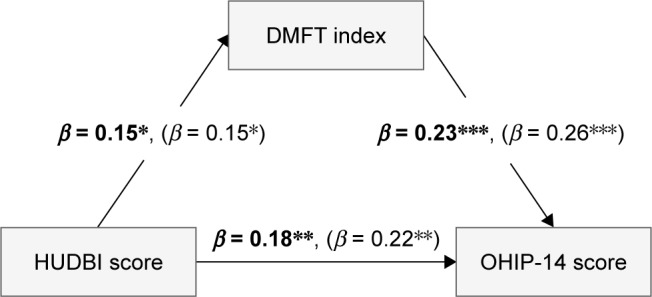
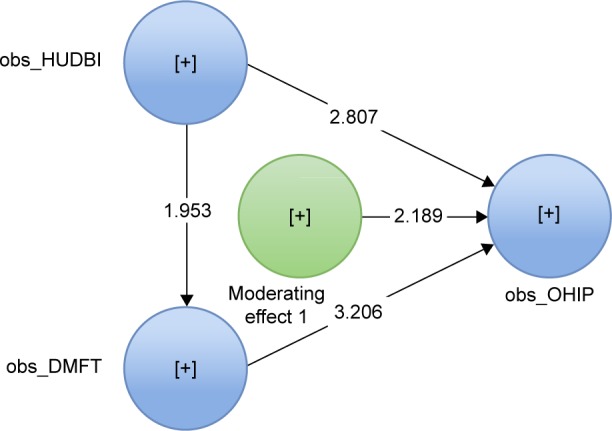
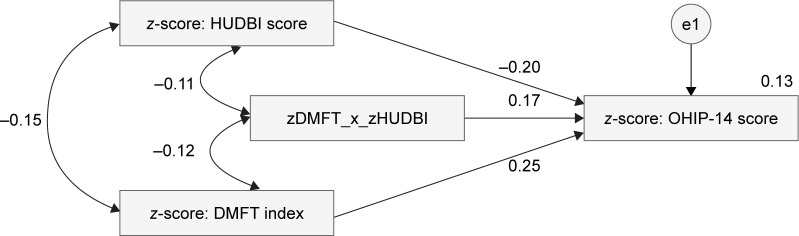
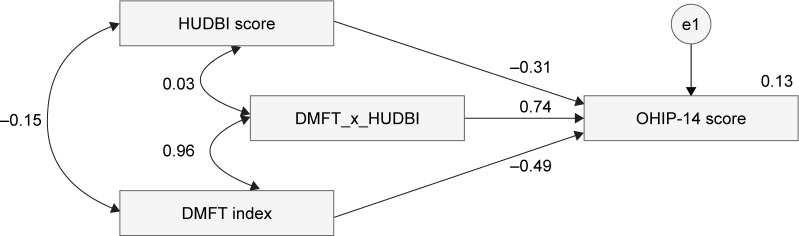
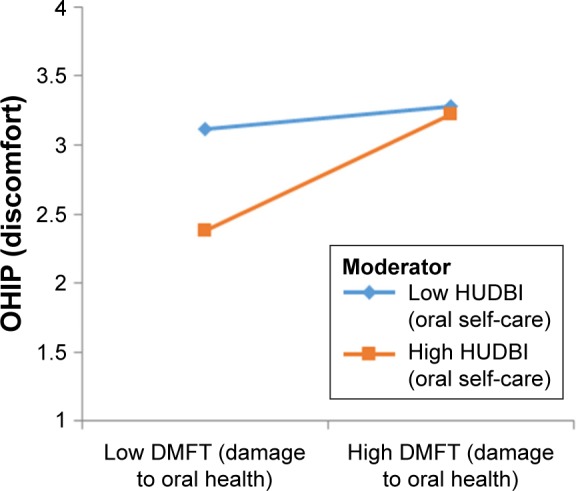
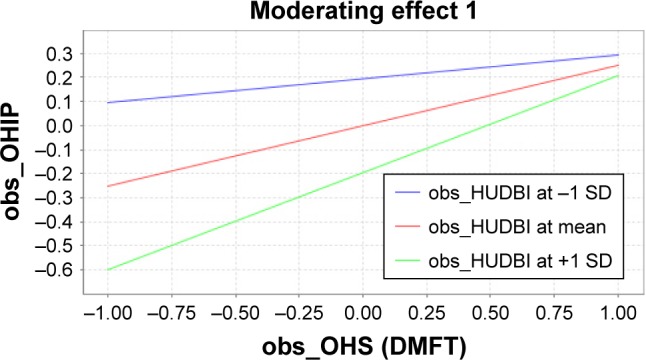
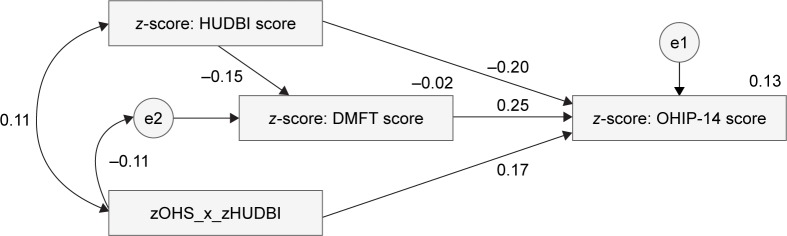
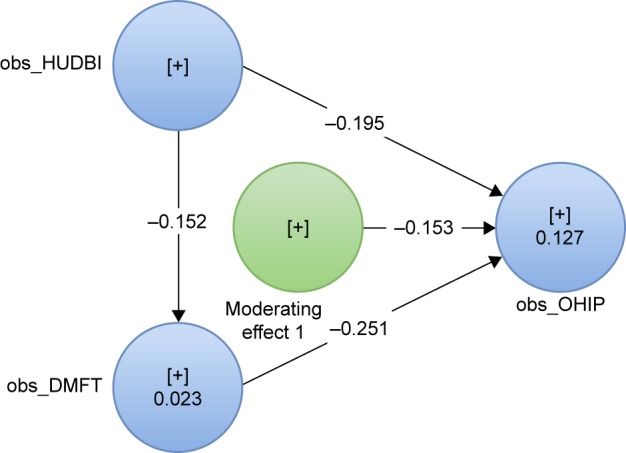
Our research showed relevant associations between HUDBI, DMFT, and OHIP. The relationship between HUDBI and OHIP was mediated by DMFT. Furthermore, HUDBI worked as a moderator between DMFT and OHIP. Thus, our study revealed a case for moderated mediation, which is usually ignored in similar research.
The "straightforward" causality between oral health-related behavior and the actual OHS must be considered with caution, as well as their impact on the oral health-related quality of life. Further research is needed to investigate the interaction between variables, the strength of the interrelations and the magnitude of their interactions, and the confidence that can be placed in these measurements, with respect to the general population and/or those lacking domain-specific education.
本研究旨在开发并测试一个有调节的中介模型,该模型能够描述口腔健康相关态度与行为、口腔健康状况(OHS)以及口腔健康相关生活质量之间的关系。假设的关系对应于诸如“一个人的口腔健康是否由其为预防口腔健康问题而采取的行动所预测?”以及“口腔健康状况较好的个体是否也具有更高水平的口腔健康相关生活质量?”等研究问题。
在罗马尼亚克卢日 - 纳波卡市,对191名参与者进行了一项具有选定预测变量的横断面相关性研究,这些参与者就读于克卢日 - 纳波卡医科药科大学牙科学院的四年级和六年级。参与者完成了针对其口腔自我护理的特定行为和态度的广岛大学牙科行为量表(HUDBI)问卷、用于测量口腔健康相关生活质量的口腔健康影响程度量表(OHIP)简版问卷,并且使用龋失补牙面数(DMFT)指数客观评估当前的口腔健康状况。使用结构方程建模软件进行统计分析。
我们的研究表明HUDBI、DMFT和OHIP之间存在相关关联。HUDBI与OHIP之间的关系由DMFT介导。此外,HUDBI在DMFT和OHIP之间起调节作用。因此,我们的研究揭示了一种有调节的中介情况,这在类似研究中通常被忽视。
必须谨慎考虑口腔健康相关行为与实际口腔健康状况之间的“直接”因果关系,以及它们对口腔健康相关生活质量的影响。需要进一步研究以调查变量之间的相互作用、相互关系的强度及其相互作用的大小,以及对于一般人群和/或缺乏特定领域教育的人群而言,这些测量结果的可信度。